Let’s get the unpleasant part out of the way first: the New York Audio Labs Moscode 600 is not a pretty amplifier. It looks like something bolted into a 1980s broadcast truck, or standing guard in the boiler room of a Brooklyn walk-up. A perforated metal cage hides the tubes, a fan hums along whether you need it or not, and the whole thing has the industrial charm of a toaster oven designed by a committee of electricians. If you buy hi-fi to impress the neighbors, keep walking. If you buy it to be moved by music, pull up a chair, because that ugly cage is hiding something beautiful.
A little history, a little surgery
NYAL was Harvey “Gizmo” Rosenberg’s company, and the engineering came from George Kaye, whose Moscode 300 of 1984 was one of the first true tube/MOSFET hybrids. The 600 is its bigger sibling, with tube-regulated high voltage for the tube stages. My sample needed the usual forty-year service: a full recap, fresh regulator tubes and a set of dead bias-network zeners that briefly gave me 25 volts of DC offset and a few new gray hairs. Once sorted, it made its full 300 watts into 8 ohms and settled in for the long haul.
This amp has a soul
I don’t use that phrase lightly. Plenty of amplifiers come through here that measure well and sound correct, and I’ve forgotten most of them by the time the next box arrives. The Moscode 600 is not one of those. From the first track it sounded like music rather than a reproduction of music. It is deeply musical and, at the same time, remarkably transparent, a combination that usually forces you to pick one. Warm amps tend to blur; transparent amps tend to lecture. This one does neither.
Voices
Terry Callier’s “Paris Blues” is where it got me. Callier’s voice is all breath, grain and phrasing, and through lesser amps the words come out as a string of notes. Through the 600, every word carried on into the next, held and shaped, as if he weren’t singing the melody so much as singing the text itself. I could follow the diction, the little catches in his throat, the way one syllable decays just before the next one begins. I played it three times. Then I played it a fourth time, which is when I knew I had a review. Every singer I put on afterwards got the same treatment: not more detail thrown at me, but more intention. You hear what the singer meant, not just what the singer did.
Timbre and midrange
The midrange is full, warm and densely colored without turning syrupy. Acoustic guitars have wood in them, saxophones have brass and spit, and piano notes have a real attack followed by a long, natural bloom instead of a clipped decay. Instruments sound like objects made of materials rather than tones generated by a box. Upstairs, the treble is clean and extended, with none of the grayish haze that MOSFET amplifiers sometimes get accused of. Cymbals shimmer and fade instead of sizzling and stopping.
Microdynamics
This is where the 600 gets spooky. The tiny swells and fades that most solid-state amps flatten into politeness come through with a lifelike ebb and flow: a finger lifting off a string, a singer easing back from the mic, a brush grazing a snare, the bow pressure changing mid-note on a cello. It is the difference between watching musicians on a screen and sitting in the room with them. Quiet passages are not just quieter; they are full of small events, and the amp keeps every one of them in proportion.
Space, scale and bass
The soundstage has real depth, not just width, and musicians stay put in it, each surrounded by a bit of air. Turn it up and nothing hardens or collapses. With 300 watts on tap, dynamic speakers simply do as they’re told. Bass is weighty, tuneful and controlled, with good pitch definition rather than one-note thump. Big orchestral crescendos arrive with genuine scale, and then the amp drops back to a whisper without missing a beat. And perhaps the best compliment I can pay it: after hours of listening, I wasn’t tired. I just wanted one more track.
Why it sounds this way (the short version)
I’m wary of reviewers who explain sound with schematics, but here the topology points in the right direction:
All the voltage gain is done by triodes. The MOSFETs only follow, so the distortion that remains is low-order and fades smoothly as the signal gets quieter, which is exactly where breath and decay live.
Lateral MOSFETs, biased hot. At close to 300mA, quiet passages stay well away from crossover trouble. The devices’ negative temperature coefficient keeps the bias from drifting with the music.
Tube-regulated B+ for each channel. When the output stage gulps current, the voltage stages don’t feel it, so timbre holds steady while the music gets busy.
Add moderate global feedback, enough for control but not so much that the sound turns etched, and you have a design that favors the music without ignoring the measurements.
Specifications (as measured and observed)
Type: stereo hybrid power amplifier, tube voltage stages, lateral MOSFET output
Power: 300W per channel into 8 ohms (verified on my bench)
Output devices: 2SK176 / 2SJ56 lateral MOSFETs
Tubes: dual-triode gain and driver stages, tube-regulated 390V B+
Bias: approximately 280-300mA
Protection: turn-on delay and DC offset relay
Cooling: fan, always on
The caveats
It runs hot and pulls about 2A from the wall at idle, so this is not an amp you leave on overnight. The fan never stops, and in a very quiet room you’ll hear it between tracks. The bias and offset trims are touchy and they interact. And it’s forty years old: unless the one you’re eyeing has been properly restored, assume it hasn’t been.
Final verdict
The Moscode 600 is ugly on the outside and gorgeous on the inside, the audio equivalent of a beat-up old Gibson that plays like a dream. Restored, it delivers the three things that matter most to me: musicality, transparency and microdynamics that make you sit forward in your chair. It doesn’t just play the notes; it lets singers sing the words. If you can live with the looks, the heat and the fan, and are willing to do (or pay for) a proper rebuild, it’s one of the most rewarding vintage amplifiers I’ve had on my bench. Highly recommended. Keep the cage on, and close your eyes.
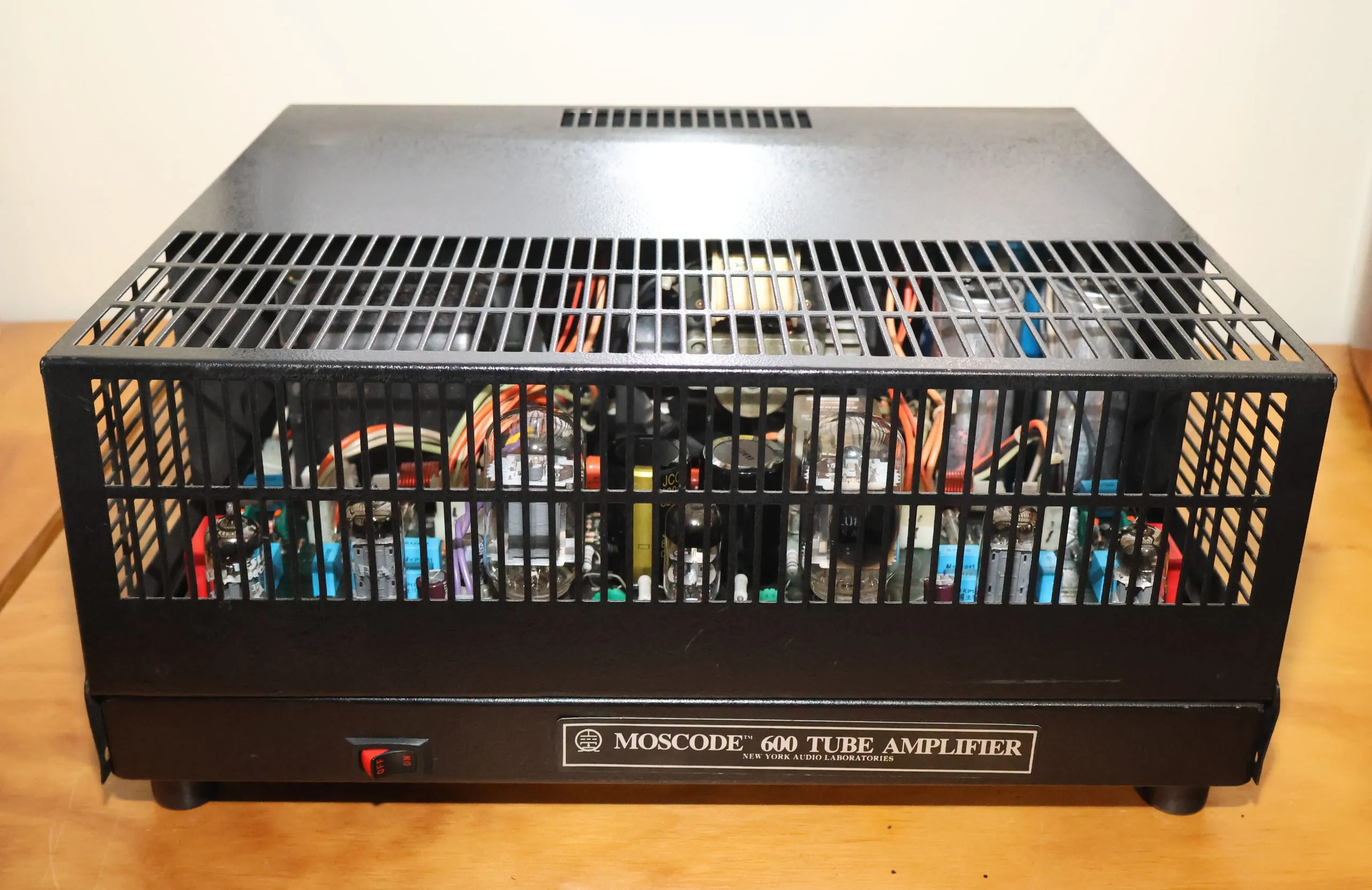

Let’s get the unpleasant part out of the way first: the New York Audio Labs Moscode 600 is not a pretty amplifier. It looks like something bolted into a 1980s broadcast truck, or standing guard in the boiler room of a Brooklyn walk-up. A perforated metal cage hides the tubes, a fan hums along whether you need it or not, and the whole thing has the industrial charm of a toaster oven designed by a committee of electricians. If you buy hi-fi to impress the neighbors, keep walking. If you buy it to be moved by music, pull up a chair, because that ugly cage is hiding something beautiful.
A little history, a little surgery
NYAL was Harvey “Gizmo” Rosenberg’s company, and the engineering came from George Kaye, whose Moscode 300 of 1984 was one of the first true tube/MOSFET hybrids. The 600 is its bigger sibling, with tube-regulated high voltage for the tube stages. My sample needed the usual forty-year service: a full recap, fresh regulator tubes and a set of dead bias-network zeners that briefly gave me 25 volts of DC offset and a few new gray hairs. Once sorted, it made its full 300 watts into 8 ohms and settled in for the long haul.
This amp has a soul
I don’t use that phrase lightly. Plenty of amplifiers come through here that measure well and sound correct, and I’ve forgotten most of them by the time the next box arrives. The Moscode 600 is not one of those. From the first track it sounded like music rather than a reproduction of music. It is deeply musical and, at the same time, remarkably transparent, a combination that usually forces you to pick one. Warm amps tend to blur; transparent amps tend to lecture. This one does neither.
Voices
Terry Callier’s “Paris Blues” is where it got me. Callier’s voice is all breath, grain and phrasing, and through lesser amps the words come out as a string of notes. Through the 600, every word carried on into the next, held and shaped, as if he weren’t singing the melody so much as singing the text itself. I could follow the diction, the little catches in his throat, the way one syllable decays just before the next one begins. I played it three times. Then I played it a fourth time, which is when I knew I had a review. Every singer I put on afterwards got the same treatment: not more detail thrown at me, but more intention. You hear what the singer meant, not just what the singer did.
Timbre and midrange
The midrange is full, warm and densely colored without turning syrupy. Acoustic guitars have wood in them, saxophones have brass and spit, and piano notes have a real attack followed by a long, natural bloom instead of a clipped decay. Instruments sound like objects made of materials rather than tones generated by a box. Upstairs, the treble is clean and extended, with none of the grayish haze that MOSFET amplifiers sometimes get accused of. Cymbals shimmer and fade instead of sizzling and stopping.
Microdynamics
This is where the 600 gets spooky. The tiny swells and fades that most solid-state amps flatten into politeness come through with a lifelike ebb and flow: a finger lifting off a string, a singer easing back from the mic, a brush grazing a snare, the bow pressure changing mid-note on a cello. It is the difference between watching musicians on a screen and sitting in the room with them. Quiet passages are not just quieter; they are full of small events, and the amp keeps every one of them in proportion.
Space, scale and bass
The soundstage has real depth, not just width, and musicians stay put in it, each surrounded by a bit of air. Turn it up and nothing hardens or collapses. With 300 watts on tap, dynamic speakers simply do as they’re told. Bass is weighty, tuneful and controlled, with good pitch definition rather than one-note thump. Big orchestral crescendos arrive with genuine scale, and then the amp drops back to a whisper without missing a beat. And perhaps the best compliment I can pay it: after hours of listening, I wasn’t tired. I just wanted one more track.
Why it sounds this way (the short version)
I’m wary of reviewers who explain sound with schematics, but here the topology points in the right direction:
Add moderate global feedback, enough for control but not so much that the sound turns etched, and you have a design that favors the music without ignoring the measurements.
Specifications (as measured and observed)
The caveats
It runs hot and pulls about 2A from the wall at idle, so this is not an amp you leave on overnight. The fan never stops, and in a very quiet room you’ll hear it between tracks. The bias and offset trims are touchy and they interact. And it’s forty years old: unless the one you’re eyeing has been properly restored, assume it hasn’t been.
Final verdict
The Moscode 600 is ugly on the outside and gorgeous on the inside, the audio equivalent of a beat-up old Gibson that plays like a dream. Restored, it delivers the three things that matter most to me: musicality, transparency and microdynamics that make you sit forward in your chair. It doesn’t just play the notes; it lets singers sing the words. If you can live with the looks, the heat and the fan, and are willing to do (or pay for) a proper rebuild, it’s one of the most rewarding vintage amplifiers I’ve had on my bench. Highly recommended. Keep the cage on, and close your eyes.