When an amplifier arrives on my bench with one channel’s fuses not blown but gone, I don’t reach for music. I reach for the variac, the dim-bulb tester and a strong cup of coffee. A missing fuse is the audio equivalent of a used car with black tape over the check-engine light. Somebody knew something and decided you didn’t need to. So before I tell you how the Bedini 150/150 Mk II sounds, let me tell you that it very nearly didn’t get the chance.
The short version (the long version lives on the tech blog): the filter caps were healthy, the output transistors were healthy, and the culprit was a bias setting that could charitably be called “ambitious.” The left channel was idling at a current better suited to toasting bread than to playing music, which, in a Florida garage in October, is not a feature anyone asked for. I walked the trimmers back to sane territory, the rails settled, the heatsinks stopped radiating hostility, and the amp came to life. Then I listened. Then I kept listening, which, after all these years, is still the only review metric I fully trust.
A Little History, A Lot of Legend
The late John Bedini was one of American audio’s genuine characters: part engineer, part showman, part mad scientist. His smaller Class A amps earned a cult following that persists to this day, and the 150/150 was the muscular class AB sibling, built for people whose speakers ate watts for breakfast. The Mk II is surrounded by folklore, including the oft-repeated tale that Bedini sanded the markings off his output transistors and treated them with some secret elixir before sealing them back up. I used to file that under audiophile campfire stories. Then I opened my sample. The part numbers on the output transistors had been removed, and the tops were coated in some sort of mystery goo, each one bearing a single, cryptic letter: W. Not a part number, not a date code, just W. Was it a batch mark? A signature? A private joke aimed at future repair techs? I have no idea, and I suspect that was exactly the point. Whatever ritual took place, the devices behave like MJ15024s on the bench, and they survived a bias setting that should have killed them, so I’m inclined to leave the voodoo undisturbed. Some mysteries are better left sealed.
Specs, Briefly
Rated output: 150 watts per channel into 8 ohms, class AB
Output stage: four MJ15024-type devices per channel on 1.5-ohm emitter resistors, markings removed at the factory and replaced with goo and a lone “W”
Supply rails: roughly ±68V once settled on my bench
Measured output: 33.7V RMS into 8 ohms on direct mains, about 142 watts, close enough to the badge to keep everyone honest
Protection: two slow-blow rail fuses per channel, assuming the previous owner leaves them in
It’s a refreshingly old-school design: big transformer, big caps, multiple output devices per channel, and no microprocessor second-guessing your every move. You can see everything and service everything, mystery goo aside, which, given my opening paragraph, is not a small virtue.
The Sound
Let me be blunt: this amplifier doesn’t sound like a 1980s solid-state power amp is supposed to sound. There’s no glassy sheen on top, no gray, sandpapery grain on massed strings, and none of the “hi-fi” brightness that sends you fishing for the remote after twenty minutes. Instead, there’s a warmth and body through the midrange that tube lovers will recognize instantly. Female vocals have flesh on their bones. A tenor sax has reed and breath, not just pitch. Acoustic guitar has the wooden box around the strings, which is where all the fun is anyway.
But here’s the part that surprised me. That warmth isn’t purchased with mush. Plenty of “tube-like” transistor amps get there by rolling off the top and bloating the bass, and calling it musicality. The Bedini doesn’t cheat. Transients are quick and clean, cymbals shimmer and decay naturally instead of hissing at you, and the stage has real depth: instruments sit behind one another, not just side by side like commuters on a bench.
The bass is where the “150” earns its keep. It’s taut, well-controlled and genuinely authoritative. Kick drums have a front edge and a body, and synth lines stay pitch-defined rather than turning into an undifferentiated rumble. Even with the volume pushed to levels that would earn me a visit from the neighbors, if I had neighbors close enough to complain, the amp kept its composure. Dynamic swings come with that effortless “there’s more where that came from” quality that only a stout power supply delivers.
At low listening levels, where many big amps go limp and lifeless, the Bedini still sounds alive and detailed. Late at night, at whisper volume, it kept me in the chair. I’m not exaggerating. I kept saying “one more track” and then not meaning it.
The Not-So-Good
No amp is perfect, and a forty-something-year-old amp has earned a few wrinkles.
Service history matters enormously. As my sample proved, these amps are often tinkered with, and a botched bias adjustment can cook output devices you can’t simply look up and reorder. Good luck cross-referencing “W.”
Documentation is scarce. Schematics are not exactly falling off trees. Budget time for detective work.
Clipping isn’t perfectly symmetric on my unit. Run within its means, you’ll never hear it, but this is not the amp to flog into hard clipping at parties.
Heat. It runs warm even when properly biased. Give it air, and keep it off the carpet.
Final Verdict
The Bedini 150/150 Mk II is that rare vintage solid-state amplifier that delivers on its legend once it’s set up properly. It combines a tube-like richness and midrange humanity with the grip, speed and power reserves that tubes struggle to match at this output level, and that’s a combination many modern amplifiers costing several times as much still chase. It isn’t the most neutral amp I’ve had here, and it doesn’t try to be. It’s a musical amp first and a measurement exercise second, and I’ve made my peace with that, happily.
My advice is simple: buy one with eyes wide open, budget for a proper checkout by someone who knows what they’re doing. Do that, and you’ll own an amplifier that makes your music sound like music.
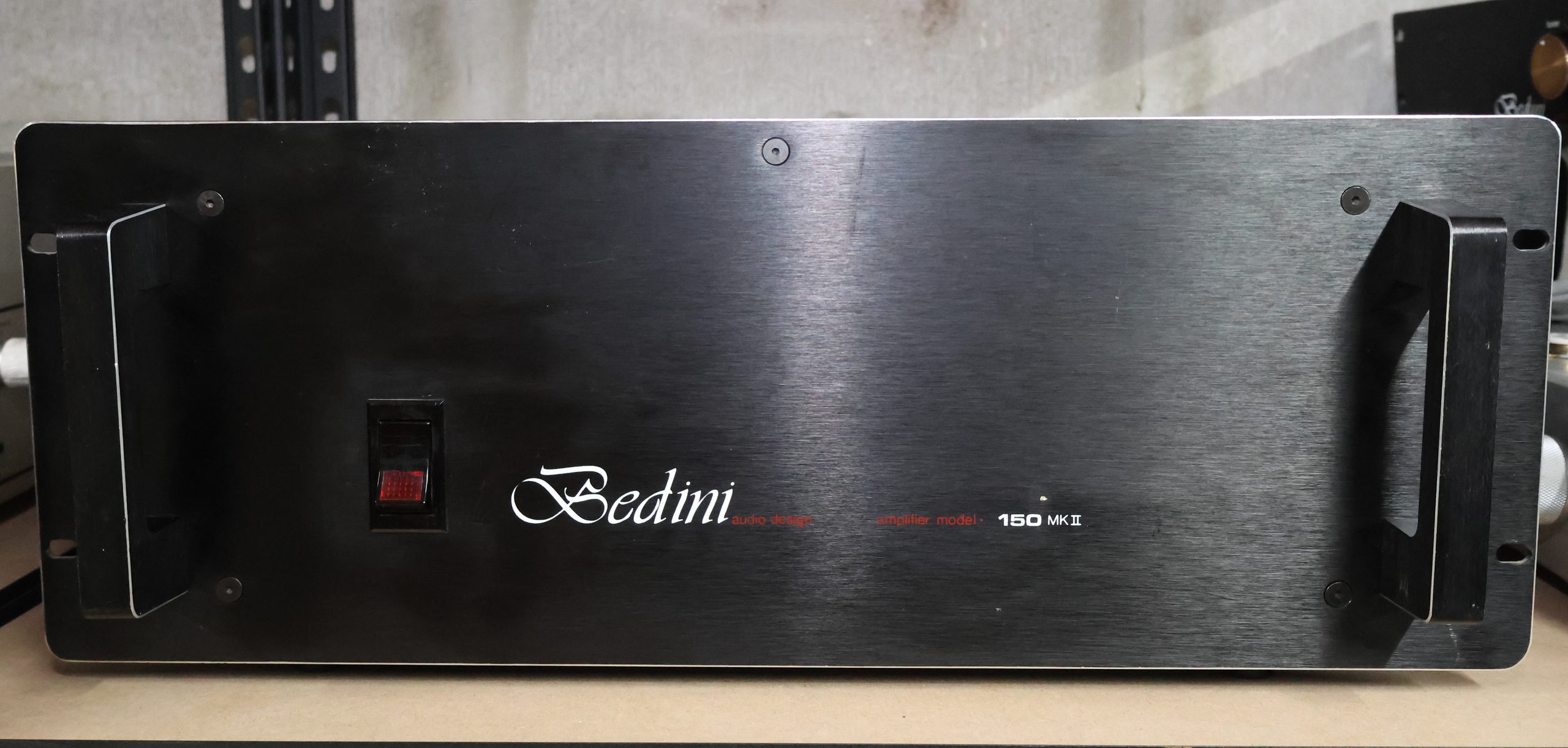

When an amplifier arrives on my bench with one channel’s fuses not blown but gone, I don’t reach for music. I reach for the variac, the dim-bulb tester and a strong cup of coffee. A missing fuse is the audio equivalent of a used car with black tape over the check-engine light. Somebody knew something and decided you didn’t need to. So before I tell you how the Bedini 150/150 Mk II sounds, let me tell you that it very nearly didn’t get the chance.
The short version (the long version lives on the tech blog): the filter caps were healthy, the output transistors were healthy, and the culprit was a bias setting that could charitably be called “ambitious.” The left channel was idling at a current better suited to toasting bread than to playing music, which, in a Florida garage in October, is not a feature anyone asked for. I walked the trimmers back to sane territory, the rails settled, the heatsinks stopped radiating hostility, and the amp came to life. Then I listened. Then I kept listening, which, after all these years, is still the only review metric I fully trust.
A Little History, A Lot of Legend
The late John Bedini was one of American audio’s genuine characters: part engineer, part showman, part mad scientist. His smaller Class A amps earned a cult following that persists to this day, and the 150/150 was the muscular class AB sibling, built for people whose speakers ate watts for breakfast. The Mk II is surrounded by folklore, including the oft-repeated tale that Bedini sanded the markings off his output transistors and treated them with some secret elixir before sealing them back up. I used to file that under audiophile campfire stories. Then I opened my sample. The part numbers on the output transistors had been removed, and the tops were coated in some sort of mystery goo, each one bearing a single, cryptic letter: W. Not a part number, not a date code, just W. Was it a batch mark? A signature? A private joke aimed at future repair techs? I have no idea, and I suspect that was exactly the point. Whatever ritual took place, the devices behave like MJ15024s on the bench, and they survived a bias setting that should have killed them, so I’m inclined to leave the voodoo undisturbed. Some mysteries are better left sealed.
Specs, Briefly
It’s a refreshingly old-school design: big transformer, big caps, multiple output devices per channel, and no microprocessor second-guessing your every move. You can see everything and service everything, mystery goo aside, which, given my opening paragraph, is not a small virtue.
The Sound
Let me be blunt: this amplifier doesn’t sound like a 1980s solid-state power amp is supposed to sound. There’s no glassy sheen on top, no gray, sandpapery grain on massed strings, and none of the “hi-fi” brightness that sends you fishing for the remote after twenty minutes. Instead, there’s a warmth and body through the midrange that tube lovers will recognize instantly. Female vocals have flesh on their bones. A tenor sax has reed and breath, not just pitch. Acoustic guitar has the wooden box around the strings, which is where all the fun is anyway.
But here’s the part that surprised me. That warmth isn’t purchased with mush. Plenty of “tube-like” transistor amps get there by rolling off the top and bloating the bass, and calling it musicality. The Bedini doesn’t cheat. Transients are quick and clean, cymbals shimmer and decay naturally instead of hissing at you, and the stage has real depth: instruments sit behind one another, not just side by side like commuters on a bench.
The bass is where the “150” earns its keep. It’s taut, well-controlled and genuinely authoritative. Kick drums have a front edge and a body, and synth lines stay pitch-defined rather than turning into an undifferentiated rumble. Even with the volume pushed to levels that would earn me a visit from the neighbors, if I had neighbors close enough to complain, the amp kept its composure. Dynamic swings come with that effortless “there’s more where that came from” quality that only a stout power supply delivers.
At low listening levels, where many big amps go limp and lifeless, the Bedini still sounds alive and detailed. Late at night, at whisper volume, it kept me in the chair. I’m not exaggerating. I kept saying “one more track” and then not meaning it.
The Not-So-Good
No amp is perfect, and a forty-something-year-old amp has earned a few wrinkles.
Final Verdict
The Bedini 150/150 Mk II is that rare vintage solid-state amplifier that delivers on its legend once it’s set up properly. It combines a tube-like richness and midrange humanity with the grip, speed and power reserves that tubes struggle to match at this output level, and that’s a combination many modern amplifiers costing several times as much still chase. It isn’t the most neutral amp I’ve had here, and it doesn’t try to be. It’s a musical amp first and a measurement exercise second, and I’ve made my peace with that, happily.
My advice is simple: buy one with eyes wide open, budget for a proper checkout by someone who knows what they’re doing. Do that, and you’ll own an amplifier that makes your music sound like music.