One thought on “NYAL Moscode 300 Hybrid Amplifier”
When I reviewed the Moscode 150, I closed by advising owners of power-hungry speakers to look at the bigger Moscode 300. Then I went and bought one. That is the occupational hazard of giving advice: sooner or later you hear yourself.
The 300 is the original. George Kaye and Harvey “Gizmo” Rosenberg launched it in 1984 for $899, and it is the reason the word “Moscode” still gives grown audiophiles a faraway look. Gizmo’s owner’s manual famously prescribed a ritual to be performed before unpacking: warm baths, cold showers, massage, silk robes, herbal infusions and strong drink. I skipped the silk robe. I did not skip the strong drink, although in fairness that came after the bias adjustment, not before.
Same Family, Bigger Shoulders
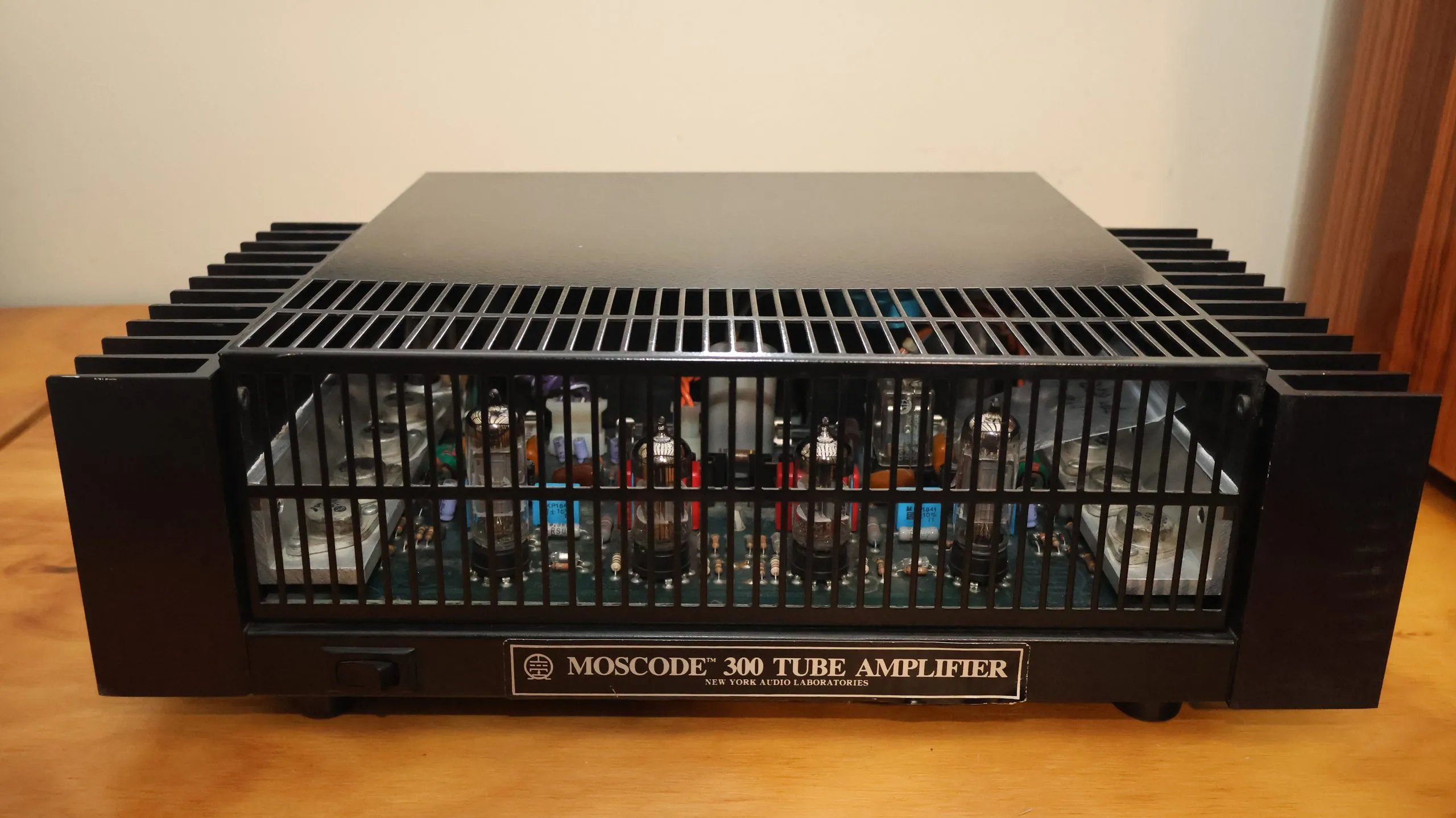
Lift the lid and the family resemblance is immediate. The front end is the same short, sensible circuit as its little brother. Each channel gets a 6DJ8 for voltage gain and a 6CG7 to drive the MOSFET gates, with one modest global feedback loop and a separately regulated high-voltage supply for the tubes. The difference is everything downstream. The 150 makes do with a single complementary pair of Hitachi laterals per channel. The 300 gets two pairs of 2SK135/2SJ50, the higher-voltage siblings of the 150’s 2SK134/2SJ49, on ±60V rails instead of ±50V, and a power supply with roughly 31,000µF of storage behind them.
The model-number arithmetic is unchanged. The “300” makes 150 watts per channel, because NYAL added the channels together again. I have to admire the consistency, which is more than you can say for most marketing departments.
Power: 150 watts per channel into 8 ohms
Tubes: 2 x 6DJ8/ECC88, 2 x 6CG7/6FQ7
Outputs: two pairs of Hitachi lateral MOSFETs (2SK135/2SJ50) per channel on ±60V rails
Filter capacitance: roughly 31,000µF
Tube supply: separately regulated B+
Feedback: one global loop returned to the input tube’s cathode
Protection: relay-delayed speaker turn-on, about 45 seconds
Original price: $899 (1984)
Twice the output devices means twice the idle current. The manual asks for 280 to 300mA per channel, measured in place of the rail fuse. Mine needed some persuading. Check yours before you form any opinion about the sound, because an underbiased 300 is a different and lesser amplifier.
The 45-second turn-on delay is still there, and it still lasts exactly long enough to make you wonder whether you’ve broken something.
The Sound
If the 150 is a sports car, the 300 is the same car with a bigger engine and a slightly heavier chassis. You give a little of one thing to get a lot of another, and the trade is worth it more often than not.
The headline here is not the midrange. It is grip. Kaye was a bass player, and with this amp you can tell. Bass lines have weight, pitch definition and a firm leading edge, with none of the soft, overripe bloom you get from a tube amp that is out of its depth. Kick drums land and then leave. Acoustic bass has wood and string, not just a vague pressure in the room. My speakers sounded like they had been to the gym.
Scale comes with it. The 300 sounds considerably bigger than 150 watts, and it stays relaxed as the volume rises. Crescendos open up rather than compress, and large-scale orchestral music keeps its layers when everybody plays at once. The amp has a kind of life and snap that makes it exciting to listen to. Smoother, more “civilized” amplifiers exist. I am not convinced they are more musical, and at times smoothness is just missing detail in a nice suit.
The midrange is unmistakably related to the 150’s. Voices have body and presence, cello and woodwinds have that woody, physical quality, and images are solid and three-dimensional. Don’t expect golden syrup, though. This is a clean, timbrally honest tube midrange, closer to a modern hybrid than to a vintage transformer-coupled amp. The tubes add texture and dimensionality to the music. They do not add sugar.
Compared with its little brother, I hear a slight shift in emphasis. The 150 seemed almost startlingly see-through, a clean window with nothing in the way. The 300 gives up a sliver of that delicacy and gets authority in return. Reverb tails are still there and the room is still there, but the presentation is more about weight and drive than about air. If you were hoping for a tube amp that sounded like a tube amp, the 300 leans further toward the solid-state side of the family than the 150 does.
It is also a good-natured partner. It got along with every preamp I put in front of it, glass or silicon, and I never heard a synergy problem. That’s a rare quality in a 40-year-old amplifier with opinions.
Where It Shows Its Age
The same caveat applies as with the 150. On hot recordings, the upper midrange and lower treble can show some grain, and leading edges carry a slight burr. Some days I call that energy. Other days I call it edge. Tube rolling helps more than you might expect, and the stock 6DJ8s are the start of the discussion, not the end of it.
It also runs warmer than the 150, which is no surprise given four output devices per channel at higher idle current. It is still nowhere near a tube amp’s heat. The real concern with any vintage Moscode is age. The capacitors are four decades old, the laterals are no longer made, and the previous owner’s handiwork is unknown. My 150 taught me that the most dangerous part in any vintage amplifier is the last person who repaired it.
Final Verdict
The Moscode 300 is the amp that made the hybrid idea respectable, and it still holds up. You get a clean, tube-lit midrange, bass with real grip and heft, dynamics with snap, and enough power to drive speakers that would humble the 150. In exchange, you lose a little of the small amp’s transparency and inherit some top-end grain on poor recordings.
The choice between them is simple. With efficient speakers, and if you value the window above everything else, buy the 150. With difficult loads, a big room or a taste for scale, buy the 300. Either way, recap it, verify the bias and read the resistor color codes yourself.

When I reviewed the Moscode 150, I closed by advising owners of power-hungry speakers to look at the bigger Moscode 300. Then I went and bought one. That is the occupational hazard of giving advice: sooner or later you hear yourself.
The 300 is the original. George Kaye and Harvey “Gizmo” Rosenberg launched it in 1984 for $899, and it is the reason the word “Moscode” still gives grown audiophiles a faraway look. Gizmo’s owner’s manual famously prescribed a ritual to be performed before unpacking: warm baths, cold showers, massage, silk robes, herbal infusions and strong drink. I skipped the silk robe. I did not skip the strong drink, although in fairness that came after the bias adjustment, not before.
Same Family, Bigger Shoulders
Lift the lid and the family resemblance is immediate. The front end is the same short, sensible circuit as its little brother. Each channel gets a 6DJ8 for voltage gain and a 6CG7 to drive the MOSFET gates, with one modest global feedback loop and a separately regulated high-voltage supply for the tubes. The difference is everything downstream. The 150 makes do with a single complementary pair of Hitachi laterals per channel. The 300 gets two pairs of 2SK135/2SJ50, the higher-voltage siblings of the 150’s 2SK134/2SJ49, on ±60V rails instead of ±50V, and a power supply with roughly 31,000µF of storage behind them.
The model-number arithmetic is unchanged. The “300” makes 150 watts per channel, because NYAL added the channels together again. I have to admire the consistency, which is more than you can say for most marketing departments.
Twice the output devices means twice the idle current. The manual asks for 280 to 300mA per channel, measured in place of the rail fuse. Mine needed some persuading. Check yours before you form any opinion about the sound, because an underbiased 300 is a different and lesser amplifier.
The 45-second turn-on delay is still there, and it still lasts exactly long enough to make you wonder whether you’ve broken something.
The Sound
If the 150 is a sports car, the 300 is the same car with a bigger engine and a slightly heavier chassis. You give a little of one thing to get a lot of another, and the trade is worth it more often than not.
The headline here is not the midrange. It is grip. Kaye was a bass player, and with this amp you can tell. Bass lines have weight, pitch definition and a firm leading edge, with none of the soft, overripe bloom you get from a tube amp that is out of its depth. Kick drums land and then leave. Acoustic bass has wood and string, not just a vague pressure in the room. My speakers sounded like they had been to the gym.
Scale comes with it. The 300 sounds considerably bigger than 150 watts, and it stays relaxed as the volume rises. Crescendos open up rather than compress, and large-scale orchestral music keeps its layers when everybody plays at once. The amp has a kind of life and snap that makes it exciting to listen to. Smoother, more “civilized” amplifiers exist. I am not convinced they are more musical, and at times smoothness is just missing detail in a nice suit.
The midrange is unmistakably related to the 150’s. Voices have body and presence, cello and woodwinds have that woody, physical quality, and images are solid and three-dimensional. Don’t expect golden syrup, though. This is a clean, timbrally honest tube midrange, closer to a modern hybrid than to a vintage transformer-coupled amp. The tubes add texture and dimensionality to the music. They do not add sugar.
Compared with its little brother, I hear a slight shift in emphasis. The 150 seemed almost startlingly see-through, a clean window with nothing in the way. The 300 gives up a sliver of that delicacy and gets authority in return. Reverb tails are still there and the room is still there, but the presentation is more about weight and drive than about air. If you were hoping for a tube amp that sounded like a tube amp, the 300 leans further toward the solid-state side of the family than the 150 does.
It is also a good-natured partner. It got along with every preamp I put in front of it, glass or silicon, and I never heard a synergy problem. That’s a rare quality in a 40-year-old amplifier with opinions.
Where It Shows Its Age
The same caveat applies as with the 150. On hot recordings, the upper midrange and lower treble can show some grain, and leading edges carry a slight burr. Some days I call that energy. Other days I call it edge. Tube rolling helps more than you might expect, and the stock 6DJ8s are the start of the discussion, not the end of it.
It also runs warmer than the 150, which is no surprise given four output devices per channel at higher idle current. It is still nowhere near a tube amp’s heat. The real concern with any vintage Moscode is age. The capacitors are four decades old, the laterals are no longer made, and the previous owner’s handiwork is unknown. My 150 taught me that the most dangerous part in any vintage amplifier is the last person who repaired it.
Final Verdict
The Moscode 300 is the amp that made the hybrid idea respectable, and it still holds up. You get a clean, tube-lit midrange, bass with real grip and heft, dynamics with snap, and enough power to drive speakers that would humble the 150. In exchange, you lose a little of the small amp’s transparency and inherit some top-end grain on poor recordings.
The choice between them is simple. With efficient speakers, and if you value the window above everything else, buy the 150. With difficult loads, a big room or a taste for scale, buy the 300. Either way, recap it, verify the bias and read the resistor color codes yourself.