One thought on “Bedini Model 66 Mk II Preamplifier”
Let me start with the thing that will confuse you the moment you unpack it: the Bedini Model 66 Mk II has no power button. None. Not on the front panel, not on the back, not tucked under the chassis where I spent an embarrassing few minutes poking around with a flashlight. Plug it in and it’s on. Pull the plug and it’s off. Maybe Bedini decided a preamp sounds best when it never cools down. Maybe the switch fell off the parts order. Either way, this is the houseguest who never goes to bed, so plug it into a switched outlet on your power amp or conditioner — or make peace with it living its entire life “on.”
Once you get past that, the 66 Mk II is an interesting little machine. It was built as the companion to Bedini’s Mk II power amplifiers, the high-bias designs that earned the brand its cult following, and it looks the part: 19 inches wide, under 3 inches tall and about 7.5 inches deep, more lab instrument than living-room jewelry. You get a moving-magnet phono stage, tuner, two aux inputs, tape in and out, and three sets of preamp outputs, which is handy if you’re running a subwoofer or bi-amping. Volume is handled by two separate knobs, one per channel. There’s no balance control because you are the balance control. I found myself fiddling with them the way some people fiddle with a crooked picture frame — constantly, and with mild irritation.
Build quality is better than the plain faceplate suggests. Inside you’ll find 1% metal film resistors, gold-plated RCA jacks and a tidy layout, with NE5534 op-amps doing the heavy lifting. Hold that thought.
On the Bench
I fed the line input a 1 V peak-to-peak 1 kHz sine with both volume knobs wide open and read 5.37 V peak-to-peak at the output. That’s a voltage gain of 5.37×, or about 14.6 dB (20 × log 5.37). Healthy, and frankly more than most modern sources need. With a typical 2 V RMS DAC, you’ll spend your evenings in the lower third of the knob travel.
Then I got mischievous and pushed the input to 5 V peak-to-peak. The output climbed all the way to 25 V peak-to-peak before the waveform flattened. For context, consumer unbalanced line level is specified at −10 dBV, or 0.316 V RMS, and the CD standard tops out at 2 V RMS. Twenty-five volts peak-to-peak works out to roughly 8.8 V RMS — so yes, that’s “a bit more” than spec, in the same way a Peterbilt is “a bit more” truck than a golf cart. I couldn’t find a real-world source that would come anywhere near clipping this thing. Headroom is not the 66’s problem.
The Sound
The 66 Mk II makes a very good first impression. It is sweet and warm, with a full-bodied midrange that makes voices sound substantial and present. Male vocals take on a chesty richness; acoustic guitar has a pleasing wooden glow. This little preamp sounds bigger than it looks, with a wide soundstage and bass that’s weighty and round rather than lean and taut. Treble is polite and never harsh, and on bright recordings or edgy digital sources that’s a genuine kindness. Nobody is going to accuse the Bedini of being fatiguing. You could listen to it all day.
But the longer I listened, the more I noticed what wasn’t there. Transients arrive with their edges sanded off. The leading pluck of a string, the snap of a snare, the little breath before a singer’s phrase — all present, all softened. The air around the instruments, the spatial cues that tell you how big the room was and where the walls stood, are dimmed. Image depth is shallower than the width suggests. It’s like looking at a fine photograph through a sheer curtain: the colors are lovely, the composition is intact, but you can’t quite read the fine print.
I’m pinning much of this on the NE5534. It was a fine workhorse op-amp in its day, and it’s still respectable, but in this circuit it imposes its own warm, slightly thick character on everything passing through. The result is a preamp that sounds comfortable rather than truthful. I want a preamp to get out of the way — to sound like nothing at all and let the recording and the power amp speak for themselves. The 66 Mk II prefers to add a little something to the conversation. Hey, I’m just telling you what I heard.
To be fair, plenty of listeners will hear exactly what I heard and love it. If your system leans lean, bright or analytical, the Bedini’s warmth could be the cure rather than the disease. Pair it with forward speakers or a hard-sounding DAC and it may be just the ticket. Nothing here is broken — it’s a voicing choice. It’s just not my voicing. (My soldering iron is already giving me that look. Modern low-noise op-amps would likely open things up, but that would be a different preamp, and this review is about the one Bedini built.)
What I Liked and What I Didn’t
Liked: Enormous headroom — 25 V peak-to-peak before clipping
Liked: Healthy 14.6 dB of line gain
Liked: Sweet, warm, full-bodied midrange that never turns harsh
Liked: Three sets of preamp outputs and solid parts quality
Didn’t like: No power button whatsoever
Didn’t like: Separate volume knobs per channel make level matching a chore
Didn’t like: NE5534 op-amps leave the sound warm and veiled, with softened transients and reduced air
Final Verdict
The Bedini Model 66 Mk II is a well-built, overachieving preamp with headroom to burn and a sound that’s easy to like. It’s sweet, warm and smooth, and if that’s what your system needs, you’ll be happy. But for me, warmth isn’t the same as truth. The NE5534s draw a soft-focus filter over the music, and once I heard what was missing — the snap, the air, the sense of real musicians in a real space — I couldn’t un-hear it. Recommended for listeners who want comfort and color. If you’re chasing transparency and lifelike realism, as I am, keep looking — and keep your hand near the wall socket, because that’s the only way to turn this thing off.
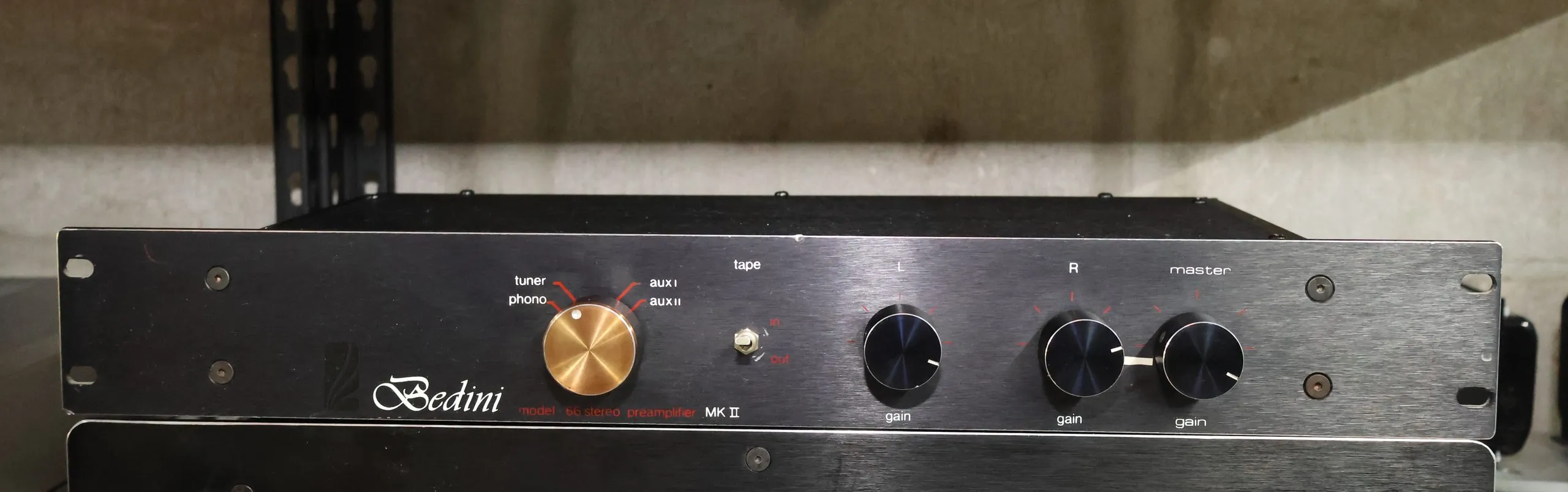

Let me start with the thing that will confuse you the moment you unpack it: the Bedini Model 66 Mk II has no power button. None. Not on the front panel, not on the back, not tucked under the chassis where I spent an embarrassing few minutes poking around with a flashlight. Plug it in and it’s on. Pull the plug and it’s off. Maybe Bedini decided a preamp sounds best when it never cools down. Maybe the switch fell off the parts order. Either way, this is the houseguest who never goes to bed, so plug it into a switched outlet on your power amp or conditioner — or make peace with it living its entire life “on.”
Once you get past that, the 66 Mk II is an interesting little machine. It was built as the companion to Bedini’s Mk II power amplifiers, the high-bias designs that earned the brand its cult following, and it looks the part: 19 inches wide, under 3 inches tall and about 7.5 inches deep, more lab instrument than living-room jewelry. You get a moving-magnet phono stage, tuner, two aux inputs, tape in and out, and three sets of preamp outputs, which is handy if you’re running a subwoofer or bi-amping. Volume is handled by two separate knobs, one per channel. There’s no balance control because you are the balance control. I found myself fiddling with them the way some people fiddle with a crooked picture frame — constantly, and with mild irritation.
Build quality is better than the plain faceplate suggests. Inside you’ll find 1% metal film resistors, gold-plated RCA jacks and a tidy layout, with NE5534 op-amps doing the heavy lifting. Hold that thought.
On the Bench
I fed the line input a 1 V peak-to-peak 1 kHz sine with both volume knobs wide open and read 5.37 V peak-to-peak at the output. That’s a voltage gain of 5.37×, or about 14.6 dB (20 × log 5.37). Healthy, and frankly more than most modern sources need. With a typical 2 V RMS DAC, you’ll spend your evenings in the lower third of the knob travel.
Then I got mischievous and pushed the input to 5 V peak-to-peak. The output climbed all the way to 25 V peak-to-peak before the waveform flattened. For context, consumer unbalanced line level is specified at −10 dBV, or 0.316 V RMS, and the CD standard tops out at 2 V RMS. Twenty-five volts peak-to-peak works out to roughly 8.8 V RMS — so yes, that’s “a bit more” than spec, in the same way a Peterbilt is “a bit more” truck than a golf cart. I couldn’t find a real-world source that would come anywhere near clipping this thing. Headroom is not the 66’s problem.
The Sound
The 66 Mk II makes a very good first impression. It is sweet and warm, with a full-bodied midrange that makes voices sound substantial and present. Male vocals take on a chesty richness; acoustic guitar has a pleasing wooden glow. This little preamp sounds bigger than it looks, with a wide soundstage and bass that’s weighty and round rather than lean and taut. Treble is polite and never harsh, and on bright recordings or edgy digital sources that’s a genuine kindness. Nobody is going to accuse the Bedini of being fatiguing. You could listen to it all day.
But the longer I listened, the more I noticed what wasn’t there. Transients arrive with their edges sanded off. The leading pluck of a string, the snap of a snare, the little breath before a singer’s phrase — all present, all softened. The air around the instruments, the spatial cues that tell you how big the room was and where the walls stood, are dimmed. Image depth is shallower than the width suggests. It’s like looking at a fine photograph through a sheer curtain: the colors are lovely, the composition is intact, but you can’t quite read the fine print.
I’m pinning much of this on the NE5534. It was a fine workhorse op-amp in its day, and it’s still respectable, but in this circuit it imposes its own warm, slightly thick character on everything passing through. The result is a preamp that sounds comfortable rather than truthful. I want a preamp to get out of the way — to sound like nothing at all and let the recording and the power amp speak for themselves. The 66 Mk II prefers to add a little something to the conversation. Hey, I’m just telling you what I heard.
To be fair, plenty of listeners will hear exactly what I heard and love it. If your system leans lean, bright or analytical, the Bedini’s warmth could be the cure rather than the disease. Pair it with forward speakers or a hard-sounding DAC and it may be just the ticket. Nothing here is broken — it’s a voicing choice. It’s just not my voicing. (My soldering iron is already giving me that look. Modern low-noise op-amps would likely open things up, but that would be a different preamp, and this review is about the one Bedini built.)
What I Liked and What I Didn’t
Final Verdict
The Bedini Model 66 Mk II is a well-built, overachieving preamp with headroom to burn and a sound that’s easy to like. It’s sweet, warm and smooth, and if that’s what your system needs, you’ll be happy. But for me, warmth isn’t the same as truth. The NE5534s draw a soft-focus filter over the music, and once I heard what was missing — the snap, the air, the sense of real musicians in a real space — I couldn’t un-hear it. Recommended for listeners who want comfort and color. If you’re chasing transparency and lifelike realism, as I am, keep looking — and keep your hand near the wall socket, because that’s the only way to turn this thing off.