One thought on “Sony TA-4650 VFET Integrated Amplifier”
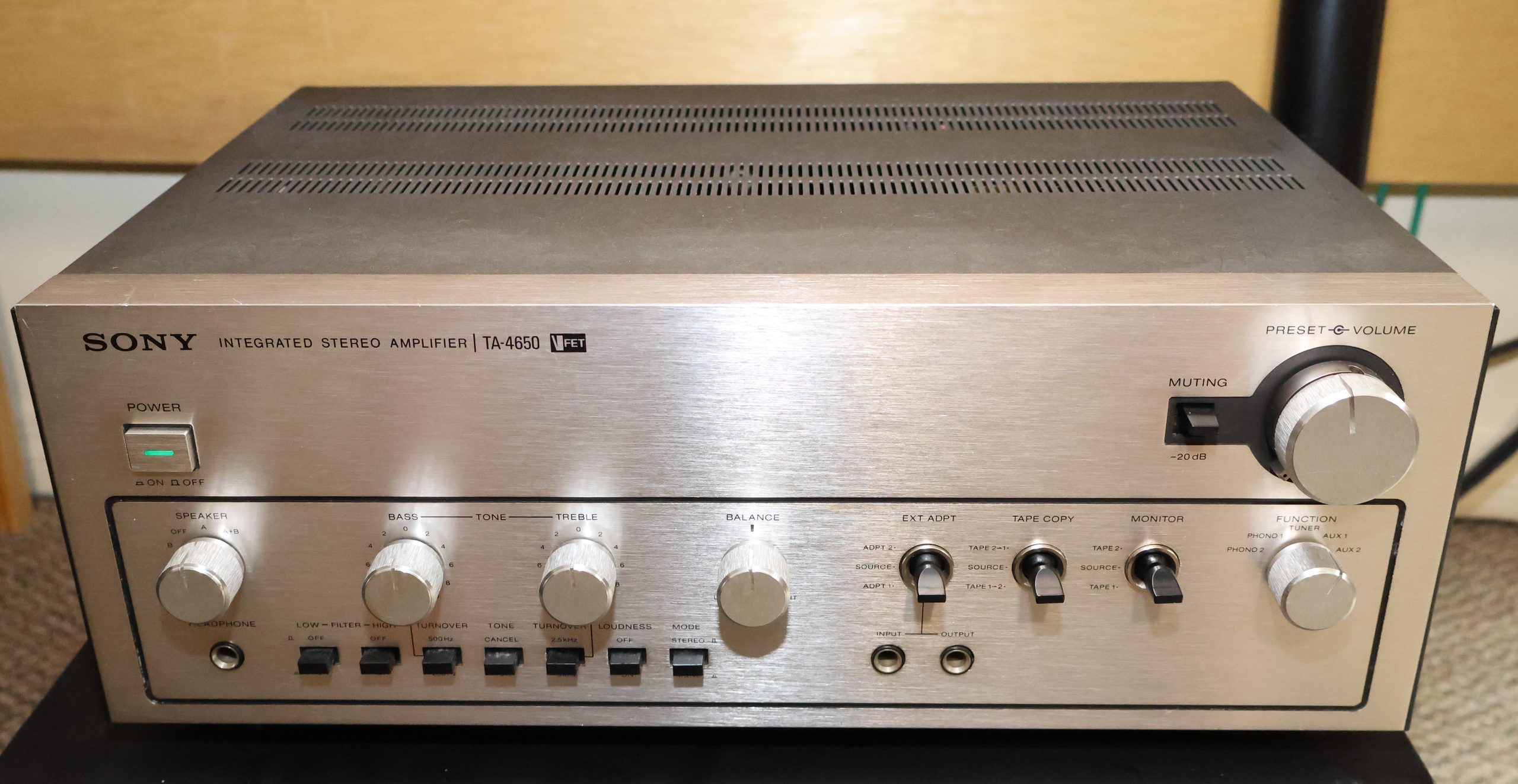
I’ll begin with a confession, since the best reviews usually do: I did not need another vintage integrated amplifier. Nobody needs another vintage integrated amplifier. But when a clean Sony TA-4650 surfaces, the part of my brain in charge of sensible decisions quietly packs a bag and leaves the building. So here we are.
For the uninitiated, the TA-4650 comes from the mid-1970s, that brief and glorious stretch when Sony decided ordinary bipolar transistors weren’t good enough and bet heavily on the V-FET, the vertical field-effect transistor. On paper it’s a modest 30 watts per channel into 8 ohms. In the hand it’s 27 pounds of brushed aluminum, a serious power transformer, and switches and knobs that move with the oiled precision of a bank vault door. Plenty of modern 100-watt amplifiers don’t weigh this much. They should be ashamed of themselves.
So what’s a V-FET, and why should you care?
The short version: a V-FET’s characteristic curves look far less like a transistor’s and far more like a triode’s. It’s a voltage-controlled device that generates mostly low-order, even harmonics, and when biased properly it behaves like a power tube that never glows, never wears out and never needs re-matching. Sony used a single complementary pair per channel, the 2SK60 and 2SJ18, in a direct-coupled DC-amplifier topology, and even tucked small-signal V-FETs into the phono stage. Sony stopped making these parts decades ago, and nobody has made anything quite like them since, which is why V-FET owners hoard spares the way my neighbor hoards canned beans before hurricane season.
First, a word of warning
Before mine played a single note, it went to the bench. The TA-4650 has a known weakness: a handful of bias diodes that the vintage crowd, with typical gallows humor, calls the “death diodes.” When they fail, they take the irreplaceable output devices with them. Replacing them and resetting the bias to factory spec is cheap insurance. Skipping it is like driving a classic Ferrari with the oil light taped over. You might be fine. You might also be writing a very sad forum post.
The back panel also offers pre-out and main-in jumpers, so the preamp and power amp sections can be used separately. Remember that. It matters later.
The sound
The first thing that hits you is the midrange, and “hits” is exactly the wrong word, because nothing about this amplifier hits. It flows. Voices have body, texture and a physical presence I usually associate with good single-ended tube amps, not with 1970s Japanese solid state. Put on a well-recorded female vocal and there’s breath, there’s the tiny click of lips parting before a phrase, and there’s a human being standing between the speakers instead of sound coming out of two boxes. More than once I caught myself glancing at the top cover, half expecting to see a pair of 300Bs glowing through the vents. Which, naturally, meant my real 300B amp had to come off the shelf for a showdown. More on that shortly.
The top end is airy and extended but never etched. Cymbals shimmer and decay naturally rather than splashing like a bucket of gravel dumped on sheet metal. Some will call the balance “warm.” I’d call it correct, with the edges sanded down by someone who genuinely cares about your ears.
Imaging is where the TA-4650 surprised me most. The soundstage is wide and deep, and images are carved out with real air around them, stable and precisely placed. There’s also an open, unforced ease with musical swings that reminds me of big direct-heated triodes. Microdynamics are lively: small shifts in touch on a piano or in bow pressure on a cello come through with a naturalness most solid-state amps of the era simply couldn’t manage.
Bass is tight, tuneful and well controlled, though it isn’t the last word in slam. With a damping factor of 45 and just 30 watts on tap, the Sony will run out of grip on big, hungry woofers long before your ears run out of patience. Pair it with reasonably efficient speakers and it sounds far larger than its rating suggests. Pair it with power-sucking 4-ohm monsters and you’ll both be miserable.
The built-in preamp: good, not great
Here’s where that back-panel jumper comes in. The internal preamp is perfectly respectable and the tone controls are well implemented, but it’s the weak link. It thickens the low end a touch and draws a faint veil over the finest detail. Pull the jumpers, feed the main-in from a quality external preamp, and the power amp section opens up dramatically: more transparency, more air, sharper focus. It’s like wiping off glasses you didn’t know were smudged.
And yes, since this is a 1970s integrated, I did spin a few records. The phono stage is quiet and genuinely musical, better than some standalone phono boxes that have passed across my bench.
V-FET vs. 300B: the showdown
So how close does the Sony really get to the real thing? I set the TA-4650, fed from an external preamp, against my 300B single-ended amplifier on the same efficient speakers, and switched back and forth long enough to annoy everyone within earshot. Let me be clear: the V-FET is fantastic. It’s the closest thing to tube magic I’ve heard from a transistor amplifier of any vintage. But it still can’t touch the 300B where it matters most.
Through the 300B, the midrange takes on a three-dimensional bloom, a density of tone color and a sense of presence that borders on the uncanny. Voices don’t just sit between the speakers; they occupy the room. And the air! Around every instrument there’s a halo of space, a way notes hang and then dissolve into silence, that the Sony hints at but never fully delivers. Switch back to the TA-4650 and everything is still there, cleaner and firmer, but a little more earthbound, as if someone had let some air out of the tires.
In fairness, the Sony hits back exactly where SETs are weakest. It has better bass control and grip, far more composure on loud, complex passages, and it isn’t nearly as fussy about which speakers you hook up. It also won’t turn your listening room into a sauna or send you hunting for a matched pair of premium 300Bs. The V-FET gets you most of the way to that midrange magic with none of the drama. That last stretch is where the obsession lives, and your wallet knows it.
What to keep in mind before buying
30 watts is 30 watts. Efficient speakers are your friend; a difficult low-impedance load is not.
The output V-FETs are irreplaceable. If one dies, matched replacements are rare and expensive, if you can find them at all.
Any example you find is pushing 50 years old. Budget for fresh capacitors, cleaned controls, the diode fix and a proper bias adjustment by a tech who knows these amps.
Prices keep climbing as more listeners discover what V-FET owners have known for decades.
Final verdict
The Sony TA-4650 is not a spec-sheet champion, and it doesn’t try to be. It’s something rarer: a solid-state amplifier with a genuinely tube-like soul, and it pulls off that trick without the heat, the glow or the recurring bill for fresh output tubes. Its midrange is liquid and human, its top end sweet and open, its imaging uncannily precise. It won’t dethrone a good 300B SET for midrange bloom and airiness, and nothing solid state I’ve heard does, but it comes closer than any transistor has a right to, with bass control and speaker tolerance no SET can match. The bass won’t rearrange your furniture, and the built-in preamp holds back some of what the power stage can do.
Not so much: modest power, a merely good internal preamp, irreplaceable output devices, and still short of a 300B SET’s midrange magic and air
Buy a properly serviced example with the bias diodes replaced, and drive it with efficient speakers. Better still, run its power section from a good external preamp. Do that, and this 30-watt Sony from the Ford administration will embarrass plenty of amplifiers costing many times its price. Just don’t say I didn’t warn you: once you’ve heard a V-FET, one rarely stays one.

I’ll begin with a confession, since the best reviews usually do: I did not need another vintage integrated amplifier. Nobody needs another vintage integrated amplifier. But when a clean Sony TA-4650 surfaces, the part of my brain in charge of sensible decisions quietly packs a bag and leaves the building. So here we are.
For the uninitiated, the TA-4650 comes from the mid-1970s, that brief and glorious stretch when Sony decided ordinary bipolar transistors weren’t good enough and bet heavily on the V-FET, the vertical field-effect transistor. On paper it’s a modest 30 watts per channel into 8 ohms. In the hand it’s 27 pounds of brushed aluminum, a serious power transformer, and switches and knobs that move with the oiled precision of a bank vault door. Plenty of modern 100-watt amplifiers don’t weigh this much. They should be ashamed of themselves.
So what’s a V-FET, and why should you care?
The short version: a V-FET’s characteristic curves look far less like a transistor’s and far more like a triode’s. It’s a voltage-controlled device that generates mostly low-order, even harmonics, and when biased properly it behaves like a power tube that never glows, never wears out and never needs re-matching. Sony used a single complementary pair per channel, the 2SK60 and 2SJ18, in a direct-coupled DC-amplifier topology, and even tucked small-signal V-FETs into the phono stage. Sony stopped making these parts decades ago, and nobody has made anything quite like them since, which is why V-FET owners hoard spares the way my neighbor hoards canned beans before hurricane season.
First, a word of warning
Before mine played a single note, it went to the bench. The TA-4650 has a known weakness: a handful of bias diodes that the vintage crowd, with typical gallows humor, calls the “death diodes.” When they fail, they take the irreplaceable output devices with them. Replacing them and resetting the bias to factory spec is cheap insurance. Skipping it is like driving a classic Ferrari with the oil light taped over. You might be fine. You might also be writing a very sad forum post.
The back panel also offers pre-out and main-in jumpers, so the preamp and power amp sections can be used separately. Remember that. It matters later.
The sound
The first thing that hits you is the midrange, and “hits” is exactly the wrong word, because nothing about this amplifier hits. It flows. Voices have body, texture and a physical presence I usually associate with good single-ended tube amps, not with 1970s Japanese solid state. Put on a well-recorded female vocal and there’s breath, there’s the tiny click of lips parting before a phrase, and there’s a human being standing between the speakers instead of sound coming out of two boxes. More than once I caught myself glancing at the top cover, half expecting to see a pair of 300Bs glowing through the vents. Which, naturally, meant my real 300B amp had to come off the shelf for a showdown. More on that shortly.
The top end is airy and extended but never etched. Cymbals shimmer and decay naturally rather than splashing like a bucket of gravel dumped on sheet metal. Some will call the balance “warm.” I’d call it correct, with the edges sanded down by someone who genuinely cares about your ears.
Imaging is where the TA-4650 surprised me most. The soundstage is wide and deep, and images are carved out with real air around them, stable and precisely placed. There’s also an open, unforced ease with musical swings that reminds me of big direct-heated triodes. Microdynamics are lively: small shifts in touch on a piano or in bow pressure on a cello come through with a naturalness most solid-state amps of the era simply couldn’t manage.
Bass is tight, tuneful and well controlled, though it isn’t the last word in slam. With a damping factor of 45 and just 30 watts on tap, the Sony will run out of grip on big, hungry woofers long before your ears run out of patience. Pair it with reasonably efficient speakers and it sounds far larger than its rating suggests. Pair it with power-sucking 4-ohm monsters and you’ll both be miserable.
The built-in preamp: good, not great
Here’s where that back-panel jumper comes in. The internal preamp is perfectly respectable and the tone controls are well implemented, but it’s the weak link. It thickens the low end a touch and draws a faint veil over the finest detail. Pull the jumpers, feed the main-in from a quality external preamp, and the power amp section opens up dramatically: more transparency, more air, sharper focus. It’s like wiping off glasses you didn’t know were smudged.
And yes, since this is a 1970s integrated, I did spin a few records. The phono stage is quiet and genuinely musical, better than some standalone phono boxes that have passed across my bench.
V-FET vs. 300B: the showdown
So how close does the Sony really get to the real thing? I set the TA-4650, fed from an external preamp, against my 300B single-ended amplifier on the same efficient speakers, and switched back and forth long enough to annoy everyone within earshot. Let me be clear: the V-FET is fantastic. It’s the closest thing to tube magic I’ve heard from a transistor amplifier of any vintage. But it still can’t touch the 300B where it matters most.
Through the 300B, the midrange takes on a three-dimensional bloom, a density of tone color and a sense of presence that borders on the uncanny. Voices don’t just sit between the speakers; they occupy the room. And the air! Around every instrument there’s a halo of space, a way notes hang and then dissolve into silence, that the Sony hints at but never fully delivers. Switch back to the TA-4650 and everything is still there, cleaner and firmer, but a little more earthbound, as if someone had let some air out of the tires.
In fairness, the Sony hits back exactly where SETs are weakest. It has better bass control and grip, far more composure on loud, complex passages, and it isn’t nearly as fussy about which speakers you hook up. It also won’t turn your listening room into a sauna or send you hunting for a matched pair of premium 300Bs. The V-FET gets you most of the way to that midrange magic with none of the drama. That last stretch is where the obsession lives, and your wallet knows it.
What to keep in mind before buying
Final verdict
The Sony TA-4650 is not a spec-sheet champion, and it doesn’t try to be. It’s something rarer: a solid-state amplifier with a genuinely tube-like soul, and it pulls off that trick without the heat, the glow or the recurring bill for fresh output tubes. Its midrange is liquid and human, its top end sweet and open, its imaging uncannily precise. It won’t dethrone a good 300B SET for midrange bloom and airiness, and nothing solid state I’ve heard does, but it comes closer than any transistor has a right to, with bass control and speaker tolerance no SET can match. The bass won’t rearrange your furniture, and the built-in preamp holds back some of what the power stage can do.
Buy a properly serviced example with the bias diodes replaced, and drive it with efficient speakers. Better still, run its power section from a good external preamp. Do that, and this 30-watt Sony from the Ford administration will embarrass plenty of amplifiers costing many times its price. Just don’t say I didn’t warn you: once you’ve heard a V-FET, one rarely stays one.