One thought on “Kenwood L-07M Monoblock Amplifiers”
There’s a certain kind of amplifier that walks into your listening room, shakes your hand, says all the right things and leaves no fingerprints. You listen for a week, you nod politely, you smile at it the way you’d smile at a stranger at a bar. Pleasant company, nice conversation, and gone from memory before the coffee finishes brewing the next morning. I’ve reviewed plenty of those. The Kenwood L-07M is not one of them.
Kenwood introduced the L-07M in 1977, at the height of the Japanese spec wars, when slew rate, rise time and distortion figures were printed in brochures the way horsepower figures are printed in car ads today. Most of the spec-sheet heroes from that era have since retired to the “nice vintage piece” shelf. The L-07M, nearly fifty years later, still makes a serious case for itself, and not as a nostalgia trip. As an amplifier, period. Not bad for a company most people today associate with the car stereo they had in college.
The basics
The L-07M is a solid-state monoblock rated at 150 watts into 8 ohms. Each one weighs about 13 kg in a chassis only 20 cm wide, which makes it feel like someone poured a much larger amplifier into a much smaller box and then sat on the lid. Pick one up and you’ll understand where the weight went: a big transformer and a serious power supply, packed with the space efficiency of a Tokyo apartment. Kenwood’s published specifications include:
Power: 150 W into 8 ohms
Total harmonic distortion: 0.008% at rated power, 20 Hz to 20 kHz
Slew rate: ±170 V/µs
Rise time: 0.55 µs
Signal-to-noise ratio: 120 dB
Damping factor: 100 (8 ohms)
I’m a skeptic by nature when it comes to vintage spec sheets. 1970s marketing departments were not known for their modesty. So I put the L-07M on my bench, fully expecting to catch Kenwood exaggerating. Instead, distortion measured 0.003%, better than the factory figure, and everything else Kenwood claimed held up. I was almost disappointed. Almost.
The system
For this review I skipped the preamp entirely and connected an R2R DAC directly to the L-07M. No preamp means nothing in the chain to sweeten, soften or flatter the sound, so what you hear is the amplifier, warts and all (spoiler: there aren’t many warts, but we’ll get to who has them). Speakers were the Triangle Theta Signature and the Tekton Design Double Impact SE, two very different personalities: the Triangles transparent and detailed, the Tektons bigger, punchier and a touch more relaxed.
Speed, and why you should care
Before we talk music, let me explain one number, because it explains almost everything about how this amplifier sounds. Slew rate is simply how quickly an amplifier can react to a sudden change in the signal: a snare hit, a plucked string, the attack of a piano hammer. A slow amplifier rounds those edges off, the way a tired runner rounds a corner. A fast one turns on a dime. At ±170 V/µs, the L-07M turns on a dime and gives you change.
Even more impressive, Kenwood rated the rise time at the same 0.55 µs whether the amp is swinging 1 volt or 40 volts. Translation: it stays just as quick at loud, full-throttle peaks as it does at whisper levels. Plenty of amps are fast when nothing is asked of them. This one stays fast when the music gets serious.
If you’ve ever swapped op-amps in a DAC or preamp, here’s the best comparison I can offer. Op-amps are the small chips that shape the sound inside a lot of audio gear, and upgrading from the standard ones to a premium, hand-tuned discrete part like the Burson V7 Classic is a revelation: everything gets clearer, quicker, more alive. Moving from a conventional amplifier to the L-07M feels exactly like that, and most of it comes down to speed.
And here’s the part spec sheets never tell you: speed is exciting. That alone makes the L-07M more engaging to listen to. It is never boring. Not once in weeks of listening did I find myself checking my phone between tracks.
What it sounds like
The first word that comes to mind is transparent. The second is dynamic. The L-07M doesn’t so much play music as get out of its way. There’s no warm blanket over the midrange, no polite rounding of the treble, no “house sound” to speak of. Tonally it’s honest and neutral rather than lush. Anyone looking for a syrupy, romantic presentation should keep walking.
What it gives you instead is control. The bass is tight, deep and seemingly bottomless, and it starts and stops exactly when the recording says so, with none of the overhang that makes lesser amps sound like they’re playing in a parking garage. Treble is crisp and sparkling without turning glassy on good recordings. And for a 150-watt brute, it has a surprisingly delicate touch with small details: a breath before a vocal line, a brush lifting off a cymbal, the decay of a note into the room.
A few tracks that told the story:
André Rieu, “Viola”: The soundstage was huge, wide and deep, with the orchestra laid out in layers well behind the speakers. The presentation was lifelike enough that I briefly considered dressing up for the occasion.
Amir, “Carrousel”: This is where the speed shows up. The track is packed with transients, and the L-07M nailed every one of them, fast, snappy and clean, with dynamic swings that made me reach for the volume knob (and then realize there isn’t one on a power amp).
Leonard Cohen, “Slow”: After Amir, switching to Cohen was like stepping from a sports car into a leather armchair. There was real weight in the vocals that made the whole track come alive, and that famous growl in his voice was downright visceral. This is the track that proved the L-07M isn’t some fast, thin, clinical machine. It has body, texture and soul when the recording has them.
The catch: this amp doesn’t lie
Now for the part of the review where I have to be honest, because the L-07M certainly is. This is a very unforgiving amplifier.
Give it a great recording and you are in heaven. Give it a poorly made one, and there is a lot of those out there, and it will put every flaw under a spotlight with the enthusiasm of a forensic accountant at tax time. Heavily compressed, loudness-war masterings in particular can become flat, harsh and, in some cases, honestly unlistenable. I had a few tracks I’d happily played for years on other amps that I simply skipped on the Kenwood.
To be clear: this has nothing to do with age. Plenty of older recordings sound smooth, natural and wonderful through the L-07M, often better than recent releases. The issue is how a recording was made, not when.
And it’s not the amp’s fault. It’s doing exactly what a truly accurate amplifier is supposed to do. But “it’s not my fault” is cold comfort when your favorite album suddenly sounds like it was mastered inside a tin can. It makes the L-07M a little harder to live with day to day, especially if your music library is a mixed bag.
Speaker matching matters here. The unforgiving character showed up with both pairs of speakers, but it was more obvious with the Triangle Theta Signature, which is the more transparent of the two. Pair the L-07M with very revealing speakers and you’ll get the truth at full volume. If you want a little more mercy, lean toward speakers with a warmer or more relaxed voicing.
Who it’s for
Great fit: Listeners with well-recorded music who want the unvarnished truth, plenty of speed and real dynamics.
Great fit: Anyone running a high-quality DAC straight into a power amp who wants nothing standing between the source and the speakers.
Think twice: Listeners whose libraries are dominated by heavily compressed, modern mastering, or who prefer a warm, forgiving sound that makes everything pleasant.
Final verdict
Some amps come and go. You listen to them, you smile at them like that stranger at the bar, and you don’t remember them the next day. The Kenwood L-07M is the opposite. It’s fast, transparent, dynamic and full of life, with specs that still hold up on the bench almost fifty years later. Yes, it’s demanding. It will not flatter a bad recording, and it will not apologize for that. But give it good music and it delivers the kind of listening sessions that keep you up well past bedtime, telling yourself “just one more track.”
This amplifier truly deserves its legendary name. I’ve heard a lot of gear come through this room, and I’m willing to bet I’ll still remember the L-07M many, many years from now.
Highly recommended, with one condition: feed it well.
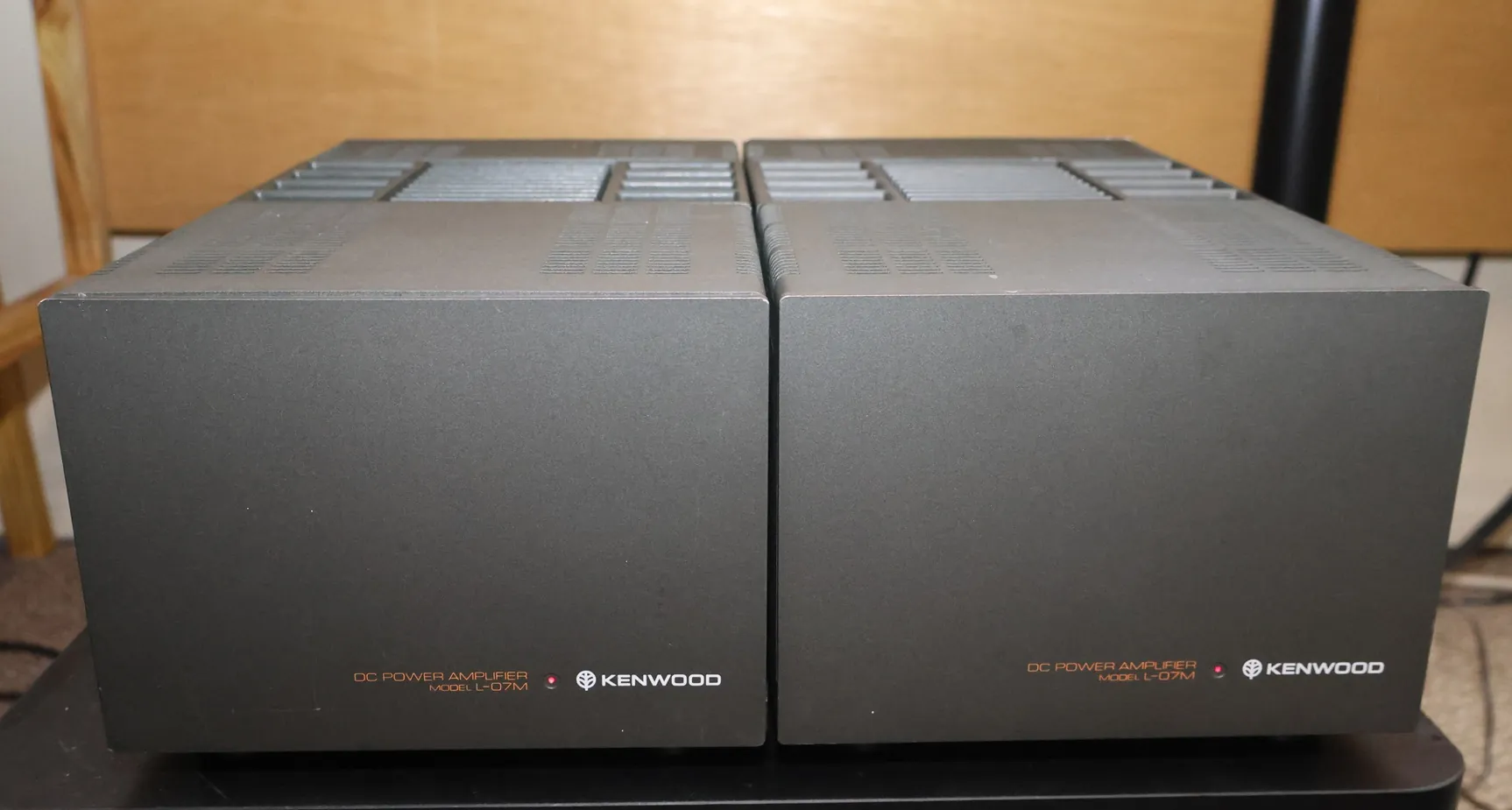

There’s a certain kind of amplifier that walks into your listening room, shakes your hand, says all the right things and leaves no fingerprints. You listen for a week, you nod politely, you smile at it the way you’d smile at a stranger at a bar. Pleasant company, nice conversation, and gone from memory before the coffee finishes brewing the next morning. I’ve reviewed plenty of those. The Kenwood L-07M is not one of them.
Kenwood introduced the L-07M in 1977, at the height of the Japanese spec wars, when slew rate, rise time and distortion figures were printed in brochures the way horsepower figures are printed in car ads today. Most of the spec-sheet heroes from that era have since retired to the “nice vintage piece” shelf. The L-07M, nearly fifty years later, still makes a serious case for itself, and not as a nostalgia trip. As an amplifier, period. Not bad for a company most people today associate with the car stereo they had in college.
The basics
The L-07M is a solid-state monoblock rated at 150 watts into 8 ohms. Each one weighs about 13 kg in a chassis only 20 cm wide, which makes it feel like someone poured a much larger amplifier into a much smaller box and then sat on the lid. Pick one up and you’ll understand where the weight went: a big transformer and a serious power supply, packed with the space efficiency of a Tokyo apartment. Kenwood’s published specifications include:
I’m a skeptic by nature when it comes to vintage spec sheets. 1970s marketing departments were not known for their modesty. So I put the L-07M on my bench, fully expecting to catch Kenwood exaggerating. Instead, distortion measured 0.003%, better than the factory figure, and everything else Kenwood claimed held up. I was almost disappointed. Almost.
The system
For this review I skipped the preamp entirely and connected an R2R DAC directly to the L-07M. No preamp means nothing in the chain to sweeten, soften or flatter the sound, so what you hear is the amplifier, warts and all (spoiler: there aren’t many warts, but we’ll get to who has them). Speakers were the Triangle Theta Signature and the Tekton Design Double Impact SE, two very different personalities: the Triangles transparent and detailed, the Tektons bigger, punchier and a touch more relaxed.
Speed, and why you should care
Before we talk music, let me explain one number, because it explains almost everything about how this amplifier sounds. Slew rate is simply how quickly an amplifier can react to a sudden change in the signal: a snare hit, a plucked string, the attack of a piano hammer. A slow amplifier rounds those edges off, the way a tired runner rounds a corner. A fast one turns on a dime. At ±170 V/µs, the L-07M turns on a dime and gives you change.
Even more impressive, Kenwood rated the rise time at the same 0.55 µs whether the amp is swinging 1 volt or 40 volts. Translation: it stays just as quick at loud, full-throttle peaks as it does at whisper levels. Plenty of amps are fast when nothing is asked of them. This one stays fast when the music gets serious.
If you’ve ever swapped op-amps in a DAC or preamp, here’s the best comparison I can offer. Op-amps are the small chips that shape the sound inside a lot of audio gear, and upgrading from the standard ones to a premium, hand-tuned discrete part like the Burson V7 Classic is a revelation: everything gets clearer, quicker, more alive. Moving from a conventional amplifier to the L-07M feels exactly like that, and most of it comes down to speed.
And here’s the part spec sheets never tell you: speed is exciting. That alone makes the L-07M more engaging to listen to. It is never boring. Not once in weeks of listening did I find myself checking my phone between tracks.
What it sounds like
The first word that comes to mind is transparent. The second is dynamic. The L-07M doesn’t so much play music as get out of its way. There’s no warm blanket over the midrange, no polite rounding of the treble, no “house sound” to speak of. Tonally it’s honest and neutral rather than lush. Anyone looking for a syrupy, romantic presentation should keep walking.
What it gives you instead is control. The bass is tight, deep and seemingly bottomless, and it starts and stops exactly when the recording says so, with none of the overhang that makes lesser amps sound like they’re playing in a parking garage. Treble is crisp and sparkling without turning glassy on good recordings. And for a 150-watt brute, it has a surprisingly delicate touch with small details: a breath before a vocal line, a brush lifting off a cymbal, the decay of a note into the room.
A few tracks that told the story:
The catch: this amp doesn’t lie
Now for the part of the review where I have to be honest, because the L-07M certainly is. This is a very unforgiving amplifier.
Give it a great recording and you are in heaven. Give it a poorly made one, and there is a lot of those out there, and it will put every flaw under a spotlight with the enthusiasm of a forensic accountant at tax time. Heavily compressed, loudness-war masterings in particular can become flat, harsh and, in some cases, honestly unlistenable. I had a few tracks I’d happily played for years on other amps that I simply skipped on the Kenwood.
To be clear: this has nothing to do with age. Plenty of older recordings sound smooth, natural and wonderful through the L-07M, often better than recent releases. The issue is how a recording was made, not when.
And it’s not the amp’s fault. It’s doing exactly what a truly accurate amplifier is supposed to do. But “it’s not my fault” is cold comfort when your favorite album suddenly sounds like it was mastered inside a tin can. It makes the L-07M a little harder to live with day to day, especially if your music library is a mixed bag.
Speaker matching matters here. The unforgiving character showed up with both pairs of speakers, but it was more obvious with the Triangle Theta Signature, which is the more transparent of the two. Pair the L-07M with very revealing speakers and you’ll get the truth at full volume. If you want a little more mercy, lean toward speakers with a warmer or more relaxed voicing.
Who it’s for
Final verdict
Some amps come and go. You listen to them, you smile at them like that stranger at the bar, and you don’t remember them the next day. The Kenwood L-07M is the opposite. It’s fast, transparent, dynamic and full of life, with specs that still hold up on the bench almost fifty years later. Yes, it’s demanding. It will not flatter a bad recording, and it will not apologize for that. But give it good music and it delivers the kind of listening sessions that keep you up well past bedtime, telling yourself “just one more track.”
This amplifier truly deserves its legendary name. I’ve heard a lot of gear come through this room, and I’m willing to bet I’ll still remember the L-07M many, many years from now.
Highly recommended, with one condition: feed it well.