Holo Audio named this DAC “Spring,” which is a fine name for a season, a mattress, or a bottled water, but not exactly a name that strikes fear into the hearts of competitors costing three times as much. It should. The Spring 3 KTE arrived in an unassuming box, weighed more than I expected, and within a week had quietly elbowed a much pricier converter off my rack and into the closet, where it now sulks.
Why R2R, and Why Me
Over the years, I’ve had a long parade of delta-sigma DACs pass through my system. Many of them were impressively transparent, measured beautifully, and revealed every last detail in a recording. And every one of them, to my ears, had a sharp edge — a glassy, slightly hard quality on top that kept reminding me I was listening to digital. I’m not here to argue about it. We all hear differently, and plenty of listeners love those DACs. I’m simply not one of them.
R2R ladder DACs were different. For the first time, digital gave me a sound I could truly relax into and enjoy for hours — something very close to the analog warmth and flow of a good reel-to-reel deck. And honestly, look at the name: R2R and R2R. Resistor-to-resistor, reel-to-reel. Same letters, so they must sound the same, right? I rest my case, and I’d advise the engineers in the audience to put down their pitchforks. 🙂
What It Is
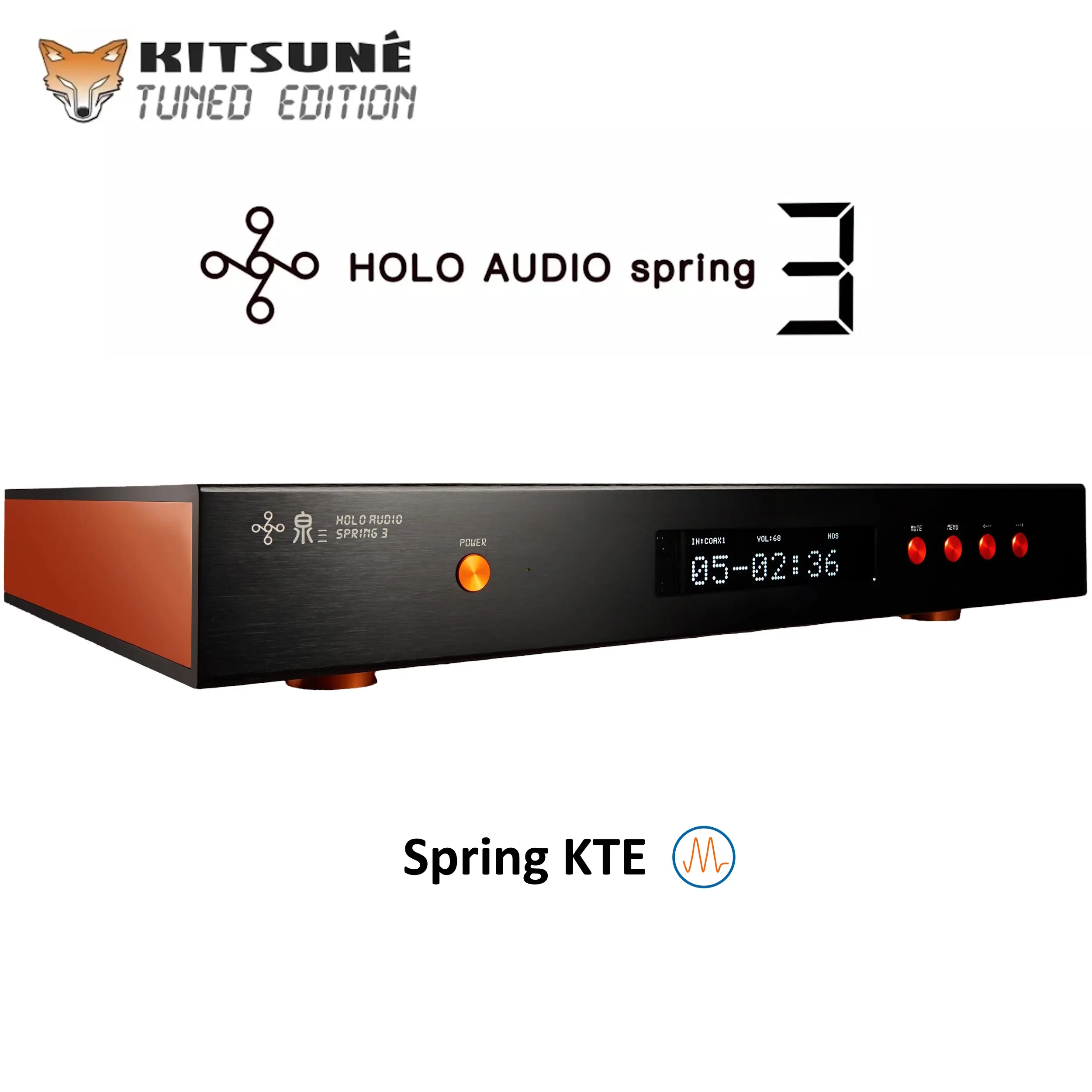
The Spring 3 is designed by Jeff Zhu of Holo Audio, and the KTE (Kitsune Tuned Edition) is the top of three versions. There’s no off-the-shelf DAC chip anywhere inside. Instead you get a fully discrete R2R resistor ladder for PCM and a separate discrete ladder for native DSD — no sneaky conversion of DSD to PCM behind your back. The KTE treatment adds a 100VA flat-wire O-core transformer (not a toroid), pure silver internal wiring, upgraded capacitors, and the enhanced USB module borrowed from Holo’s flagship May DAC.
Inputs cover USB, I2S over HDMI, AES/EBU, coax and optical. Outputs are balanced XLR and single-ended RCA. It decodes up to PCM 1.536MHz and DSD1024, which is roughly 1,500 times more resolution than I will ever need and about 1,499 times more than my ears can confirm. An optional preamp module with volume control is available if you want to run it straight into a power amp.
You can choose between NOS (non-oversampling) and OS (oversampling) modes, and this is where the fun — and the arguing — begins.
Break-In: Bring a Book
Out of the box, the Spring 3 KTE sounded clean, competent and slightly buttoned-up, like a new accountant on his first day. I’d advise anyone buying one to leave it powered and playing for a few hundred hours before forming opinions. Somewhere past that point, the shirt collar loosened, the tie came off, and the thing started to swing. I don’t fully understand why a resistor ladder needs to “settle in,” and I’ve stopped asking. My wife suggests the same thing happened to me.
The Sound
The first thing that hit me was the silence. The background is profoundly black — not the processed, scrubbed-clean black I’ve heard from many delta-sigma designs, but the kind of quiet that makes the music seem to arrive from nowhere. Notes start and stop with a natural envelope instead of being stamped onto the air with a rubber stamp.
The second thing was the space. The Spring 3 KTE throws a deep, wide, genuinely three-dimensional soundstage. Instruments aren’t just placed left-to-right; they’re layered front-to-back with real air between them. On a well-recorded live jazz set, I could locate the drummer’s ride cymbal behind and slightly above the piano with the kind of specificity that makes you glance at the corner of the room. “Holographic” is an overused word in this hobby, and I apologize in advance for using it, but here it applies.
Tonally, this DAC leans toward warmth and density, without crossing into syrup. Midrange is the star: voices have body, chest and texture. Acoustic bass has wood in it, not just pitch. Strings have that slightly rosiny bite that tells you somebody’s arm is moving a bow, not a synthesizer preset. And that sharp digital edge I’ve fought for years? Gone. Cymbals shimmer and decay instead of hissing. It’s an organic, flesh-and-blood presentation — the closest a digital source in my system has come to making me forget I’m listening to digital at all.
And yet it isn’t soft. Microdynamics are delightfully articulate, and when a recording calls for a punch, the Spring 3 KTE delivers it with real authority. Big orchestral crescendos swell without compression, and transients have snap. It’s vivid without being etched, detailed without being clinical.
NOS vs. OS
In NOS mode, the Spring 3 KTE is at its most beautiful — flowing, relaxed, harmonically rich, with a sense of ease that’s addictive. There’s a very slight gentleness at the extreme top, but in exchange you get a presentation that’s simply easy to love. This is the mode I lived in.
Switch to OS mode and the picture tightens: images get a hair sharper, the treble a touch more extended, the bass slightly more defined. Some listeners will prefer it, especially with warmer amplification or older recordings. I found myself switching back to NOS within an hour every time, like returning to a favorite chair.
A Few Quibbles
No component is perfect, and if I said otherwise you’d rightly suspect I’d been paid in noodles.
The USB input is very good, but the Spring 3 KTE rewards a quality USB cable or, better still, a good DDC feeding the I2S input. It’s revealing enough to make your upstream choices audible.
Output level is generous. If you’re running it into a sensitive preamp, you may find your volume knob living at nine o’clock.
The front panel and remote are functional rather than luxurious. This is a box built for your ears, not your guests.
If your system already leans warm and soft, the NOS mode could tip it a bit too far toward comfort. Try OS before blaming the DAC.
What I Loved
A dead-quiet background that lets low-level detail and decay emerge naturally
No sharp, glassy digital edge — just smooth, natural, analog-like flow
Deep, layered, holographic soundstage with excellent image specificity
Rich, organic midrange with real body and texture
Strong dynamic contrast — vivid and punchy without glare
True native DSD conversion and a fully discrete design at this price
Two genuinely useful sonic flavors via NOS and OS modes
Final Verdict
Plenty of DACs impress you for an afternoon. Very few make you stop evaluating and start listening. The Holo Audio Spring 3 KTE does exactly that: it makes digital files sound like music made by people in a room rather than numbers passing through a calculator. For a listener like me, who has spent years trying to sand the sharp edges off digital, it delivers what R2R promised all along — and then some. I still keep my turntable, of course — I’m not a lunatic — but I’ve found myself reaching for a playlist instead of a record sleeve far more often than I’d care to admit.
At a bit under four thousand dollars depending on configuration, the Spring 3 KTE embarrasses DACs costing considerably more, and it does so with grace, warmth and a soundstage you can practically walk into. If you’ve been waiting for a digital source that sounds like it was built by someone who actually loves music, stop waiting.
Highly recommended. As for the converter in the closet — it can come out when it learns some manners.

Holo Audio named this DAC “Spring,” which is a fine name for a season, a mattress, or a bottled water, but not exactly a name that strikes fear into the hearts of competitors costing three times as much. It should. The Spring 3 KTE arrived in an unassuming box, weighed more than I expected, and within a week had quietly elbowed a much pricier converter off my rack and into the closet, where it now sulks.
Why R2R, and Why Me
Over the years, I’ve had a long parade of delta-sigma DACs pass through my system. Many of them were impressively transparent, measured beautifully, and revealed every last detail in a recording. And every one of them, to my ears, had a sharp edge — a glassy, slightly hard quality on top that kept reminding me I was listening to digital. I’m not here to argue about it. We all hear differently, and plenty of listeners love those DACs. I’m simply not one of them.
R2R ladder DACs were different. For the first time, digital gave me a sound I could truly relax into and enjoy for hours — something very close to the analog warmth and flow of a good reel-to-reel deck. And honestly, look at the name: R2R and R2R. Resistor-to-resistor, reel-to-reel. Same letters, so they must sound the same, right? I rest my case, and I’d advise the engineers in the audience to put down their pitchforks. 🙂
What It Is
The Spring 3 is designed by Jeff Zhu of Holo Audio, and the KTE (Kitsune Tuned Edition) is the top of three versions. There’s no off-the-shelf DAC chip anywhere inside. Instead you get a fully discrete R2R resistor ladder for PCM and a separate discrete ladder for native DSD — no sneaky conversion of DSD to PCM behind your back. The KTE treatment adds a 100VA flat-wire O-core transformer (not a toroid), pure silver internal wiring, upgraded capacitors, and the enhanced USB module borrowed from Holo’s flagship May DAC.
Inputs cover USB, I2S over HDMI, AES/EBU, coax and optical. Outputs are balanced XLR and single-ended RCA. It decodes up to PCM 1.536MHz and DSD1024, which is roughly 1,500 times more resolution than I will ever need and about 1,499 times more than my ears can confirm. An optional preamp module with volume control is available if you want to run it straight into a power amp.
You can choose between NOS (non-oversampling) and OS (oversampling) modes, and this is where the fun — and the arguing — begins.
Break-In: Bring a Book
Out of the box, the Spring 3 KTE sounded clean, competent and slightly buttoned-up, like a new accountant on his first day. I’d advise anyone buying one to leave it powered and playing for a few hundred hours before forming opinions. Somewhere past that point, the shirt collar loosened, the tie came off, and the thing started to swing. I don’t fully understand why a resistor ladder needs to “settle in,” and I’ve stopped asking. My wife suggests the same thing happened to me.
The Sound
The first thing that hit me was the silence. The background is profoundly black — not the processed, scrubbed-clean black I’ve heard from many delta-sigma designs, but the kind of quiet that makes the music seem to arrive from nowhere. Notes start and stop with a natural envelope instead of being stamped onto the air with a rubber stamp.
The second thing was the space. The Spring 3 KTE throws a deep, wide, genuinely three-dimensional soundstage. Instruments aren’t just placed left-to-right; they’re layered front-to-back with real air between them. On a well-recorded live jazz set, I could locate the drummer’s ride cymbal behind and slightly above the piano with the kind of specificity that makes you glance at the corner of the room. “Holographic” is an overused word in this hobby, and I apologize in advance for using it, but here it applies.
Tonally, this DAC leans toward warmth and density, without crossing into syrup. Midrange is the star: voices have body, chest and texture. Acoustic bass has wood in it, not just pitch. Strings have that slightly rosiny bite that tells you somebody’s arm is moving a bow, not a synthesizer preset. And that sharp digital edge I’ve fought for years? Gone. Cymbals shimmer and decay instead of hissing. It’s an organic, flesh-and-blood presentation — the closest a digital source in my system has come to making me forget I’m listening to digital at all.
And yet it isn’t soft. Microdynamics are delightfully articulate, and when a recording calls for a punch, the Spring 3 KTE delivers it with real authority. Big orchestral crescendos swell without compression, and transients have snap. It’s vivid without being etched, detailed without being clinical.
NOS vs. OS
In NOS mode, the Spring 3 KTE is at its most beautiful — flowing, relaxed, harmonically rich, with a sense of ease that’s addictive. There’s a very slight gentleness at the extreme top, but in exchange you get a presentation that’s simply easy to love. This is the mode I lived in.
Switch to OS mode and the picture tightens: images get a hair sharper, the treble a touch more extended, the bass slightly more defined. Some listeners will prefer it, especially with warmer amplification or older recordings. I found myself switching back to NOS within an hour every time, like returning to a favorite chair.
A Few Quibbles
No component is perfect, and if I said otherwise you’d rightly suspect I’d been paid in noodles.
What I Loved
Final Verdict
Plenty of DACs impress you for an afternoon. Very few make you stop evaluating and start listening. The Holo Audio Spring 3 KTE does exactly that: it makes digital files sound like music made by people in a room rather than numbers passing through a calculator. For a listener like me, who has spent years trying to sand the sharp edges off digital, it delivers what R2R promised all along — and then some. I still keep my turntable, of course — I’m not a lunatic — but I’ve found myself reaching for a playlist instead of a record sleeve far more often than I’d care to admit.
At a bit under four thousand dollars depending on configuration, the Spring 3 KTE embarrasses DACs costing considerably more, and it does so with grace, warmth and a soundstage you can practically walk into. If you’ve been waiting for a digital source that sounds like it was built by someone who actually loves music, stop waiting.
Highly recommended. As for the converter in the closet — it can come out when it learns some manners.