Let me confess something up front: I met this amplifier under the worst possible circumstances. It landed on my bench with one channel deader than disco. Every output transistor on that side was shorted, the protection relay had retired from protecting anything, and one circuit trace had lifted off the board like a bad toupee in a stiff breeze. So my first impression of the Jolida JD1501 was not “smooth and silky.” It was the smell.
That is not how reviews normally begin. Normally a pristine box arrives, the reviewer admires the faceplate, and everyone pretends the amp has never had a bad day in its life. I got to know this one the honest way: I fixed it, set the bias and DC offset, and then dropped it into the main system “just to confirm it works.” That was supposed to take one evening. It is still there, and the amplifier it displaced is starting to give me looks.
What It Is
The JD1501 is a hybrid integrated: two 12AX7 tubes up front, a solid-state output stage behind them, 100 watts per channel into 8 ohms and considerably more into 4. It weighs about 32 pounds, uses an ALPS volume pot, and sold for roughly $1,100 when new. The pitch is the oldest one in audio: tube tone with transistor grip, the best of both worlds.
I have heard that pitch many times. Usually you get the worst of both worlds: tube noise and transistor glare, sharing a chassis and blaming each other. So I sat down with my arms folded.
One bench note. The literature talks about a MOSFET output stage. Mine is full of Toshiba 2SA1943 and 2SC5200 bipolars, which I know intimately because I soldered a fresh set in. I am not complaining. Those Toshibas are terrific output devices, and I would rather have them than a brochure.
The Sound
Start at the bottom. The bass is solid, weighty, and tuneful. Kick drums have real punch, and bass guitar lines have pitch instead of just mass, so you can follow the player’s left hand rather than a vague warm rumor. But it is not the last word in control. On demanding material the lowest notes hang around a beat longer than they should, like a party guest who has already put his coat on but keeps talking. A big-iron amp with a death grip on the woofers will stop and start more cleanly. What you get here is generous and enjoyable bass, not iron-fisted bass.
The midrange is where the two little tubes earn their rent. There is a touch of sweetness, a slight euphony, as if someone at the factory put a thumb on the scale. It is a tasteful thumb. Voices have body and a rounded, human quality. Is it strictly neutral? No. Did I care after ten minutes? Also no.
The top end is where the surprise came, and not the good kind. With the stock tubes the treble is a bit edgy. Cymbals have a slightly hard leading edge and sibilants get more attention than they deserve. This is not what I expected from an amp with a tube input stage, which is supposed to be the part of the circuit that takes the edge off. It is like ordering the soup and finding it crunchy. It is not harsh, and it never chased me out of the room, but it is there, and on bright recordings you will notice it.
Then there is the soundstage, which surprised me the other way. It is wide and open, with real space around instruments and decent depth behind the speakers. Orchestral music gets a proper hall to breathe in rather than a hallway.
Finally, rhythm. This amp keeps time. Busy, syncopated music stays sorted, dynamic accents land where they should, and the JD1501 never trips over its own feet trying to keep up.
About Those Tubes
You knew this was coming. The stock 12AX7s are the weakest link in the box, and they are the main suspects in the case of the edgy treble. My recommendation is a pair of Amperex 12AX7. They smooth out the top end without dulling it, the hardness on cymbals relaxes, and the midrange picks up extra warmth and texture as a bonus. With the Amperex in place, the amp finally sounds like the tube hybrid it claims to be.
Since there are only two tubes, this is the cheapest tube-rolling hobby you will ever have. It is the gateway drug of the tube world. You have been warned.
The Highlights
Bass: solid, weighty and tuneful, though not the last word in control
Midrange: slightly sweet, full-bodied, excellent with voices
Treble: a bit edgy with stock tubes, smooth with Amperex 12AX7
Soundstage: wide and open with good depth
Rhythm: lively and sure-footed
Power: a real 100 watts that does not flinch at 4-ohm speakers
The Grumbles
The casework is resonant. Rap the top cover with a knuckle and it answers back.
The fit and finish are fine from the listening chair and merely okay from six inches.
The stock tubes should be treated as packing material.
Line inputs only, so vinyl people will need an outboard phono stage.
Having been inside one, I can tell you the board is not the friendliest place to work. Treat the amp kindly and do not short your speaker cables.
Final Verdict
I expected a compromise and found a point of view, plus a couple of rough edges. The Jolida JD1501 is not the most transparent amplifier I have heard, its bass could be tighter, and out of the box the treble has more bite than a tube front end should allow. But the midrange is lovely, the soundstage is big, the rhythm is right, and the one real flaw is fixed with two small glass bottles.
If you want a microscope, buy a microscope. If you want an amplifier that makes you play one more album at midnight when you have work in the morning, this is a bargain on the used market. Mine came back from the dead, and I am glad I did the paperwork. Recommended, with a pair of Amperex 12AX7s and a clear conscience.
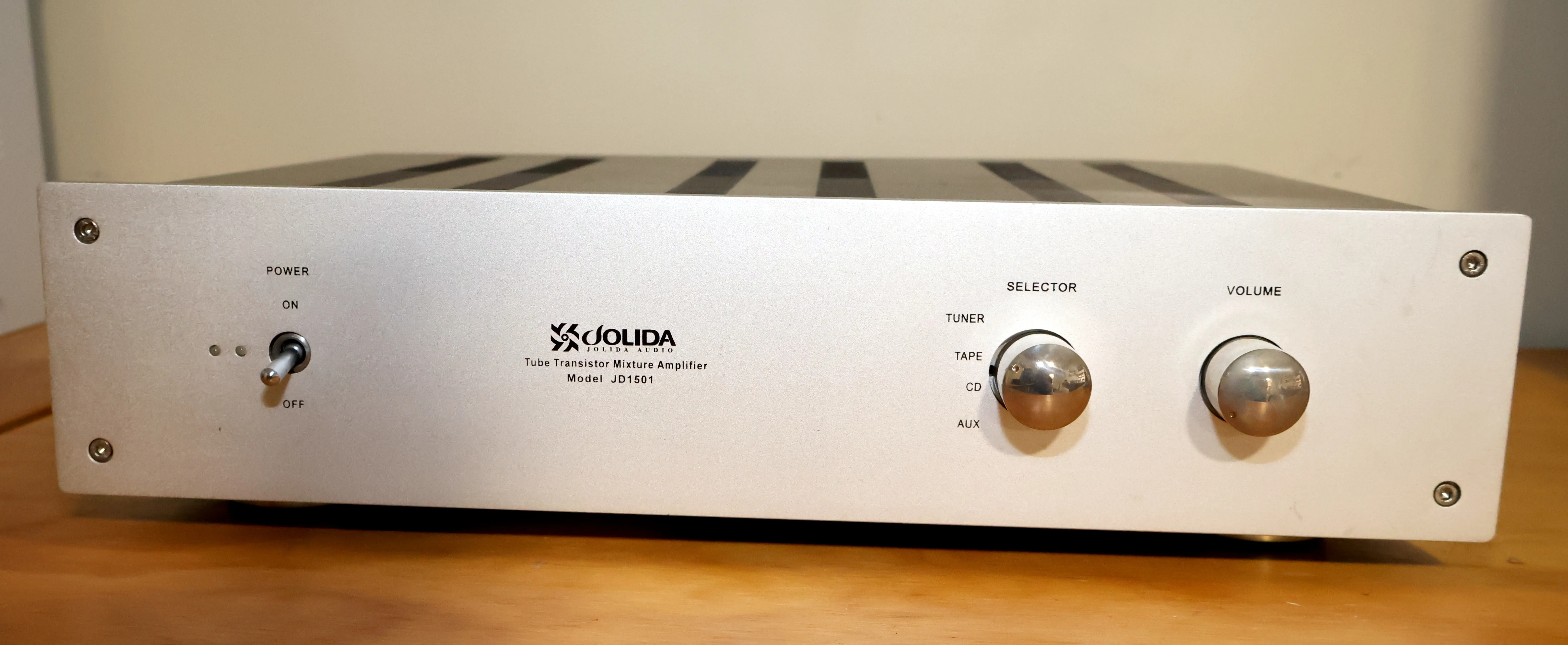

Let me confess something up front: I met this amplifier under the worst possible circumstances. It landed on my bench with one channel deader than disco. Every output transistor on that side was shorted, the protection relay had retired from protecting anything, and one circuit trace had lifted off the board like a bad toupee in a stiff breeze. So my first impression of the Jolida JD1501 was not “smooth and silky.” It was the smell.
That is not how reviews normally begin. Normally a pristine box arrives, the reviewer admires the faceplate, and everyone pretends the amp has never had a bad day in its life. I got to know this one the honest way: I fixed it, set the bias and DC offset, and then dropped it into the main system “just to confirm it works.” That was supposed to take one evening. It is still there, and the amplifier it displaced is starting to give me looks.
What It Is
The JD1501 is a hybrid integrated: two 12AX7 tubes up front, a solid-state output stage behind them, 100 watts per channel into 8 ohms and considerably more into 4. It weighs about 32 pounds, uses an ALPS volume pot, and sold for roughly $1,100 when new. The pitch is the oldest one in audio: tube tone with transistor grip, the best of both worlds.
I have heard that pitch many times. Usually you get the worst of both worlds: tube noise and transistor glare, sharing a chassis and blaming each other. So I sat down with my arms folded.
One bench note. The literature talks about a MOSFET output stage. Mine is full of Toshiba 2SA1943 and 2SC5200 bipolars, which I know intimately because I soldered a fresh set in. I am not complaining. Those Toshibas are terrific output devices, and I would rather have them than a brochure.
The Sound
Start at the bottom. The bass is solid, weighty, and tuneful. Kick drums have real punch, and bass guitar lines have pitch instead of just mass, so you can follow the player’s left hand rather than a vague warm rumor. But it is not the last word in control. On demanding material the lowest notes hang around a beat longer than they should, like a party guest who has already put his coat on but keeps talking. A big-iron amp with a death grip on the woofers will stop and start more cleanly. What you get here is generous and enjoyable bass, not iron-fisted bass.
The midrange is where the two little tubes earn their rent. There is a touch of sweetness, a slight euphony, as if someone at the factory put a thumb on the scale. It is a tasteful thumb. Voices have body and a rounded, human quality. Is it strictly neutral? No. Did I care after ten minutes? Also no.
The top end is where the surprise came, and not the good kind. With the stock tubes the treble is a bit edgy. Cymbals have a slightly hard leading edge and sibilants get more attention than they deserve. This is not what I expected from an amp with a tube input stage, which is supposed to be the part of the circuit that takes the edge off. It is like ordering the soup and finding it crunchy. It is not harsh, and it never chased me out of the room, but it is there, and on bright recordings you will notice it.
Then there is the soundstage, which surprised me the other way. It is wide and open, with real space around instruments and decent depth behind the speakers. Orchestral music gets a proper hall to breathe in rather than a hallway.
Finally, rhythm. This amp keeps time. Busy, syncopated music stays sorted, dynamic accents land where they should, and the JD1501 never trips over its own feet trying to keep up.
About Those Tubes
You knew this was coming. The stock 12AX7s are the weakest link in the box, and they are the main suspects in the case of the edgy treble. My recommendation is a pair of Amperex 12AX7. They smooth out the top end without dulling it, the hardness on cymbals relaxes, and the midrange picks up extra warmth and texture as a bonus. With the Amperex in place, the amp finally sounds like the tube hybrid it claims to be.
Since there are only two tubes, this is the cheapest tube-rolling hobby you will ever have. It is the gateway drug of the tube world. You have been warned.
The Highlights
The Grumbles
Final Verdict
I expected a compromise and found a point of view, plus a couple of rough edges. The Jolida JD1501 is not the most transparent amplifier I have heard, its bass could be tighter, and out of the box the treble has more bite than a tube front end should allow. But the midrange is lovely, the soundstage is big, the rhythm is right, and the one real flaw is fixed with two small glass bottles.
If you want a microscope, buy a microscope. If you want an amplifier that makes you play one more album at midnight when you have work in the morning, this is a bargain on the used market. Mine came back from the dead, and I am glad I did the paperwork. Recommended, with a pair of Amperex 12AX7s and a clear conscience.