There are loudspeakers you listen to, and there are loudspeakers that grab you by the collar and insist you listen. The Klipsch La Scala belongs firmly in the second camp. Cue up anything with a pulse, and within about eight seconds you realize these things aren’t so much reproducing music as flinging it across the room at you, like an overjoyed Labrador that nobody ever told weighs ninety pounds.
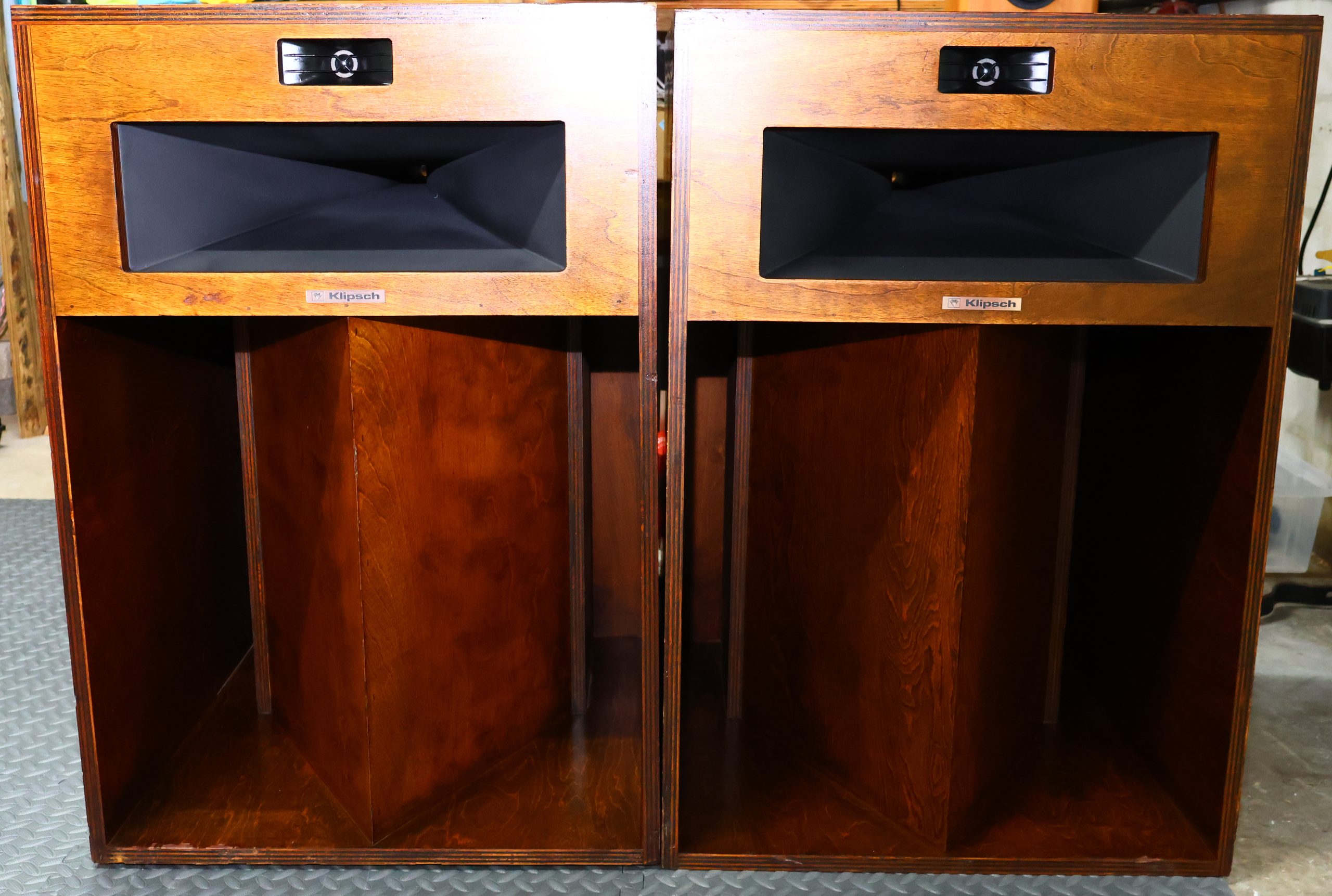
The obvious comes first. These are not small speakers. When the crates came off the truck, my first thought was that someone had delivered a pair of kitchen cabinets to the wrong address. Each La Scala is a folded bass horn about the size of a dorm-room refrigerator, with a midrange horn and a tweeter horn perched on top. Paul Klipsch conceived it in the early 1960s as a more manageable sibling to the Klipschorn, one that didn’t need a corner and could also handle public-address duty. You can still sense that heritage. These speakers were built to make a crowd pay attention, and they haven’t forgotten how.
The first notes
Here’s the thing nobody fully prepares you for: the sensitivity. With efficiency well north of 100 dB, the La Scalas turn every watt into something consequential. The first watt is loud. The second watt is a lifestyle choice. I found myself listening at the “1” position on a volume control that normally lives near “3,” and I still had to remind myself that my neighbors never agreed to attend the concert.
That efficiency isn’t just a party trick. It changes how music feels. Transients arrive with startling snap: a rimshot is a rimshot, not a polite suggestion of one. A trumpet sounds like brass being blown hard, and plucked bass strings have a physical thwack that most box speakers round off into something tasteful and dull. Dynamic swings happen with no apparent strain, because the horns aren’t working hard to get there. It’s the difference between someone describing a thunderstorm and standing in one.
Filling the room, and then some
My listening space isn’t small, and the La Scalas treated it like a broom closet. They fill a large room effortlessly, with a sense of scale and presence that makes the band seem to be in the room rather than behind a window. Orchestral crescendos swell without compressing. Rock records sound the way they did when you were nineteen and the speakers belonged to someone with a van. Imaging isn’t laser-etched, but the soundstage is big and bold. Performers are life-sized, not miniaturized into a diorama between the cabinets.
A few things stood out again and again:
Dynamics: Micro and macro dynamics are simply exceptional. Soft passages stay alive, loud ones explode.
Immediacy: There’s a “live event” quality that’s hard to quantify but impossible to miss. Drums especially sound startlingly real.
Amplifier friendliness: A few good watts go a very long way, which makes these a natural partner for low-power tube amps, including single-ended designs.
Fast, punchy mid-bass: Kick drums and bass guitar arrive with real speed and impact. How deep that bass goes is another story, which I’ll get to.
Honesty about the chain: With sensitivity this high, you’ll hear every bit of hiss and hum from upstream. Noisy amplifiers need not apply.
The bass question
The La Scala’s bass is a paradox. It’s quick, tight, and punchy, the kind of bass that starts and stops on command and makes most ported boxes sound like they’re wading through pudding. A walking acoustic bass line has pace and pluck, and a kick drum lands in your chest rather than somewhere near your ankles.
But it isn’t deep. The folded horn simply runs out of road in the bottom octave. Pipe organ pedal notes, synth drops, the lowest string on a five-string electric bass, and the rumble of a big orchestral bass drum are implied more than delivered. You hear the attack, and then the floor that should be under it isn’t quite there. For a speaker this size, that’s a genuine surprise, a bit like opening a refrigerator-sized box and finding a very enthusiastic toaster inside.
So I added a subwoofer, and not just any subwoofer. I paired the La Scalas with a Velodyne HGS-15, a servo-controlled 15-incher with the speed and control to keep pace with horns, which is not something every sub can claim. Integration took some patience with crossover point, level, and phase, but once it clicked, the full musical range started to sing. Nothing was missing any longer. The La Scalas kept their snap and immediacy, and the Velodyne laid down the foundation underneath without drawing attention to itself. Organ recordings suddenly had weight, electronic music had its floor back, and orchestral climaxes finally felt anchored. It’s the combination I’d recommend to anyone who wants the La Scala experience without the asterisk.
La Scala versus B&W 804
I had a pair of B&W 804s in the very same setup, same room and same electronics, which makes the comparison more than a fond recollection. The 804s are more refined in some ways. They image with more precision, their cabinet is quieter, and they’re better behaved at the frequency extremes. They’re a well-dressed, well-spoken dinner guest.
But I liked the La Scalas more. The B&Ws, for all their polish, sounded a bit polite and a bit like they were presenting a lovely recording of music. The La Scalas sounded like music, warts included. Going back to the 804s after a week with the Klipsches felt like switching from a live set to the radio broadcast of it: accurate, articulate, and somehow less fun. If engagement is the point of this hobby, and I think it is, the La Scalas won the argument.
Now for the warts
I’d be doing you a disservice if I stopped there, because the La Scala’s personality comes with some baggage, and some of it rattles.
The resonances are audible, starting in the midrange. The horn rings. On piano, massed strings, and cymbals especially, there’s a lingering metallic sheen, a faint “ting” that hangs on after the note should have decayed. Once you hear it, you can’t unhear it, much like noticing that your favorite restaurant’s “homemade” bread comes in a bag.
The bigger issue shows up at higher volumes, where the bass cabinet itself joins the band as an uninvited member. Put a hand on the side panel during a loud passage and you’ll feel the enclosure singing along. That resonance colors the bass, blurring pitch definition and adding a boomy overhang that wasn’t on the recording. The problem doesn’t stay politely in the basement, either. It works its way up into voices. Male vocals in particular take on a chesty, boxy quality at party levels, as if the singer had been asked to perform from inside a wine barrel. Female voices fare better, but the coloration is there.
At moderate levels, much of this recedes and the speaker’s virtues dominate. But these are speakers that practically dare you to crank them up, and that’s exactly when the cabinet starts talking back. It’s a cruel irony: the La Scala’s greatest temptation is also its greatest weakness.
Poorly recorded material can also get a little shouty through the upper midrange. Modern pop mastered at maximum loudness can turn fatiguing quickly. Well-recorded acoustic jazz, live albums, and anything with real dynamic range, on the other hand, sound spectacular.
Living with them
Beyond sound, there’s the practical matter of cohabitation. The La Scalas are heavy, tall, and unapologetically present in a room. Their wife acceptance factor hovers somewhere between “industrial HVAC unit” and “that motorcycle you’re restoring in the living room.” Add a 15-inch subwoofer and you’ve more or less furnished the room. On the plus side, they’re built like furniture, and you can set a drink on top without fear. I’m not saying you should. I’m saying you can.
Placement is fairly forgiving. They’re happy near a wall, which helps the bass, and they don’t need to be pulled far into the room the way many audiophile boxes demand. Pair them with a quiet, clean amplifier. A good low-power tube amp is a natural match, and you’ll wonder why you ever needed 200 watts.
FINAL VERDICT
The Klipsch La Scala is a gloriously alive, dynamic, room-filling loudspeaker that trades absolute neutrality for something rarer: genuine excitement. It beat the B&W 804 in my system on the metric that matters most to me, which is whether I wanted to keep listening. It’s not a perfect speaker. The midrange horn rings, and the cabinet resonates at high volume, coloring the bass and bleeding into voices. The bass is fast and punchy but not deep, so plan on a subwoofer. With the Velodyne HGS-15 filling in the bottom octave, the system finally felt complete. If you listen mostly at moderate levels, love live music, and value dynamics and scale over surgical accuracy, the La Scala, with a good sub, is easy to recommend. If you need a quiet box and pristine vocal purity at head-banging levels, look elsewhere, or budget for some serious cabinet damping.

There are loudspeakers you listen to, and there are loudspeakers that grab you by the collar and insist you listen. The Klipsch La Scala belongs firmly in the second camp. Cue up anything with a pulse, and within about eight seconds you realize these things aren’t so much reproducing music as flinging it across the room at you, like an overjoyed Labrador that nobody ever told weighs ninety pounds.
The obvious comes first. These are not small speakers. When the crates came off the truck, my first thought was that someone had delivered a pair of kitchen cabinets to the wrong address. Each La Scala is a folded bass horn about the size of a dorm-room refrigerator, with a midrange horn and a tweeter horn perched on top. Paul Klipsch conceived it in the early 1960s as a more manageable sibling to the Klipschorn, one that didn’t need a corner and could also handle public-address duty. You can still sense that heritage. These speakers were built to make a crowd pay attention, and they haven’t forgotten how.
The first notes
Here’s the thing nobody fully prepares you for: the sensitivity. With efficiency well north of 100 dB, the La Scalas turn every watt into something consequential. The first watt is loud. The second watt is a lifestyle choice. I found myself listening at the “1” position on a volume control that normally lives near “3,” and I still had to remind myself that my neighbors never agreed to attend the concert.
That efficiency isn’t just a party trick. It changes how music feels. Transients arrive with startling snap: a rimshot is a rimshot, not a polite suggestion of one. A trumpet sounds like brass being blown hard, and plucked bass strings have a physical thwack that most box speakers round off into something tasteful and dull. Dynamic swings happen with no apparent strain, because the horns aren’t working hard to get there. It’s the difference between someone describing a thunderstorm and standing in one.
Filling the room, and then some
My listening space isn’t small, and the La Scalas treated it like a broom closet. They fill a large room effortlessly, with a sense of scale and presence that makes the band seem to be in the room rather than behind a window. Orchestral crescendos swell without compressing. Rock records sound the way they did when you were nineteen and the speakers belonged to someone with a van. Imaging isn’t laser-etched, but the soundstage is big and bold. Performers are life-sized, not miniaturized into a diorama between the cabinets.
A few things stood out again and again:
The bass question
The La Scala’s bass is a paradox. It’s quick, tight, and punchy, the kind of bass that starts and stops on command and makes most ported boxes sound like they’re wading through pudding. A walking acoustic bass line has pace and pluck, and a kick drum lands in your chest rather than somewhere near your ankles.
But it isn’t deep. The folded horn simply runs out of road in the bottom octave. Pipe organ pedal notes, synth drops, the lowest string on a five-string electric bass, and the rumble of a big orchestral bass drum are implied more than delivered. You hear the attack, and then the floor that should be under it isn’t quite there. For a speaker this size, that’s a genuine surprise, a bit like opening a refrigerator-sized box and finding a very enthusiastic toaster inside.
So I added a subwoofer, and not just any subwoofer. I paired the La Scalas with a Velodyne HGS-15, a servo-controlled 15-incher with the speed and control to keep pace with horns, which is not something every sub can claim. Integration took some patience with crossover point, level, and phase, but once it clicked, the full musical range started to sing. Nothing was missing any longer. The La Scalas kept their snap and immediacy, and the Velodyne laid down the foundation underneath without drawing attention to itself. Organ recordings suddenly had weight, electronic music had its floor back, and orchestral climaxes finally felt anchored. It’s the combination I’d recommend to anyone who wants the La Scala experience without the asterisk.
La Scala versus B&W 804
I had a pair of B&W 804s in the very same setup, same room and same electronics, which makes the comparison more than a fond recollection. The 804s are more refined in some ways. They image with more precision, their cabinet is quieter, and they’re better behaved at the frequency extremes. They’re a well-dressed, well-spoken dinner guest.
But I liked the La Scalas more. The B&Ws, for all their polish, sounded a bit polite and a bit like they were presenting a lovely recording of music. The La Scalas sounded like music, warts included. Going back to the 804s after a week with the Klipsches felt like switching from a live set to the radio broadcast of it: accurate, articulate, and somehow less fun. If engagement is the point of this hobby, and I think it is, the La Scalas won the argument.
Now for the warts
I’d be doing you a disservice if I stopped there, because the La Scala’s personality comes with some baggage, and some of it rattles.
The resonances are audible, starting in the midrange. The horn rings. On piano, massed strings, and cymbals especially, there’s a lingering metallic sheen, a faint “ting” that hangs on after the note should have decayed. Once you hear it, you can’t unhear it, much like noticing that your favorite restaurant’s “homemade” bread comes in a bag.
The bigger issue shows up at higher volumes, where the bass cabinet itself joins the band as an uninvited member. Put a hand on the side panel during a loud passage and you’ll feel the enclosure singing along. That resonance colors the bass, blurring pitch definition and adding a boomy overhang that wasn’t on the recording. The problem doesn’t stay politely in the basement, either. It works its way up into voices. Male vocals in particular take on a chesty, boxy quality at party levels, as if the singer had been asked to perform from inside a wine barrel. Female voices fare better, but the coloration is there.
At moderate levels, much of this recedes and the speaker’s virtues dominate. But these are speakers that practically dare you to crank them up, and that’s exactly when the cabinet starts talking back. It’s a cruel irony: the La Scala’s greatest temptation is also its greatest weakness.
Poorly recorded material can also get a little shouty through the upper midrange. Modern pop mastered at maximum loudness can turn fatiguing quickly. Well-recorded acoustic jazz, live albums, and anything with real dynamic range, on the other hand, sound spectacular.
Living with them
Beyond sound, there’s the practical matter of cohabitation. The La Scalas are heavy, tall, and unapologetically present in a room. Their wife acceptance factor hovers somewhere between “industrial HVAC unit” and “that motorcycle you’re restoring in the living room.” Add a 15-inch subwoofer and you’ve more or less furnished the room. On the plus side, they’re built like furniture, and you can set a drink on top without fear. I’m not saying you should. I’m saying you can.
Placement is fairly forgiving. They’re happy near a wall, which helps the bass, and they don’t need to be pulled far into the room the way many audiophile boxes demand. Pair them with a quiet, clean amplifier. A good low-power tube amp is a natural match, and you’ll wonder why you ever needed 200 watts.
FINAL VERDICT
The Klipsch La Scala is a gloriously alive, dynamic, room-filling loudspeaker that trades absolute neutrality for something rarer: genuine excitement. It beat the B&W 804 in my system on the metric that matters most to me, which is whether I wanted to keep listening. It’s not a perfect speaker. The midrange horn rings, and the cabinet resonates at high volume, coloring the bass and bleeding into voices. The bass is fast and punchy but not deep, so plan on a subwoofer. With the Velodyne HGS-15 filling in the bottom octave, the system finally felt complete. If you listen mostly at moderate levels, love live music, and value dynamics and scale over surgical accuracy, the La Scala, with a good sub, is easy to recommend. If you need a quiet box and pristine vocal purity at head-banging levels, look elsewhere, or budget for some serious cabinet damping.