Some amplifiers arrive double-boxed with white gloves and a certificate. My Moscode 150 arrived with a past. Somebody had been inside it before me, armed with a soldering iron and a serene indifference to the letter “K.” I found 470K resistors where 470 ohm gate stoppers belonged, a 270K cathode resistor where 270 ohms was called for, and a shorted transistor in the tube supply regulator. The amp oscillated, clipped at a few volts, and generally behaved like a houseguest who had located the liquor cabinet.
Three faults later it biased up at 140mA per channel with less than 5mV of DC offset and delivered its full rated power. Only then did I get to hear what Harvey “Gizmo” Rosenberg and George Kaye were so worked up about in 1984.
A Little History (It’s Unavoidable)
New York Audio Labs made its name on Futterman OTL amplifiers: glorious, hot, and about as low-maintenance as a racehorse. The Moscode was the practical sequel. Keep the tubes where they do the most good, in the voltage gain and driver stages, and hand the heavy lifting to MOSFETs. No output tubes to match, no output transformers to pay for. The name is simply MOSFET plus cascode.
The model numbers are another matter. The “150” makes 75 watts per channel into 8 ohms. NYAL added both channels together, the same arithmetic used by car stereo manufacturers and by technicians estimating how long a repair will take.
What’s Under the Lid
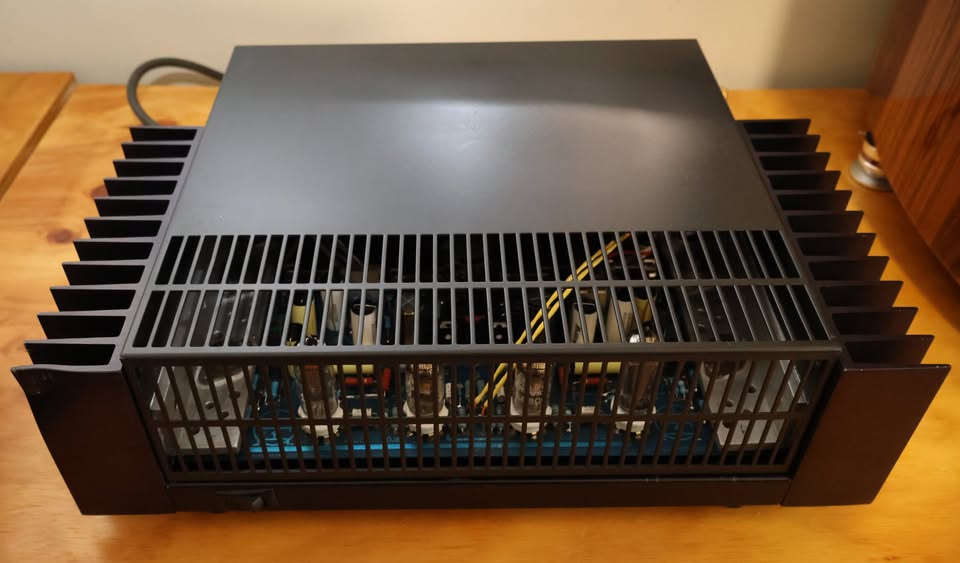
The circuit is refreshingly short. Each channel gets one 6DJ8 for voltage gain and one 6CG7 (6FQ7 if you prefer) to drive the gates of a single complementary pair of Hitachi lateral MOSFETs, the 2SK134 and 2SJ49. These are the parts everybody wishes were still made. Laterals are thermally well behaved and need very little protective babysitting, which is why the output stage is so simple. It is also why the amp survived its previous “repair.”
Power: 75 watts per channel into 8 ohms
Tubes: 2 x 6DJ8/ECC88, 2 x 6CG7/6FQ7
Outputs: one pair of Hitachi lateral MOSFETs per channel on ±50V rails
Tube supply: separately regulated 240V B+
Feedback: one modest global loop, returned to the cathode of the input tube
Protection: relay-delayed speaker connection, about 45 seconds
That regulated tube supply matters. Rosenberg preached active regulation for small-signal tubes long before it was fashionable, and I can testify to its importance from the other direction: when my regulator failed and fed the tubes raw, unregulated voltage, the amp sounded like a fax machine having a panic attack.
The turn-on delay matters too. Until the tubes warm up, the output wanders around at DC levels your woofers would not appreciate. Forty-five seconds is exactly long enough to wonder if you broke it again.
The Sound
Here is what I did not expect: this amp is fun. I mean that as the highest compliment, not the “nice personality” kind.
There are two headlines, and they arrive together: the midrange and the transparency.
The midrange is where the tubes send you the invoice, and it is money well spent. Voices have body and presence, with that slightly forward, reach-out-and-touch quality that makes a singer seem to stand in front of the speakers rather than between them. Saxophone has reed and breath. Piano has wood. It is not the golden syrup of a classic transformer-coupled amp. It is cleaner and faster than that, closer to the directness of the OTLs in its family tree, minus the space-heater side effects.
Then there is the transparency. I was braced for a pleasant, tube-flavored haze, the sonic equivalent of a soft-focus lens on an aging movie star. What I got was a clean window. This amp is not just transparent, it is surprisingly transparent. Reverb tails hang in the air until they are actually finished. You hear the room around a voice, not just the voice. Every tube I rolled into it announced itself within about ten seconds. Credit the short signal path: two tubes, one pair of MOSFETs and no output transformer standing between you and the music.
The bass is no afterthought, either. It is punchy, tuneful and quick, with none of the soft, rounded bloom you brace for when you see glass on the chassis. Kick drums have a leading edge and then get out of the way. Seventy-five watts sounds like considerably more, because the amp never seems to tighten up as the volume rises.
Soundstaging is wide and nicely layered, though a great transformer-coupled tube amp still digs further back into the hall. The Moscode counters with dynamics. Crescendos arrive with real jump, so music has momentum. My foot was tapping, which is embarrassing in a man holding a clipboard.
Where It Shows Its Age
The top end is extended and open, but on hot recordings there is a trace of grain in the upper midrange and lower treble, and a hard-pushed vocal can pick up a slight edge. That transparency cuts both ways: the Moscode will not flatter a bad recording, it will hand it to you with the receipt. Tube choice helps enormously here. The stock complement is the start of the conversation, not the end, and yes, I happen to have a few opinions about 6DJ8s.
And 75 watts is 75 watts. With reasonably efficient speakers it sounds enormous. With power-hungry planars in a big room, you will want the larger Moscode 300.
Final Verdict
The Moscode 150 is not a curiosity. It is a correct idea, executed simply, by people who cared more about music than about what the neighbors at the audio show thought. You get a tube midrange, a startlingly clear view into the recording, solid-state grip in the bass, almost no heat and no output tubes to feed. The price is a slightly grainy top on poor recordings and a model number that fibs by a factor of two.
Buy one if you find it, but budget for a recap, and inspect the previous owner’s handiwork before you trust it. Mine taught me that the most dangerous component in any vintage amplifier is the last person who fixed it.
Highly recommended. Just read the resistor color codes yourself.

Some amplifiers arrive double-boxed with white gloves and a certificate. My Moscode 150 arrived with a past. Somebody had been inside it before me, armed with a soldering iron and a serene indifference to the letter “K.” I found 470K resistors where 470 ohm gate stoppers belonged, a 270K cathode resistor where 270 ohms was called for, and a shorted transistor in the tube supply regulator. The amp oscillated, clipped at a few volts, and generally behaved like a houseguest who had located the liquor cabinet.
Three faults later it biased up at 140mA per channel with less than 5mV of DC offset and delivered its full rated power. Only then did I get to hear what Harvey “Gizmo” Rosenberg and George Kaye were so worked up about in 1984.
A Little History (It’s Unavoidable)
New York Audio Labs made its name on Futterman OTL amplifiers: glorious, hot, and about as low-maintenance as a racehorse. The Moscode was the practical sequel. Keep the tubes where they do the most good, in the voltage gain and driver stages, and hand the heavy lifting to MOSFETs. No output tubes to match, no output transformers to pay for. The name is simply MOSFET plus cascode.
The model numbers are another matter. The “150” makes 75 watts per channel into 8 ohms. NYAL added both channels together, the same arithmetic used by car stereo manufacturers and by technicians estimating how long a repair will take.
What’s Under the Lid
The circuit is refreshingly short. Each channel gets one 6DJ8 for voltage gain and one 6CG7 (6FQ7 if you prefer) to drive the gates of a single complementary pair of Hitachi lateral MOSFETs, the 2SK134 and 2SJ49. These are the parts everybody wishes were still made. Laterals are thermally well behaved and need very little protective babysitting, which is why the output stage is so simple. It is also why the amp survived its previous “repair.”
That regulated tube supply matters. Rosenberg preached active regulation for small-signal tubes long before it was fashionable, and I can testify to its importance from the other direction: when my regulator failed and fed the tubes raw, unregulated voltage, the amp sounded like a fax machine having a panic attack.
The turn-on delay matters too. Until the tubes warm up, the output wanders around at DC levels your woofers would not appreciate. Forty-five seconds is exactly long enough to wonder if you broke it again.
The Sound
Here is what I did not expect: this amp is fun. I mean that as the highest compliment, not the “nice personality” kind.
There are two headlines, and they arrive together: the midrange and the transparency.
The midrange is where the tubes send you the invoice, and it is money well spent. Voices have body and presence, with that slightly forward, reach-out-and-touch quality that makes a singer seem to stand in front of the speakers rather than between them. Saxophone has reed and breath. Piano has wood. It is not the golden syrup of a classic transformer-coupled amp. It is cleaner and faster than that, closer to the directness of the OTLs in its family tree, minus the space-heater side effects.
Then there is the transparency. I was braced for a pleasant, tube-flavored haze, the sonic equivalent of a soft-focus lens on an aging movie star. What I got was a clean window. This amp is not just transparent, it is surprisingly transparent. Reverb tails hang in the air until they are actually finished. You hear the room around a voice, not just the voice. Every tube I rolled into it announced itself within about ten seconds. Credit the short signal path: two tubes, one pair of MOSFETs and no output transformer standing between you and the music.
The bass is no afterthought, either. It is punchy, tuneful and quick, with none of the soft, rounded bloom you brace for when you see glass on the chassis. Kick drums have a leading edge and then get out of the way. Seventy-five watts sounds like considerably more, because the amp never seems to tighten up as the volume rises.
Soundstaging is wide and nicely layered, though a great transformer-coupled tube amp still digs further back into the hall. The Moscode counters with dynamics. Crescendos arrive with real jump, so music has momentum. My foot was tapping, which is embarrassing in a man holding a clipboard.
Where It Shows Its Age
The top end is extended and open, but on hot recordings there is a trace of grain in the upper midrange and lower treble, and a hard-pushed vocal can pick up a slight edge. That transparency cuts both ways: the Moscode will not flatter a bad recording, it will hand it to you with the receipt. Tube choice helps enormously here. The stock complement is the start of the conversation, not the end, and yes, I happen to have a few opinions about 6DJ8s.
And 75 watts is 75 watts. With reasonably efficient speakers it sounds enormous. With power-hungry planars in a big room, you will want the larger Moscode 300.
Final Verdict
The Moscode 150 is not a curiosity. It is a correct idea, executed simply, by people who cared more about music than about what the neighbors at the audio show thought. You get a tube midrange, a startlingly clear view into the recording, solid-state grip in the bass, almost no heat and no output tubes to feed. The price is a slightly grainy top on poor recordings and a model number that fibs by a factor of two.
Buy one if you find it, but budget for a recap, and inspect the previous owner’s handiwork before you trust it. Mine taught me that the most dangerous component in any vintage amplifier is the last person who fixed it.
Highly recommended. Just read the resistor color codes yourself.
Setting Bias and DC Offset on a Moscode 150 or 300