I’ve had the Suqiya E-550 on the bench and in the system for a few weeks now, and I still can’t decide whether to be annoyed by it or charmed by it. Both, probably. It arrived in a heavy carton, double-boxed, and when I lifted the lid I actually said “huh” out loud — which in my house counts as a rave.
Let’s start with the claim that hooked everyone: “about 30 watts into pure Class A.” No. Not a chance. Not on this planet, not in this chassis, not at these rails.
Here’s the arithmetic, and it isn’t subtle. Thirty watts into 8 ohms means 2.74 amperes of peak current. For a push-pull output stage to stay in Class A all the way to that peak, each channel must idle at roughly half that — call it 1.37A of standing bias. This amp clips at 31.8V RMS, which is 45V peak, so the rails are sitting somewhere around ±50V. Multiply it out: 50V × 1.37A × two devices ≈ 137 watts of heat per channel, 274 watts for the pair, before the music even starts. A real 30W Class A stereo amp is a space heater with a volume knob. That’s the deal you sign.
The Suqiya draws 19 watts at idle. Total. From the wall. Including the transformer’s no-load loss, the front end, the driver stage, and those cheerful little meter lamps.
Back out the obvious overhead and you’re left with maybe 10 watts across both output stages — call it 5W per channel, which at ±50V rails works out to something on the order of 50mA of bias. Push-pull Class A holds until output current reaches twice the bias, so 100mA peak, which into 8 ohms is about 0.8V peak. That’s roughly forty milliwatts of genuine Class A operation. Forty. Milliwatts. It is a Class A amplifier in exactly the way my car is a race car when I’m pulling out of the driveway.
And before anyone writes in to say it’s simply misbiased from the factory and could be dialed up — it can’t. Look at the heatsinks. Each one measures about 12 × 5 inches with 1.5-inch fins, around 90 cubic inches of extrusion. Natural convection over a finned surface like that gets you somewhere near 0.1 watt per square inch at a 40°C rise, which with realistic fin efficiency lands around 40–50 watts per sink — call it 1°C/W. Two of them, generously, handle maybe 90 watts total. To run real 30W Class A you’d need to shed 274 watts, which demands about 0.3°C/W per channel. That isn’t a heatsink adjustment. That’s a different amplifier, with fans, and possibly a permit.
Which brings me to the name. This is an Accuphase E-550 in the sense that I am Michael Jordan in the sense that we both own shoes.
The real E-550 is a pure Class A design, and it commits to it the way real Class A amplifiers have to: 30 watts per channel into 8 ohms, 60 into 4, 120 into 2, a chassis that weighs around 53 pounds, heatsinking sized to dump a couple hundred watts of continuous heat, and an idle draw that makes your electric meter spin like it’s counting down to something. It uses MOSFET output devices in parallel push-pull. It has Accuphase’s AAVA volume control, which does its attenuation in the current domain with no variable resistance in the signal path at all — genuinely clever engineering, not marketing vapor. And it measures better than 100 dB signal-to-noise, because that’s the entry fee for calling something reference-grade.
Now line that up against what’s sitting on my bench:
Class A: the real one, yes, all 30 watts of it. This one, roughly 40 milliwatts before it hands off to Class B.
Output devices: the real one, MOSFET. This one, MJ15024G bipolars.
Idle power: the real one, a few hundred watts of heat. This one, 19 watts from the wall, total, meter lamps included.
Noise floor: the real one, better than 100 dB. This one, 64 dB.
The MJ15024s themselves are perfectly respectable 250V TO-3 workhorses — nothing wrong with them, they’ve been building honest amplifiers since the Carter administration. But the listing’s claim that the G suffix denotes “gold-sealed” military selection is my favorite piece of fiction this year. The G is ON Semiconductor’s suffix for lead-free packaging. It means RoHS. It means the solder doesn’t have lead in it. Congratulations on your gold.
So what we have is a competent Class AB bipolar integrated wearing another company’s model number, another company’s operating class, and another company’s spec sheet. Strip all that away and there’s a decent amplifier underneath — which is what makes the costume so irritating. It didn’t need one.
Now the part that actually matters in a listening room: it is not quiet.
Ear 3 feet away from the tweeter, there’s hiss and a low mains-flavored buzz, and — this is the frustrating bit — it’s there on the balanced inputs too, so it isn’t a ground loop I can chase away with a cheater plug and a prayer. The marketing copy promises “purification technology,” “hum-free performance directly from your wall outlet,” and, my favorite, “REFERENCE-LEVEL SILENCE.”
The analyzer disagrees. All measurements were made in Direct Mode and inputs shorted. Signal-to-noise measures about 64 dB, and a no-signal spectrum at the speaker terminals shows a full picket fence of 120Hz-related harmonics marching up past 1kHz, the tallest around −68 dBV, sitting on a broadband floor near −100 dBV. That’s not a noise floor, that’s a xylophone. With nothing plugged in. We are about a factor of a thousand away from the machine whose badge this wears, and the measurement matches exactly what my ears reported from eight feet away.
The rest of the bench work is, honestly, better than I expected.
DC offset: 0.001V on one channel, 0.025V on the other. The second one isn’t pretty, but it’s harmless.
THD+N: 0.008% at 1W, 0.01% at 20W, hitting 1% at 125W (31.8V RMS into 8 ohms).
So the real number is roughly 125 watts per channel of ordinary Class AB, which is a genuinely useful amount of power and nothing to apologize for — if they’d just said so.
The VU meters are decorative rather than diagnostic: not calibrated, and show overload at around 65W, when there’s still half the amp left.
And the build? Really well built. Thick faceplate, proper chassis work, tidy internal layout, hardware that torques down like it means it. Whoever assembled this took pride in it. Somebody else wrote the ad copy, and I’d like to have a word with them.
So how does it sound? Better than this review has any right to admit.
Transparency is excellent. Genuinely excellent — there’s a clarity through the midrange and lower treble that lets small details through without etching them into the wall behind the speakers. Vocals land solidly in the middle of the stage with real body and no chestiness. Soundstage width is generous; depth is decent if not cavernous. The top end is open and unfussy, maybe a touch dry, but never sharp.
Bass is OK — and OK is the honest word. It goes deep enough and stays tuneful, but the grip isn’t there. On demanding loads it loosens up and the leading edge of a kick drum gets a little rounded. That’s a power supply question, and this supply has clearly been sized for a 19-watt idle rather than for iron-fisted control.
Mids are the highlight. Solid, uncolored, unbothered.
Final verdict
What it is: a nicely built, transparent-sounding ~125W Class AB bipolar integrated with a noise problem and an honesty problem.
What it isn’t: Class A, MOSFET, gold-sealed, hum-free, or reference-level silent.
Buy it if: you have efficient-ish speakers you don’t sit close to, you like the look, and you value clarity over authority.
Skip it if: you own high-sensitivity horns, or the phrase “64 dB signal-to-noise” makes your eye twitch.
I like this amplifier. I just wish it liked me enough to tell the truth.
Great, honest review with measurements, sans “audiophile” gobbledygook. This “fake” Accuphase clone sounds great, especially for the price. It replaced the Bada Purer 3.3r hybrid int amp I thought sounded good. I recently bought a Naim NAC 152/NAP 200 clone for a desktop system, and I’m impressed. I’ve owned a lot of ChiFi amps in the last 20 years, from the MingDa 300B mono blocks (best amp I’ve ever owned) to a low-priced Dussun int amp to Fosi/SMSL Class D.
I bought it 6 months ago from the AliExpress Suqia store, and the remote did not work. Had to pay $75 in duty to the US. My attempts to remediate: a replacement remote was a bunch of repeated lies; it was shipped.
Yeah, it’s hit and miss with these amps. Practically every single one that I got I had to do something about – luckily, in most cases it’s just DC offset and Bias adjustments – easy for me, hard for most people. At this point, I’m ready to give up on that whole adventure. It was an interesting experiment with some very interesting lessons.
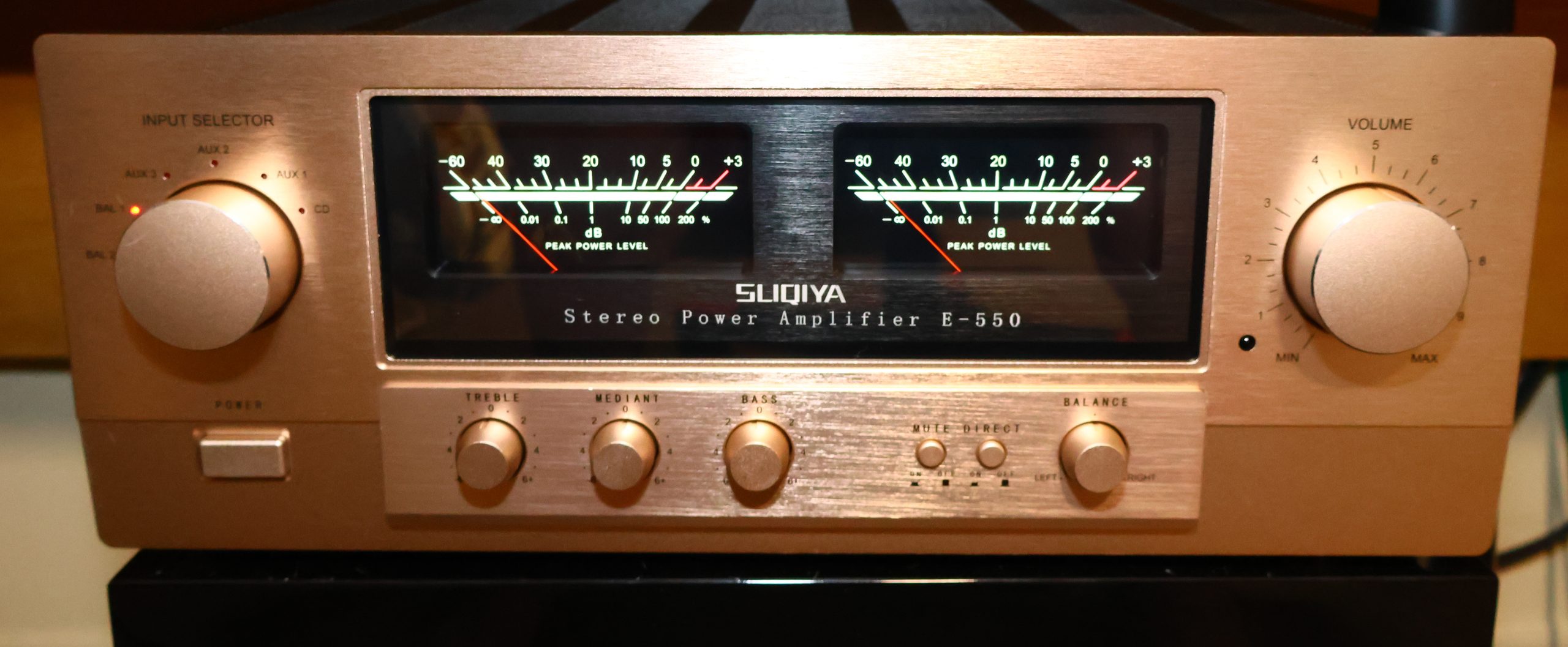

What a strange little amplifier.
I’ve had the Suqiya E-550 on the bench and in the system for a few weeks now, and I still can’t decide whether to be annoyed by it or charmed by it. Both, probably. It arrived in a heavy carton, double-boxed, and when I lifted the lid I actually said “huh” out loud — which in my house counts as a rave.
Let’s start with the claim that hooked everyone: “about 30 watts into pure Class A.” No. Not a chance. Not on this planet, not in this chassis, not at these rails.
Here’s the arithmetic, and it isn’t subtle. Thirty watts into 8 ohms means 2.74 amperes of peak current. For a push-pull output stage to stay in Class A all the way to that peak, each channel must idle at roughly half that — call it 1.37A of standing bias. This amp clips at 31.8V RMS, which is 45V peak, so the rails are sitting somewhere around ±50V. Multiply it out: 50V × 1.37A × two devices ≈ 137 watts of heat per channel, 274 watts for the pair, before the music even starts. A real 30W Class A stereo amp is a space heater with a volume knob. That’s the deal you sign.
The Suqiya draws 19 watts at idle. Total. From the wall. Including the transformer’s no-load loss, the front end, the driver stage, and those cheerful little meter lamps.
Back out the obvious overhead and you’re left with maybe 10 watts across both output stages — call it 5W per channel, which at ±50V rails works out to something on the order of 50mA of bias. Push-pull Class A holds until output current reaches twice the bias, so 100mA peak, which into 8 ohms is about 0.8V peak. That’s roughly forty milliwatts of genuine Class A operation. Forty. Milliwatts. It is a Class A amplifier in exactly the way my car is a race car when I’m pulling out of the driveway.
And before anyone writes in to say it’s simply misbiased from the factory and could be dialed up — it can’t. Look at the heatsinks. Each one measures about 12 × 5 inches with 1.5-inch fins, around 90 cubic inches of extrusion. Natural convection over a finned surface like that gets you somewhere near 0.1 watt per square inch at a 40°C rise, which with realistic fin efficiency lands around 40–50 watts per sink — call it 1°C/W. Two of them, generously, handle maybe 90 watts total. To run real 30W Class A you’d need to shed 274 watts, which demands about 0.3°C/W per channel. That isn’t a heatsink adjustment. That’s a different amplifier, with fans, and possibly a permit.
Which brings me to the name. This is an Accuphase E-550 in the sense that I am Michael Jordan in the sense that we both own shoes.
The real E-550 is a pure Class A design, and it commits to it the way real Class A amplifiers have to: 30 watts per channel into 8 ohms, 60 into 4, 120 into 2, a chassis that weighs around 53 pounds, heatsinking sized to dump a couple hundred watts of continuous heat, and an idle draw that makes your electric meter spin like it’s counting down to something. It uses MOSFET output devices in parallel push-pull. It has Accuphase’s AAVA volume control, which does its attenuation in the current domain with no variable resistance in the signal path at all — genuinely clever engineering, not marketing vapor. And it measures better than 100 dB signal-to-noise, because that’s the entry fee for calling something reference-grade.
Now line that up against what’s sitting on my bench:
The MJ15024s themselves are perfectly respectable 250V TO-3 workhorses — nothing wrong with them, they’ve been building honest amplifiers since the Carter administration. But the listing’s claim that the G suffix denotes “gold-sealed” military selection is my favorite piece of fiction this year. The G is ON Semiconductor’s suffix for lead-free packaging. It means RoHS. It means the solder doesn’t have lead in it. Congratulations on your gold.
So what we have is a competent Class AB bipolar integrated wearing another company’s model number, another company’s operating class, and another company’s spec sheet. Strip all that away and there’s a decent amplifier underneath — which is what makes the costume so irritating. It didn’t need one.
Now the part that actually matters in a listening room: it is not quiet.
Ear 3 feet away from the tweeter, there’s hiss and a low mains-flavored buzz, and — this is the frustrating bit — it’s there on the balanced inputs too, so it isn’t a ground loop I can chase away with a cheater plug and a prayer. The marketing copy promises “purification technology,” “hum-free performance directly from your wall outlet,” and, my favorite, “REFERENCE-LEVEL SILENCE.”
The analyzer disagrees. All measurements were made in Direct Mode and inputs shorted. Signal-to-noise measures about 64 dB, and a no-signal spectrum at the speaker terminals shows a full picket fence of 120Hz-related harmonics marching up past 1kHz, the tallest around −68 dBV, sitting on a broadband floor near −100 dBV. That’s not a noise floor, that’s a xylophone. With nothing plugged in. We are about a factor of a thousand away from the machine whose badge this wears, and the measurement matches exactly what my ears reported from eight feet away.
The rest of the bench work is, honestly, better than I expected.
And the build? Really well built. Thick faceplate, proper chassis work, tidy internal layout, hardware that torques down like it means it. Whoever assembled this took pride in it. Somebody else wrote the ad copy, and I’d like to have a word with them.
So how does it sound? Better than this review has any right to admit.
Transparency is excellent. Genuinely excellent — there’s a clarity through the midrange and lower treble that lets small details through without etching them into the wall behind the speakers. Vocals land solidly in the middle of the stage with real body and no chestiness. Soundstage width is generous; depth is decent if not cavernous. The top end is open and unfussy, maybe a touch dry, but never sharp.
Bass is OK — and OK is the honest word. It goes deep enough and stays tuneful, but the grip isn’t there. On demanding loads it loosens up and the leading edge of a kick drum gets a little rounded. That’s a power supply question, and this supply has clearly been sized for a 19-watt idle rather than for iron-fisted control.
Mids are the highlight. Solid, uncolored, unbothered.
Final verdict
I like this amplifier. I just wish it liked me enough to tell the truth.
Great, honest review with measurements, sans “audiophile” gobbledygook. This “fake” Accuphase clone sounds great, especially for the price. It replaced the Bada Purer 3.3r hybrid int amp I thought sounded good. I recently bought a Naim NAC 152/NAP 200 clone for a desktop system, and I’m impressed. I’ve owned a lot of ChiFi amps in the last 20 years, from the MingDa 300B mono blocks (best amp I’ve ever owned) to a low-priced Dussun int amp to Fosi/SMSL Class D.
I bought it 6 months ago from the AliExpress Suqia store, and the remote did not work. Had to pay $75 in duty to the US. My attempts to remediate: a replacement remote was a bunch of repeated lies; it was shipped.
Cheers
Yeah, it’s hit and miss with these amps. Practically every single one that I got I had to do something about – luckily, in most cases it’s just DC offset and Bias adjustments – easy for me, hard for most people. At this point, I’m ready to give up on that whole adventure. It was an interesting experiment with some very interesting lessons.