One thought on “Sansui AU-11000 Integrated Amplifier”
I did not need another integrated amplifier. Nobody who owns more than three amplifiers needs another one. That’s not how this hobby works, and anyone who tells you otherwise is either lying or married to someone with veto power. But the Sansui AU-11000 has a way of getting past your defenses. It sits there, black-faced and 42 pounds, wearing enough knobs and levers to dock a space capsule, and it dares you not to plug it in.
So I plugged it in. Then I didn’t unplug it for three weeks.
A Little Context
Built from 1975 to 1977, the AU-11000 sat one rung below the mighty AU-20000 in Sansui’s lineup and one above the AU-9900, with which it shares a good deal of circuitry. This was the height of the Japanese amplifier arms race, when engineers, not accountants, still ran the asylum. Lift the lid and it shows: a power transformer that accounts for most of your chiropractor bill, serious filter capacitance, and eight TO-3 output transistors, four per channel, bolted down like they were expected to survive re-entry.
Power output: 110 watts per channel into 8 ohms
THD: 0.08%
Frequency response: 10Hz to 50kHz
Damping factor: 80
Phono stage: discrete, with switchable loading and sensitivity
Tone controls: bass, midrange and treble with selectable turnover points, fully defeatable
Weight: 19 kg (42 lb)
By today’s standards, 0.08% distortion is the kind of number that gets you escorted out of a measurement forum by security. Hold that thought, because it turns out to matter not at all.
One design quirk deserves a mention: the inputs and speaker terminals live on the side panels, not the back. Sansui’s idea was to spare you the flashlight-in-the-teeth crawl behind the rack. In practice, your cables stick out sideways like the amp is wearing water wings. I’ve made my peace with it. Mostly.
The Sound: Where It Gets You
Here’s the thing about the AU-11000: it doesn’t impress you. It seduces you. There’s a difference, and it took me about four minutes to understand it.
The first thing I noticed was the midrange, because it is impossible not to. Voices have body. Not “detail,” not “resolution,” not any of the words we use when we’re really describing a spreadsheet, but actual chest-and-throat body. A singer stands between the speakers as a person rather than as a nicely focused outline of one. Saxophones have reed and brass. A piano has wood in it. There’s a warmth here that owners of later, punchier Sansuis will find almost un-Sansui-like: smoother, a touch lush, closer in spirit to a good push-pull tube amp than to anything else wearing transistors in 1975.
But (and this is what separates it from the merely “warm” vintage gear that sounds like music played through a cardigan) it doesn’t smear. Rhythm stays intact. Bass lines walk instead of shuffle. The low end is full and round, with real weight and, more importantly, real pitch. It is not the iron-fisted, grab-the-woofer-by-the-throat bass of a modern high-current amp, and with a damping factor of 80 nobody should expect it to be. It’s the bass you hear from an actual upright in an actual room: big, slightly bloomy, and completely convincing.
The treble is sweet and relaxed. Cymbals shimmer and decay rather than sizzle and spit. Is it the last word in air and extension? No. Did I care? I’d love to tell you I sat there with a notepad cataloguing the missing top half-octave. What I actually did was listen to four albums in a row and forget to eat dinner.
And then there’s the power. One hundred and ten watts doesn’t sound like much in an age when a class D module the size of a credit card claims five hundred, but these are honest, heavy, well-fed watts. Turn it up and the AU-11000 simply gets bigger. The soundstage widens, the dynamics open up, and that moment where a lesser amp starts to harden and glare never arrives. It stays composed, and it stays sweet.
Which brings me to something I only noticed a week in: I was listening louder than I normally do. Not on purpose, and not to show off. My hand just kept drifting back to that big volume knob, a few more degrees each time, because every nudge was a joy. With most amplifiers there’s a point where your ears quietly ask you to back off. With the Sansui, they kept asking for more. No edge, no fatigue, just more music, more room and a bigger grin. Your neighbors may have opinions, but the amplifier doesn’t flinch.
The phono stage, by the way, is no afterthought. It’s quiet, dynamic and generous, with loading and sensitivity adjustments many modern outboard units skip. That’s all I’ll say on the subject. I have a reputation to protect, and for once I’d like to protect it by showing restraint.
What It Doesn’t Do
Honesty time. A good modern amplifier will dig out more low-level detail, and it will hold the bass in a tighter grip. If you listen to equipment rather than through it, the Sansui will leave you wanting more “more.”
It is also fifty years old. A neglected AU-11000 sounds like tired capacitors and scratchy switches, which is to say flat, hazy and nothing like what I’ve described. Budget for a proper service, or buy one that’s had it. This is not optional, any more than tires are optional on a vintage Porsche.
Final Verdict
Loved: gorgeous, full-bodied midrange; sweet, fatigue-free treble; big, tuneful bass; effortless power; superb phono stage; build quality from a more civilized age
Didn’t love: not the last word in detail or bass grip; side-mounted connections; needs a proper restoration to show what it can do; prices that keep climbing
The Sansui AU-11000 is not the most accurate amplifier I’ve had on the rack. It’s not the most transparent, the most powerful or the most anything, really, except the one that kept me in the chair longest. It reminds you that the point of all this hardware is the music, and it does so without lecturing you about it.
If you want an amplifier to analyze, look elsewhere. If you want one to listen to, find a good AU-11000, have it serviced, and cancel your evening plans. Highly recommended, with the usual warning: I didn’t need another amplifier either.
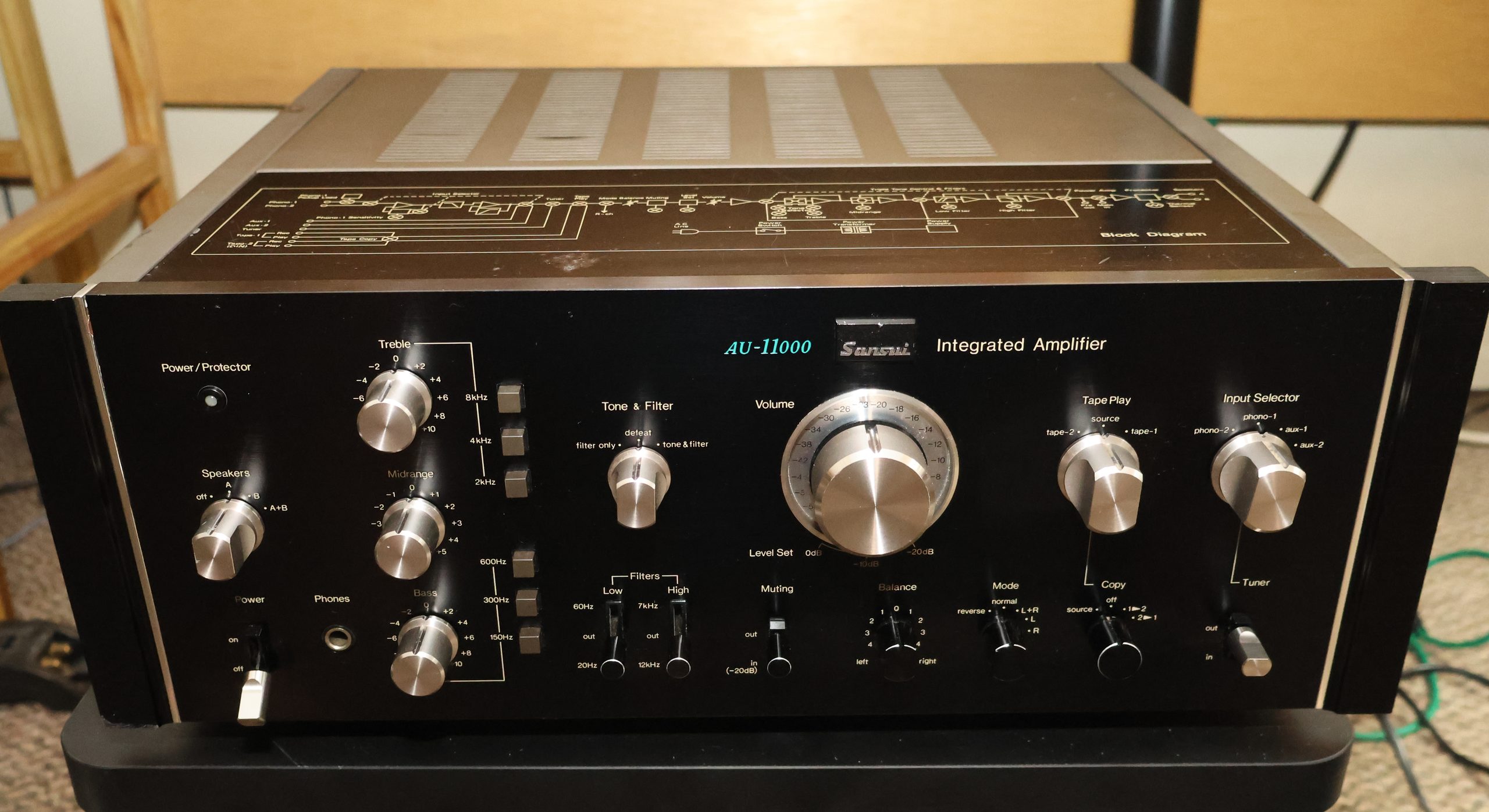

I did not need another integrated amplifier. Nobody who owns more than three amplifiers needs another one. That’s not how this hobby works, and anyone who tells you otherwise is either lying or married to someone with veto power. But the Sansui AU-11000 has a way of getting past your defenses. It sits there, black-faced and 42 pounds, wearing enough knobs and levers to dock a space capsule, and it dares you not to plug it in.
So I plugged it in. Then I didn’t unplug it for three weeks.
A Little Context
Built from 1975 to 1977, the AU-11000 sat one rung below the mighty AU-20000 in Sansui’s lineup and one above the AU-9900, with which it shares a good deal of circuitry. This was the height of the Japanese amplifier arms race, when engineers, not accountants, still ran the asylum. Lift the lid and it shows: a power transformer that accounts for most of your chiropractor bill, serious filter capacitance, and eight TO-3 output transistors, four per channel, bolted down like they were expected to survive re-entry.
By today’s standards, 0.08% distortion is the kind of number that gets you escorted out of a measurement forum by security. Hold that thought, because it turns out to matter not at all.
One design quirk deserves a mention: the inputs and speaker terminals live on the side panels, not the back. Sansui’s idea was to spare you the flashlight-in-the-teeth crawl behind the rack. In practice, your cables stick out sideways like the amp is wearing water wings. I’ve made my peace with it. Mostly.
The Sound: Where It Gets You
Here’s the thing about the AU-11000: it doesn’t impress you. It seduces you. There’s a difference, and it took me about four minutes to understand it.
The first thing I noticed was the midrange, because it is impossible not to. Voices have body. Not “detail,” not “resolution,” not any of the words we use when we’re really describing a spreadsheet, but actual chest-and-throat body. A singer stands between the speakers as a person rather than as a nicely focused outline of one. Saxophones have reed and brass. A piano has wood in it. There’s a warmth here that owners of later, punchier Sansuis will find almost un-Sansui-like: smoother, a touch lush, closer in spirit to a good push-pull tube amp than to anything else wearing transistors in 1975.
But (and this is what separates it from the merely “warm” vintage gear that sounds like music played through a cardigan) it doesn’t smear. Rhythm stays intact. Bass lines walk instead of shuffle. The low end is full and round, with real weight and, more importantly, real pitch. It is not the iron-fisted, grab-the-woofer-by-the-throat bass of a modern high-current amp, and with a damping factor of 80 nobody should expect it to be. It’s the bass you hear from an actual upright in an actual room: big, slightly bloomy, and completely convincing.
The treble is sweet and relaxed. Cymbals shimmer and decay rather than sizzle and spit. Is it the last word in air and extension? No. Did I care? I’d love to tell you I sat there with a notepad cataloguing the missing top half-octave. What I actually did was listen to four albums in a row and forget to eat dinner.
And then there’s the power. One hundred and ten watts doesn’t sound like much in an age when a class D module the size of a credit card claims five hundred, but these are honest, heavy, well-fed watts. Turn it up and the AU-11000 simply gets bigger. The soundstage widens, the dynamics open up, and that moment where a lesser amp starts to harden and glare never arrives. It stays composed, and it stays sweet.
Which brings me to something I only noticed a week in: I was listening louder than I normally do. Not on purpose, and not to show off. My hand just kept drifting back to that big volume knob, a few more degrees each time, because every nudge was a joy. With most amplifiers there’s a point where your ears quietly ask you to back off. With the Sansui, they kept asking for more. No edge, no fatigue, just more music, more room and a bigger grin. Your neighbors may have opinions, but the amplifier doesn’t flinch.
The phono stage, by the way, is no afterthought. It’s quiet, dynamic and generous, with loading and sensitivity adjustments many modern outboard units skip. That’s all I’ll say on the subject. I have a reputation to protect, and for once I’d like to protect it by showing restraint.
What It Doesn’t Do
Honesty time. A good modern amplifier will dig out more low-level detail, and it will hold the bass in a tighter grip. If you listen to equipment rather than through it, the Sansui will leave you wanting more “more.”
It is also fifty years old. A neglected AU-11000 sounds like tired capacitors and scratchy switches, which is to say flat, hazy and nothing like what I’ve described. Budget for a proper service, or buy one that’s had it. This is not optional, any more than tires are optional on a vintage Porsche.
Final Verdict
The Sansui AU-11000 is not the most accurate amplifier I’ve had on the rack. It’s not the most transparent, the most powerful or the most anything, really, except the one that kept me in the chair longest. It reminds you that the point of all this hardware is the music, and it does so without lecturing you about it.
If you want an amplifier to analyze, look elsewhere. If you want one to listen to, find a good AU-11000, have it serviced, and cancel your evening plans. Highly recommended, with the usual warning: I didn’t need another amplifier either.