
The EIA code is usually followed by a four-digit date code in a year-year-week-week format. For example, 322 6104-1 means Tung-Sol (322), made in 1961 (61), week 4 (04). The trailing digit after the dash is a shift or line code and doesn’t affect the date. On a tube marked 274 5823, read it as RCA, 1958, week 23. From around 1960 on, some makers switched to coded letter dates (for example KE 188-5 on GE tubes). These are harder to decode, but the EIA number next to them still tells you the maker.
No code doesn’t mean fake. RCA is a good example. RCA usually left its 274 code off tubes sold under its own name, but stamped 274 on tubes it made for other brands, including Sylvania and GE. So an RCA-labeled tube with only a date code can be perfectly genuine, and a Sylvania- or GE-labeled tube with 274 on it was made by RCA. GE, by contrast, did put 188 on its own tubes.
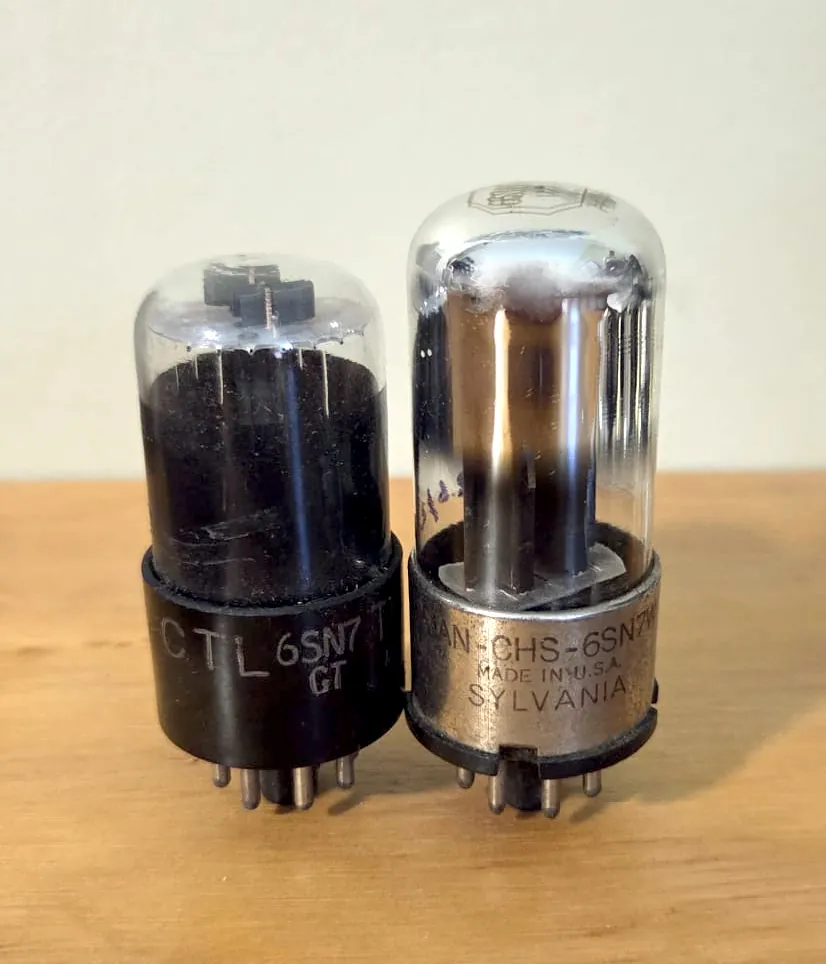
Military JAN prefixes. Tubes made for the US military often carry a JAN marking with a maker prefix, written as JAN-[prefix]-[tube type], for example JAN-CTL-6SN7GT or JAN-CRC-6AS7G. The prefix identifies the factory even when the brand printing has worn off. On small tubes the prefix is often shortened to a J plus the last letters (JG, JRP, JTL and so on).
| prefix | Maker |
|---|---|
| CRC / JRC | RCA |
| CG / CGE / JG | General Electric |
| CHS | Sylvania |
| CTL / JTL | Tung-Sol |
| CRP | Raytheon |
| CHY / JHY | Hytron / CBS-Hytron |
| CW | Western Electric |
| CWL / JWL | Westinghouse |
| CKR | Ken-Rad |
| CNU | National Union |
| COZ / JOZ | Sonotone |
| CEP | Amperex |
| CFT | Federal (ITT) |
| CEL | Electrons, Inc. |
| CNY | North American Philips (Norelco) |
Maker prefixes in the tube type. Some manufacturers added their own letters in front of the tube number, which is another way to spot the real maker:
- CK, RK = Raytheon (for example CK5654, RK-34)
- GL = General Electric (US GE, not British GEC)
- F = Federal Telephone and Radio (ITT)
- HY = Hytron
- ML = Machlett
- ECG = Philips/Sylvania replacement line (a rebrand, not a factory)
Why some tubes have no code at all. Many tubes were bought from the big factories and resold under another name, and the resellers often removed the maker’s codes. Common examples are IEC, United, Ultron and post-1950s Arcturus. United in particular relabeled Tung-Sol, RCA, Sylvania and GE stock, and its own printed numbers say nothing about where or when the tube was made. In those cases, look for any original factory code that survived. If there is none, the internal construction is the best guide: plate shape, getter, micas and the shape of the glass tip.