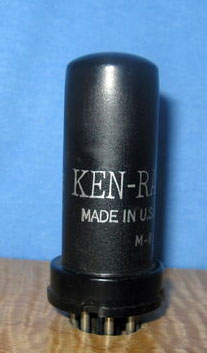
The Ken-Rad 6N7 Metal Jacket proved to be a bit of a disappointment, especially following the impressive performance of the National Union version. The soundstage was noticeably smaller than the NU, but the most significant issue was a persistent harshness in the upper frequencies. It felt as though the top end was over-extended, yet it lacked any sense of sweetness or refinement.
While this tube might perform adequately in strictly vintage gear with original, softer-sounding capacitors, it struggles in a modern context. Since most enthusiasts now swap out old components for new, high-quality capacitors—which provide a more transparent sound with better top-end extension—this Ken-Rad variant may come across as too aggressive. It simply might not work well in the majority of modern or refurbished amplifiers.
Metal Jacket Tubes
Metal jacket tubes like this 6N7 were an interesting step in vacuum tube evolution, but they come with a distinct set of trade-offs:
Pros:
Superior Shielding: The metal envelope acts as a built-in Faraday cage, which is excellent for reducing RFI (Radio Frequency Interference) and hum, making them technically “quieter” in electrically noisy environments.
Durability: These tubes are physically much tougher than glass, making them ideal for the military and industrial applications they were originally designed for.
Lower Microphonics: Because the internal structures are often better supported within the opaque shell, metal tubes can sometimes be less prone to mechanical vibration and ringing.
Cons:
Heat Dissipation: Metal shells tend to run extremely hot to the touch and don’t always dissipate internal heat as efficiently as glass, which can lead to a shorter lifespan in poorly ventilated chassis.
“Blind” Diagnostics: Unlike glass tubes, you cannot see the heater glow or check for internal sparking or gas (blue glow), making it harder to troubleshoot a failing tube.
Sonic “Dryness”: Many audiophiles argue that metal tubes lack the harmonic “sweetness” and holographic air found in glass equivalents, often sounding more clinical or, in the case of this Ken-Rad, potentially harsh.
Final Verdict
The Ken-Rad 6N7 Metal Jacket is a tough but unrefined performer. While its metal construction offers excellent shielding, its lack of top-end sweetness and somewhat compressed soundstage make it a difficult recommendation for transparent, modern systems. Unless you are specifically trying to tame a very dark vintage amplifier, there are better 6N7 options available.
I’m currently making a single-ended amplifier using the 6N7 as a driver tube. I’ll be curious to hear the differences between the RCA and GE metal 6N7s in my stash. I’ve heard various theories on why glass versions of the same tube sound better, so this is also another area to experiment with.



 Loading...
The Ken-Rad 6N7 Metal Jacket proved to be a bit of a disappointment, especially following the impressive performance of the National Union version. The soundstage was noticeably smaller than the NU, but the most significant issue was a persistent harshness in the upper frequencies. It felt as though the top end was over-extended, yet it lacked any sense of sweetness or refinement.
While this tube might perform adequately in strictly vintage gear with original, softer-sounding capacitors, it struggles in a modern context. Since most enthusiasts now swap out old components for new, high-quality capacitors—which provide a more transparent sound with better top-end extension—this Ken-Rad variant may come across as too aggressive. It simply might not work well in the majority of modern or refurbished amplifiers.
Metal Jacket Tubes
Metal jacket tubes like this 6N7 were an interesting step in vacuum tube evolution, but they come with a distinct set of trade-offs:
Pros:
Superior Shielding: The metal envelope acts as a built-in Faraday cage, which is excellent for reducing RFI (Radio Frequency Interference) and hum, making them technically “quieter” in electrically noisy environments.
Durability: These tubes are physically much tougher than glass, making them ideal for the military and industrial applications they were originally designed for.
Lower Microphonics: Because the internal structures are often better supported within the opaque shell, metal tubes can sometimes be less prone to mechanical vibration and ringing.
Cons:
Heat Dissipation: Metal shells tend to run extremely hot to the touch and don’t always dissipate internal heat as efficiently as glass, which can lead to a shorter lifespan in poorly ventilated chassis.
“Blind” Diagnostics: Unlike glass tubes, you cannot see the heater glow or check for internal sparking or gas (blue glow), making it harder to troubleshoot a failing tube.
Sonic “Dryness”: Many audiophiles argue that metal tubes lack the harmonic “sweetness” and holographic air found in glass equivalents, often sounding more clinical or, in the case of this Ken-Rad, potentially harsh.
Final Verdict
The Ken-Rad 6N7 Metal Jacket is a tough but unrefined performer. While its metal construction offers excellent shielding, its lack of top-end sweetness and somewhat compressed soundstage make it a difficult recommendation for transparent, modern systems. Unless you are specifically trying to tame a very dark vintage amplifier, there are better 6N7 options available.
I’m currently making a single-ended amplifier using the 6N7 as a driver tube. I’ll be curious to hear the differences between the RCA and GE metal 6N7s in my stash. I’ve heard various theories on why glass versions of the same tube sound better, so this is also another area to experiment with.