“A very nice sounding tube. Brilliant midrange, good bass extension, and a little rolled-off on top.” Read
“…the tube wasn’t so much slowing things down as it was taking its own sweet time to show you all it had on offer.” Read
Share this post:
6 thoughts on “Sylvania JHS 5814 Gray Plates”
After spending some quality time with the Sylvania JHS 5814 Gray Plates, I am left with one word: WOW. Whether I was running it through a Bottlehead Crack or comparing it against high-end alternatives, this tube consistently delivered an experience that felt less like listening to a recording and more like witnessing a live performance.
The first thing that strikes you is the sheer musicality. During Kari Bremnes’ “Lover in Berlin,” the melody was nothing short of magical; it has a way of making the singer feel physically present in the room. This isn’t just a tube that offers slightly better bass or more extended high frequencies—it fundamentally revoices the sound into something more involving. Even with complex orchestral pieces like Mozart’s Symphony 41, the delicacy of the violins remains intact while the bass “slam” provides a satisfying foundation that rivals much more expensive glass.
When pitted against the legendary RCA 5692 Red Base (1948), the Sylvania remarkably held its own. While it might not match the RCA’s massive slam, it actually surpasses it in finesse and detail. It creates a specific type of sonic magic similar to the Sylvania JHS 5751, but with its own unique character. For roughly $10 a tube, the performance-to-price ratio is absolutely ridiculous.
Brand History: JHS vs. Gold Brand
You will often see Sylvania tubes marked with JHS or branded as Gold Brand. The JHS designation stands for “Jan-Hytron-Sylvania” (or simply a Joint Army-Navy Sylvania designation), indicating these were military-spec tubes built for ruggedness, longevity, and low noise in demanding environments. In contrast, the Gold Brand was Sylvania’s premium commercial line, marketed to audiophiles and professional broadcasters. These were hand-selected for superior electrical specifications and often featured gold pins, representing the “best of the best” for high-fidelity home audio rather than battlefield durability.
Final Verdict
The Sylvania JHS 5814 is a hidden gem in the world of vacuum tubes. It offers a liquid, involving midrange and surprising low-end authority that puts many “industrial” sounding premium tubes to shame. If you find these at current market prices, buy them immediately before the rest of the audiophile world catches on. It is a must-try tube for anyone looking to add a touch of magic to their system.
I haven’t posted in a while, but I’ve continued to roll tubes. Also getting into 12ax7’s. I have trouble disagreeing with Nick’s assessments. This particular Sylvania 5814 is incredible. It put the 50’s Long Plate Foil Getter Amperex’s to shame – made them sound “industrial” and without sonic character.
I wouldn’t call these tonally accurate, but a voicing that’s very pleasing and difficult to describe. Very involving mid-range that’s liquid, but still easy to watch and follow (not the “floating haze” that Mullards can give). Detail is on par with the best I’ve heard. Very strong bass —“Wow, I didn’t know my speakers could produce that much bass”. I’ve read people saying they have rolled-off highs, but I get good extension out of the 803D’s. Would recommend with any kind of music. Ambient music is a real treat with these.
Are these attributes valid for both the square getter and ring getter versions? The ring getter can be found (cheaply also), but that’s not true for the square getter, which I can’t find
Thanks! Good to know.
By the way.. It’s not that I thought that a different getter structure itself could be that relevant soundwise 🙂 It’s just that I’ve read on the net, and also with regard to the 5814a, that older 50’s Sylvania (the square getter years) production was of a higher quality.
Haha. Totally understand. And you are right, some tubes, depending on getter (just showing different production run), can sound different – not in this case though.
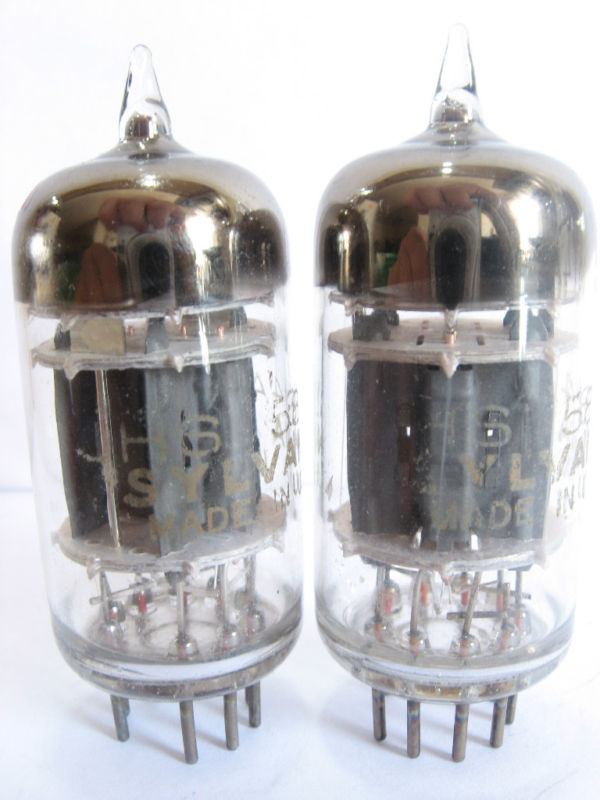

After spending some quality time with the Sylvania JHS 5814 Gray Plates, I am left with one word: WOW. Whether I was running it through a Bottlehead Crack or comparing it against high-end alternatives, this tube consistently delivered an experience that felt less like listening to a recording and more like witnessing a live performance.
The first thing that strikes you is the sheer musicality. During Kari Bremnes’ “Lover in Berlin,” the melody was nothing short of magical; it has a way of making the singer feel physically present in the room. This isn’t just a tube that offers slightly better bass or more extended high frequencies—it fundamentally revoices the sound into something more involving. Even with complex orchestral pieces like Mozart’s Symphony 41, the delicacy of the violins remains intact while the bass “slam” provides a satisfying foundation that rivals much more expensive glass.
When pitted against the legendary RCA 5692 Red Base (1948), the Sylvania remarkably held its own. While it might not match the RCA’s massive slam, it actually surpasses it in finesse and detail. It creates a specific type of sonic magic similar to the Sylvania JHS 5751, but with its own unique character. For roughly $10 a tube, the performance-to-price ratio is absolutely ridiculous.
Brand History: JHS vs. Gold Brand
You will often see Sylvania tubes marked with JHS or branded as Gold Brand. The JHS designation stands for “Jan-Hytron-Sylvania” (or simply a Joint Army-Navy Sylvania designation), indicating these were military-spec tubes built for ruggedness, longevity, and low noise in demanding environments. In contrast, the Gold Brand was Sylvania’s premium commercial line, marketed to audiophiles and professional broadcasters. These were hand-selected for superior electrical specifications and often featured gold pins, representing the “best of the best” for high-fidelity home audio rather than battlefield durability.
Final Verdict
The Sylvania JHS 5814 is a hidden gem in the world of vacuum tubes. It offers a liquid, involving midrange and surprising low-end authority that puts many “industrial” sounding premium tubes to shame. If you find these at current market prices, buy them immediately before the rest of the audiophile world catches on. It is a must-try tube for anyone looking to add a touch of magic to their system.
I haven’t posted in a while, but I’ve continued to roll tubes. Also getting into 12ax7’s. I have trouble disagreeing with Nick’s assessments. This particular Sylvania 5814 is incredible. It put the 50’s Long Plate Foil Getter Amperex’s to shame – made them sound “industrial” and without sonic character.
I wouldn’t call these tonally accurate, but a voicing that’s very pleasing and difficult to describe. Very involving mid-range that’s liquid, but still easy to watch and follow (not the “floating haze” that Mullards can give). Detail is on par with the best I’ve heard. Very strong bass —“Wow, I didn’t know my speakers could produce that much bass”. I’ve read people saying they have rolled-off highs, but I get good extension out of the 803D’s. Would recommend with any kind of music. Ambient music is a real treat with these.
Are these attributes valid for both the square getter and ring getter versions? The ring getter can be found (cheaply also), but that’s not true for the square getter, which I can’t find
Yep, the sound will be identical with different getters.
Thanks! Good to know.
By the way.. It’s not that I thought that a different getter structure itself could be that relevant soundwise 🙂 It’s just that I’ve read on the net, and also with regard to the 5814a, that older 50’s Sylvania (the square getter years) production was of a higher quality.
Haha. Totally understand. And you are right, some tubes, depending on getter (just showing different production run), can sound different – not in this case though.