“Sylvania 6SN7W has strong bass and is full, but I wouldn’t say it’s romantic or warm…” Read
“the metal base tall bottle is far superior in nearly every category..” Read
Share this post:
2 thoughts on “Sylvania CHS 6SN7W Metal Base”
The Sylvania CHS 6SN7W Metal Base stands as a titan in the world of vacuum tubes, often mentioned in the same breath as the legendary Tung-Sol round plates. Unlike the lush, “romantic” house sound associated with Sylvania’s production runs in the 1950s and 60s, this 1940s-era specimen is a different beast entirely. It trades liquid warmth for sheer transparency and explosive dynamics.
Where many Sylvania tubes are criticized for having “just okay” low-end response, the metal base 6SN7W kicks the bass into high gear with deep, structured, and authoritative impact. The high frequencies are equally impressive, offering an extended top-end that breathes life into every recording. Perhaps its most striking feature is the soundstage; it creates a “where-did-my-speakers-go” sense of space that mimics the clarity of a Type 27 or 6J5 triode. While its honest, uncolored presentation might not suit every listener, in the right system, it simply brings out the absolute best in the music.
History of 6SN7 Military Tubes
The 6SN7 family owes much of its legendary status to the rigorous demands of World War II. Originally released in 1941 as a glass-envelope version of the 6F8G, the tube quickly became a staple for military applications, particularly in radar systems, early computers, and radio equipment.
The “W” designation (as seen in the 6SN7W) signifies a ruggedized military specification. These tubes were built to withstand extreme vibration and mechanical shock—essential for shipboard or aircraft use. The “CHS” prefix specifically denotes Sylvania’s production for the U.S. Navy. During the 1940s, Sylvania experimented with various structural reinforcements, leading to the sought-after metal base design, which provided superior shielding and physical durability compared to the later phenolic (plastic) bases. These military-grade variants were manufactured with tighter tolerances and higher-grade materials than their civilian counterparts, which is why audiophiles today still hunt for these vintage “warrior” tubes for their superior sonic longevity and stability.
Final Verdict
The Sylvania 6SN7W Metal Base is a masterclass in 1940s engineering. If you value surgical precision, deep bass, and a holographic soundstage over vintage “syrup,” this is arguably the finest 6SN7 ever made. Just be prepared for its honesty—it will reveal the strengths (and flaws) of your entire signal chain.
I love and hate this tube. It has incredible sound, but very poor reliability. I went through 3 of them now. they just fail after a while. at the asking price I cry when it fails, but have to get more.
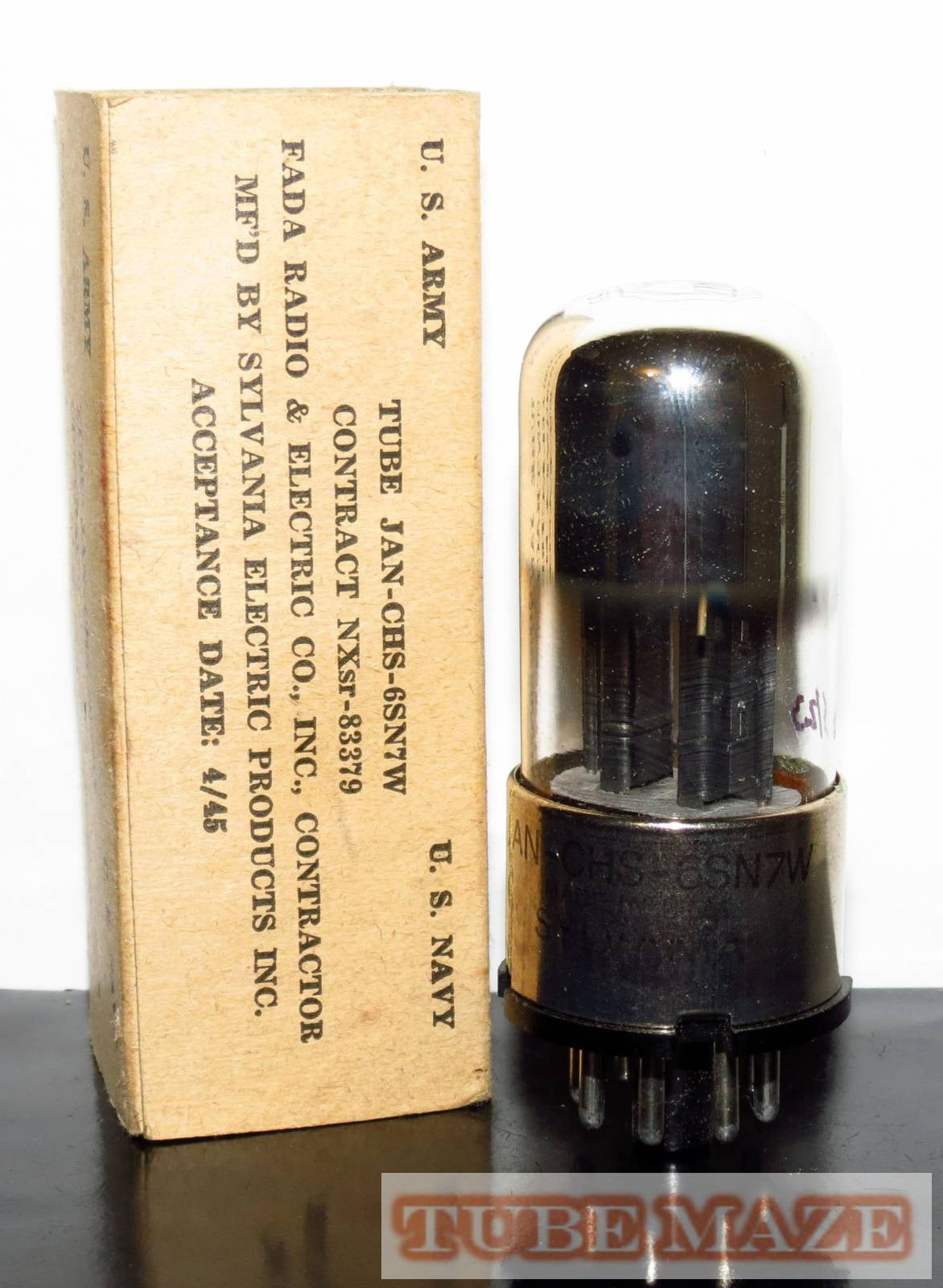

The Sylvania CHS 6SN7W Metal Base stands as a titan in the world of vacuum tubes, often mentioned in the same breath as the legendary Tung-Sol round plates. Unlike the lush, “romantic” house sound associated with Sylvania’s production runs in the 1950s and 60s, this 1940s-era specimen is a different beast entirely. It trades liquid warmth for sheer transparency and explosive dynamics.
Where many Sylvania tubes are criticized for having “just okay” low-end response, the metal base 6SN7W kicks the bass into high gear with deep, structured, and authoritative impact. The high frequencies are equally impressive, offering an extended top-end that breathes life into every recording. Perhaps its most striking feature is the soundstage; it creates a “where-did-my-speakers-go” sense of space that mimics the clarity of a Type 27 or 6J5 triode. While its honest, uncolored presentation might not suit every listener, in the right system, it simply brings out the absolute best in the music.
History of 6SN7 Military Tubes
The 6SN7 family owes much of its legendary status to the rigorous demands of World War II. Originally released in 1941 as a glass-envelope version of the 6F8G, the tube quickly became a staple for military applications, particularly in radar systems, early computers, and radio equipment.
The “W” designation (as seen in the 6SN7W) signifies a ruggedized military specification. These tubes were built to withstand extreme vibration and mechanical shock—essential for shipboard or aircraft use. The “CHS” prefix specifically denotes Sylvania’s production for the U.S. Navy. During the 1940s, Sylvania experimented with various structural reinforcements, leading to the sought-after metal base design, which provided superior shielding and physical durability compared to the later phenolic (plastic) bases. These military-grade variants were manufactured with tighter tolerances and higher-grade materials than their civilian counterparts, which is why audiophiles today still hunt for these vintage “warrior” tubes for their superior sonic longevity and stability.
Final Verdict
The Sylvania 6SN7W Metal Base is a masterclass in 1940s engineering. If you value surgical precision, deep bass, and a holographic soundstage over vintage “syrup,” this is arguably the finest 6SN7 ever made. Just be prepared for its honesty—it will reveal the strengths (and flaws) of your entire signal chain.
I love and hate this tube. It has incredible sound, but very poor reliability. I went through 3 of them now. they just fail after a while. at the asking price I cry when it fails, but have to get more.