
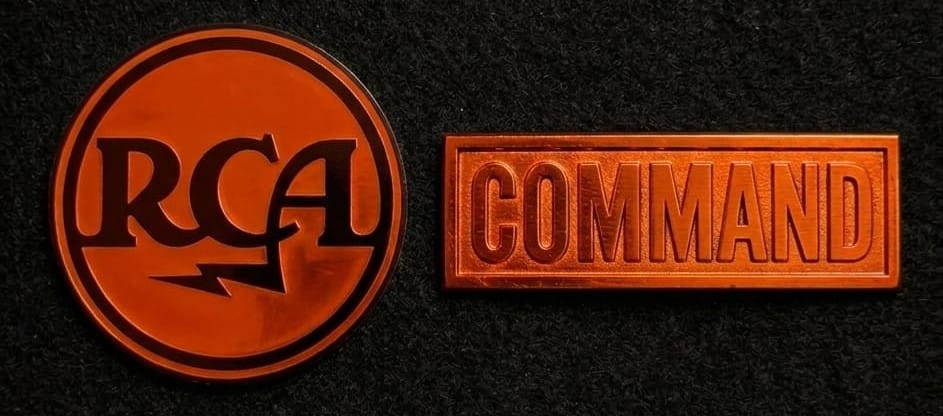
The RCA Command series is widely regarded by audiophiles as one of the very best vacuum tubes created in the USA. Positioned as the ultra-premium alternative to standard consumer and military stock, these tubes were built to maintain critical performance in the most demanding broadcast and industrial environments.
Historical Context and Development
Launched in the mid-1950s, the Command Series was RCA’s elite answer to GE’s 5-Star and Sylvania’s Gold Brand. While standard tubes were mass-produced for home radio and television, the Command line was developed specifically for “critical-use” applications where failure was not an option—namely aviation, mobile communications, and professional broadcasting.
Unlike standard tubes, which were often pulled from regular production lines via testing (screening), RCA Command tubes were manufactured under specialized conditions to meet a much higher standard of durability and electrical consistency.
Technical Innovations and Engineering
What sets the Command series apart from standard RCA tubes is not just the testing, but the physical reinforcement of the internal structure. Key architectural highlights include:
- Longevity: Often rated for 10,000+ hours of service.
- Extra-Ruggedized Construction: Designed to withstand high mechanical shock and vibration (often exceeding standard military specs), making them virtually immune to the microphonics that plague lesser tubes.
- High-Purity Materials: Use of premium cathode coatings and black-plate materials (in early versions) provided superior heat dissipation and reduced “gassing,” which extended the functional life of the tube far beyond the industry average.
- Strict Tolerance Matching: Command tubes were held to incredibly tight tolerances for transconductance ($G_m$) and plate current. This ensures that a Command tube performs exactly like its datasheet, making them the “gold standard” for balanced circuits.
How to Identify RCA Command Tubes
Identifying a genuine RCA Command series tube requires looking for specific physical markings and construction details. Because these were premium industrial versions of standard tubes, RCA used distinct labeling and structural cues to separate them from the consumer-grade “Silver Tone” or standard “Red Logo” stock.
The “Command” Branding and Logo
The most obvious identifier is the branding on the glass envelope. RCA didn’t use any special prefix to differentiate Command tubes.
- The “Command” Text: Most authentic units will have the word “Command” printed clearly in a block font, usually in orange/red ink
- Extra Support Rods: If you look closely at the “cage” inside the glass, Command tubes often have thicker or additional support rods welded to the micas to ensure the elements don’t shift during high-impact use (like in an aircraft).
- Only Double Mica Spacers: Tubes in this series, such as the RCA 5751 Command, didn’t utilized an extra mica (Third Mica) spacer at the top.
- No Gold Pins: RCA Command tubes didn’t use gold pins.
Conclusion
The RCA Command series remains a top choice for audiophiles who value a “clean, authoritative, and quiet” sound. While Sylvania Gold Brands are often praised for their detail and “air,” RCA Command tubes are celebrated for their legendary midrange warmth and rock-solid reliability. They represent the final evolution of the vacuum tube before the semiconductor era took hold.
Common RCA Command Series Tubes
The Command series didn’t used a specific numbering system, often using standard four-digit “Premium” designations rather than the standard consumer codes.
| Command Number | Common Equivalent |
| 5670 | 2C51 |
| 5654 | 6AK5 |
| 5751 | 12AX7 |
| 5814A | 12AU7 |
| 6005 | 6AQ5 |
| 6136 | 6AU6 |
| 6189 | 12AU7WA |
| 6201 | 12AT7 |
| 6681 | 12AX7 |