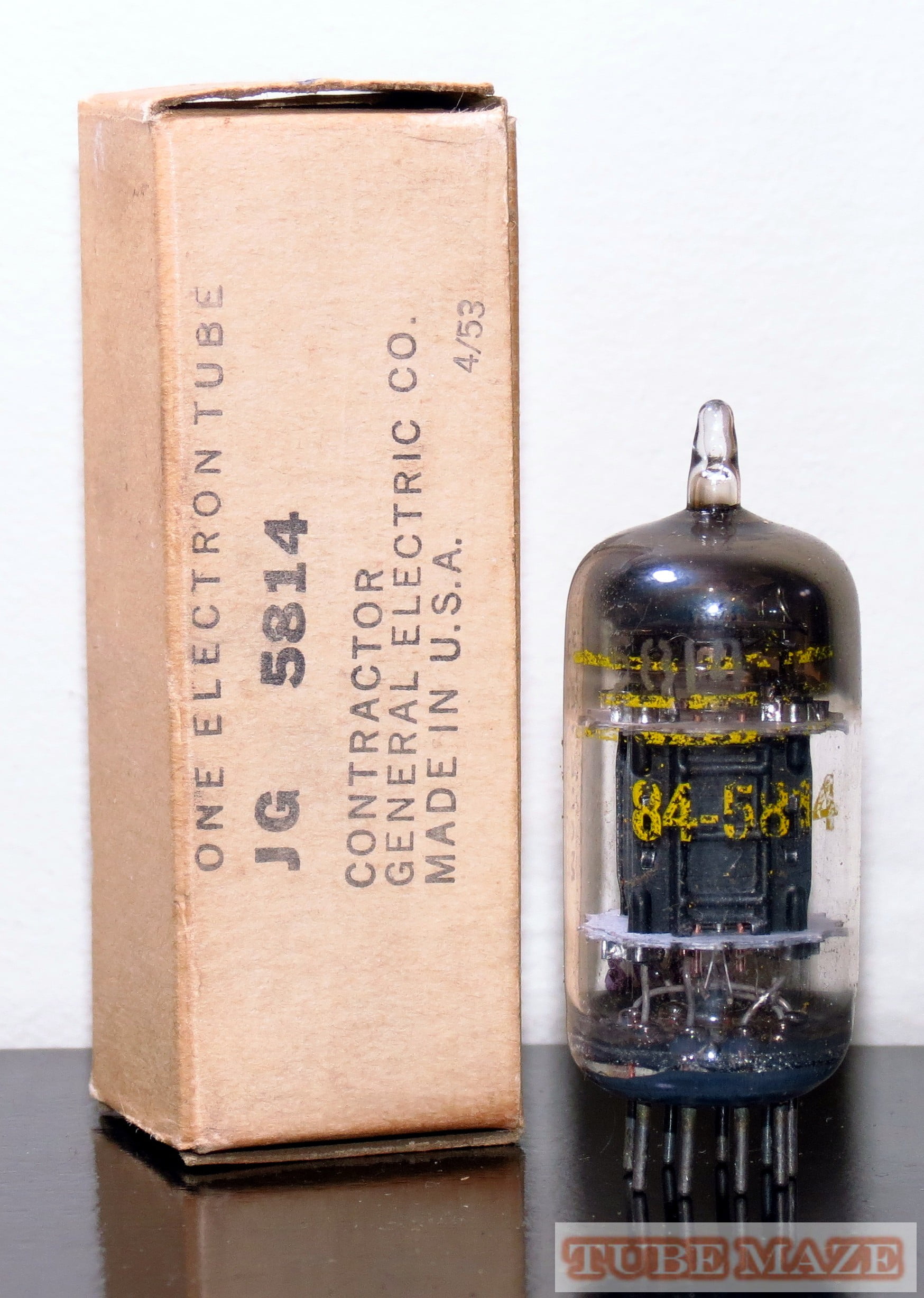
This particular GE JG-5814 is an incredibly rare find, likely produced during the narrow transitionary period between 1952 and 1953. Before this window, all 5814 production featured carbon plates. Moving into late 1953, GE shifted toward the more common triple mica construction with shiny black plates. This “Black Flat Plate” variant represents the best of both worlds.
An interesting detail on this specific batch is the 84V stamp found on both the glass and the original box. While official documentation on this code is scarce, it almost certainly denotes a selected tube—screened for specific tight tolerances or low noise for a high-priority contract.
The 5814 Heritage: Military & Industrial Strength
The 5814 was never intended for your average tabletop radio. It was developed as a “Special Quality” or premium industrial version of the standard 12AU7/ECC82. Its history is rooted in demanding environments:
Military Reliability: Developed for the Joint Army-Navy (JAN) specifications (often designated as JG-5814), these tubes were built to withstand extreme vibration, mechanical shock, and frequent on-off cycling.
Industrial Computing: Before the transistor, 5814s were used in early digital computers and instrumentation where consistency and longevity were non-negotiable.
Long-Life Design: Unlike consumer tubes, the 5814 features a more robust heater and reinforced internal structures, often rated for thousands of hours of stable operation.
Sound Performance
Sound-wise, this tube is virtually identical to the highly coveted carbon plate 5814s originally produced by Ken-Rad and later by GE. It delivers a superb, rich tonality that is difficult to match in modern production. It provides a deep, textured soundstage while maintaining the rugged electrical stability of a military-grade component.
Final Verdict: If you find a pair of these “Transition” GE 5814s, grab them. They offer the legendary Ken-Rad sound signature with the added historical intrigue of a rare, selected-grade military production.
Sound-wise, the tube is identical to the carbon plates 5814, which is a superb sounding 5814 and was produced first by Ken-Rad and later by GE.


 (34 votes, average: 4.12 out of 5)
 Loading...
This particular GE JG-5814 is an incredibly rare find, likely produced during the narrow transitionary period between 1952 and 1953. Before this window, all 5814 production featured carbon plates. Moving into late 1953, GE shifted toward the more common triple mica construction with shiny black plates. This “Black Flat Plate” variant represents the best of both worlds.
An interesting detail on this specific batch is the 84V stamp found on both the glass and the original box. While official documentation on this code is scarce, it almost certainly denotes a selected tube—screened for specific tight tolerances or low noise for a high-priority contract.
The 5814 Heritage: Military & Industrial Strength
The 5814 was never intended for your average tabletop radio. It was developed as a “Special Quality” or premium industrial version of the standard 12AU7/ECC82. Its history is rooted in demanding environments:
Sound Performance
Sound-wise, this tube is virtually identical to the highly coveted carbon plate 5814s originally produced by Ken-Rad and later by GE. It delivers a superb, rich tonality that is difficult to match in modern production. It provides a deep, textured soundstage while maintaining the rugged electrical stability of a military-grade component.
Final Verdict: If you find a pair of these “Transition” GE 5814s, grab them. They offer the legendary Ken-Rad sound signature with the added historical intrigue of a rare, selected-grade military production.
Sound-wise, the tube is identical to the carbon plates 5814, which is a superb sounding 5814 and was produced first by Ken-Rad and later by GE.