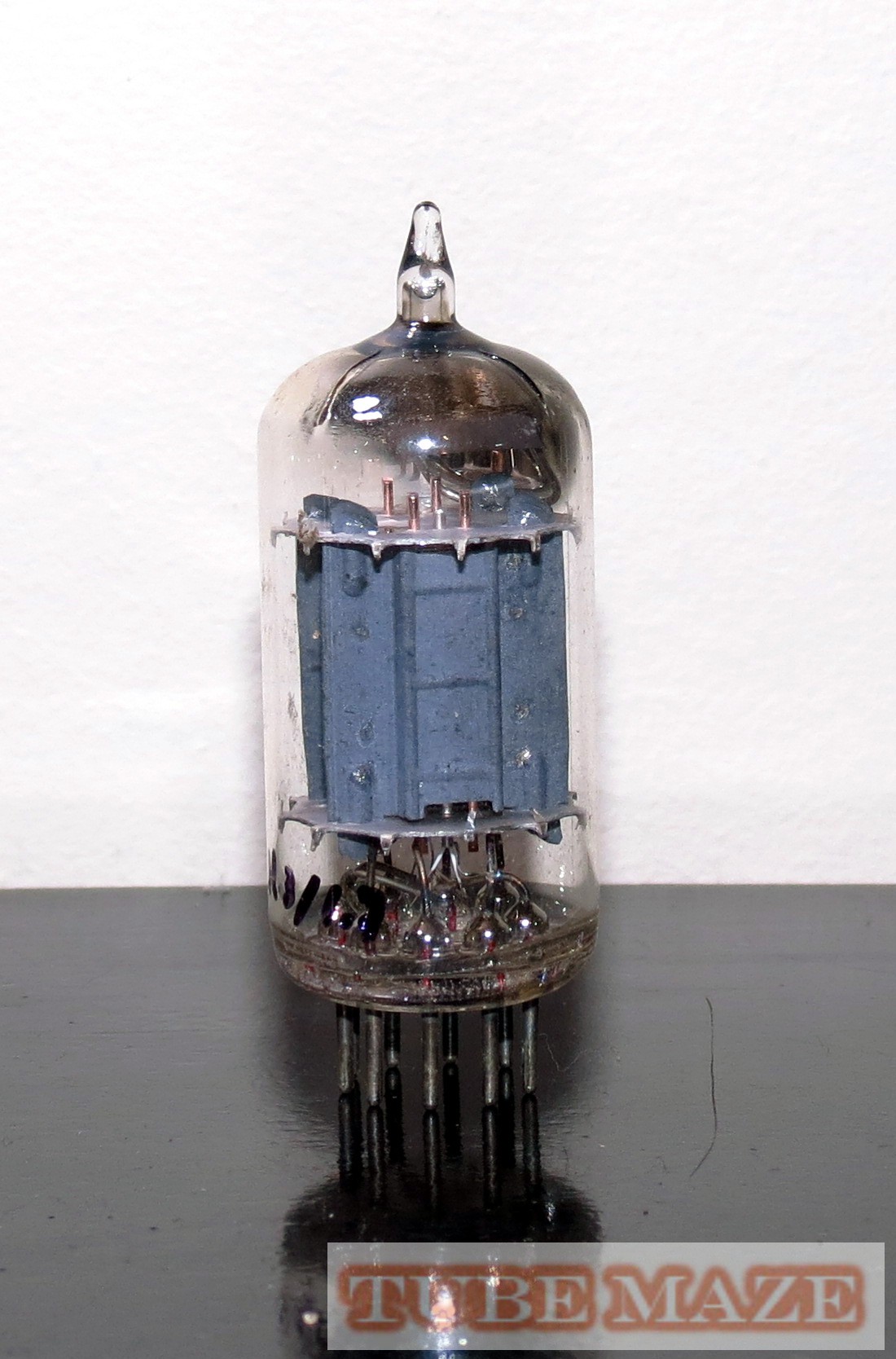
This is one of the earliest European 12AX7 tubes in existence. Produced by Amperex/Philips, this version actually predates the famous Mullard square-getter tubes.
These were manufactured between 1951 and 1956. You can identify them by the date code printed directly between the pins—I have personally seen them with mP1 and mPC codes.
Unique Construction Features:
There are several unusual characteristics that set these apart from later production:
Welded Plates: Unlike the standard riveted plates, these feature welded construction. While more expensive to produce, it significantly reduces micro-vibrations.
Angled Getter: The getter is attached directly to the plate and positioned at a distinct 45-degree angle.
Foil Strip: It utilizes a foil strip getter similar to what you see in highly sought-after later vintage tubes.
Sound Signature & Performance:
The sound is a perfect example of Philips tubes from that era: very delicate, a bit slow, and highly euphoric. In fact, it is the most delicate sounding 12AX7 I have ever experienced.
Because of these traits, it isn’t a “do-it-all” tube. It is absolutely sublime for vocal jazz, which truly highlights its strengths, but it lacks the raw dynamics required for Rock.
One area where it truly shines is its technical floor. Back in the day, they didn’t spare any costs, and it shows:
Noise Floor: Measures at a practically impossible -90 dB!
Comparison: Regular 12AX7 tubes typically measure around -82 to -83 dB. Since the dB scale is exponential, this tube is roughly twice as quiet as a standard 12AX7.
The Amperex 12AX7 Angled Foil Getter represents a peak in early European tube engineering, offering a quiet, euphoric presentation that is unmatched for critical vocal listening.
Oh man, what an amazing tube! Honey sweet mid-range. Euphoric as all get out. A bit of a softened, yet oddly ultra realistic top end. Glorious bass. The little bugger just sings. I have a quad of rare Mullard made with Amperex labels. “Gt. Britain”. Faded Amperex globe. Date codes faded and all but unreadable. 1966 or 1968 production, maybe. A bit slow for some (though by no means all) rock music. Great for punchy R&B. Female vocals soar. (Sinead O’Connor’s “Last Day Of Our Acquaintance” plays as I type. Wow!) This may well be the most unique and satisfying sounding 12ax7 I’ve ever enjoyed. By the way, Matsushita made a decent (less than equal but still nice – not to mention more affordable) copy/clone.



 (24 votes, average: 3.88 out of 5)
 Loading...
This is one of the earliest European 12AX7 tubes in existence. Produced byAmperex/Philips , this version actually predates the famous Mullard square-getter tubes.
These were manufactured between 1951 and 1956. You can identify them by the date code printed directly between the pins—I have personally seen them withmP1 and mPC codes.
Unique Construction Features:
There are several unusual characteristics that set these apart from later production:
Sound Signature & Performance:
The sound is a perfect example of Philips tubes from that era: very delicate, a bit slow, and highly euphoric. In fact, it is the most delicate sounding 12AX7 I have ever experienced.
Because of these traits, it isn’t a “do-it-all” tube. It is absolutely sublime forvocal jazz , which truly highlights its strengths, but it lacks the raw dynamics required for Rock .
One area where it truly shines is its technical floor. Back in the day, they didn’t spare any costs, and it shows:
The Amperex 12AX7 Angled Foil Getter represents a peak in early European tube engineering, offering a quiet, euphoric presentation that is unmatched for critical vocal listening.
Oh man, what an amazing tube! Honey sweet mid-range. Euphoric as all get out. A bit of a softened, yet oddly ultra realistic top end. Glorious bass. The little bugger just sings. I have a quad of rare Mullard made with Amperex labels. “Gt. Britain”. Faded Amperex globe. Date codes faded and all but unreadable. 1966 or 1968 production, maybe. A bit slow for some (though by no means all) rock music. Great for punchy R&B. Female vocals soar. (Sinead O’Connor’s “Last Day Of Our Acquaintance” plays as I type. Wow!) This may well be the most unique and satisfying sounding 12ax7 I’ve ever enjoyed. By the way, Matsushita made a decent (less than equal but still nice – not to mention more affordable) copy/clone.