


 (14 votes, average: 3.93 out of 5)
 Loading...
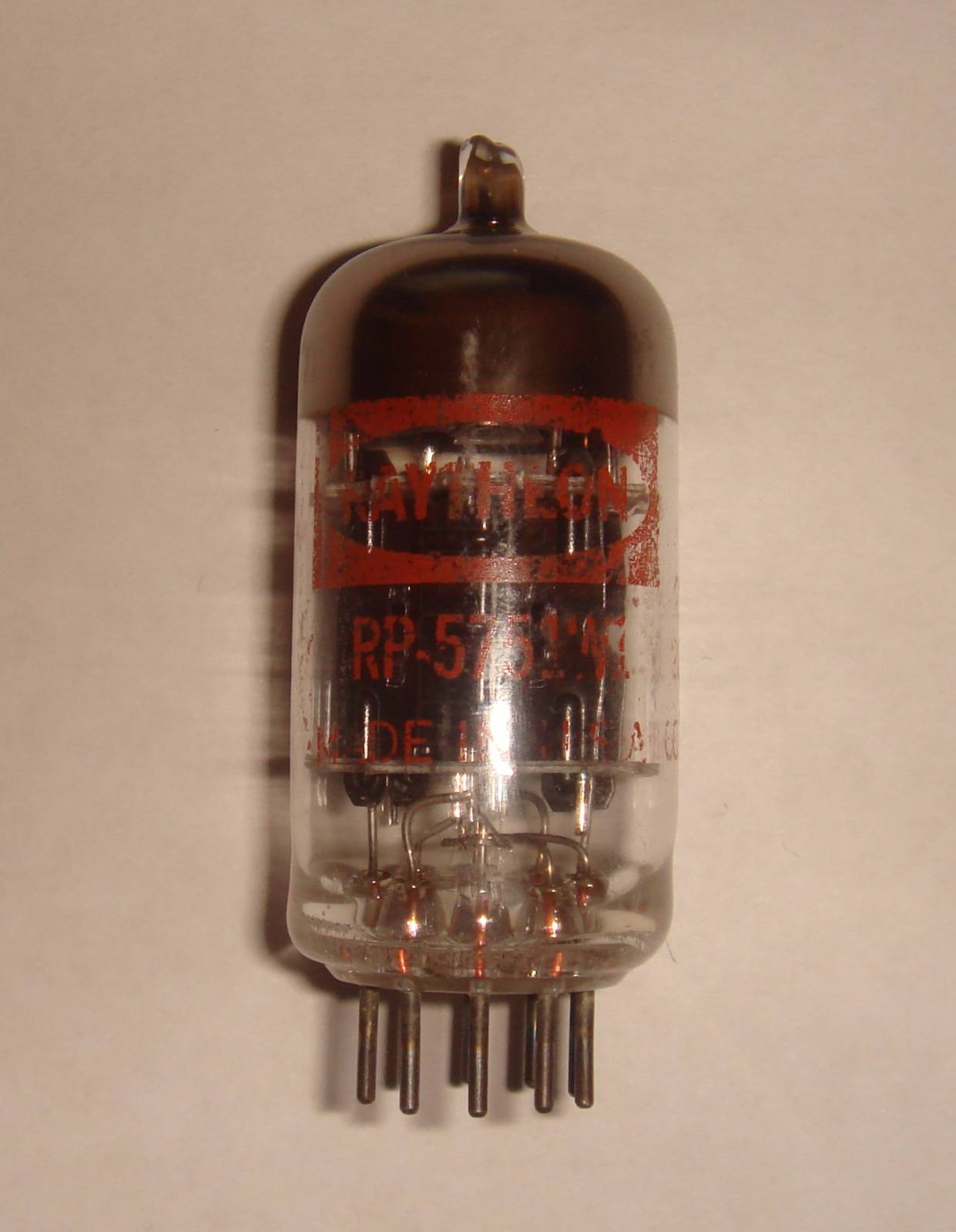
“I do believe I’m in love. The Raytheon black plate 3 mice (1961)
is truly wonderful. I do like it better even than a GE BP 3-mica (1957).
clarity, dynamics, bass. yum.”
” Sweet and smooth Raytheon 5751 tubes with the rare four bladed windmill shape top getter. Rich and smooth tone with quiet background.” Read
As one of the most legendary vacuum tubes to come out of the United States, the Raytheon 5751 Black Plate with the Windmill Getter is a piece of hardware that arrives with massive expectations. These are becoming increasingly difficult to source, and after finally securing a set, I put them through their paces. Initially, I was a bit underwhelmed; when tested through my Dared and McIntosh amplifiers, the soundstage felt somewhat compressed compared to the Raytheon 5751 BP 3-Mica, and the midrange lacked that signature “luscious” sweetness found in the Sylvania Gold Brand. The highs weren’t quite as extended as other top-tier tubes, leading me to give it a cautious 4.5-star rating.
However, a second round of testing with a different amplifier completely changed my perspective. When rolled against a variety of other 5751s, this tube and the Sylvania GB were the only ones left standing. What truly sets the Raytheon apart is its extraordinary dynamics. It offers a fast, direct attack that I haven’t heard from any other tube in this class. It provides a “cool” tonal profile that is absolutely perfect for the energy and grit of hard rock.
The famous “Windmill” getter—a unique, four-bladed top getter—was utilized by Raytheon primarily during the late 1950s and early 1960s. It was designed to maximize the surface area for the “flashing” process, which helps maintain a high vacuum over the life of the tube. This robust construction is exactly why these tubes remain so stable and quiet decades later.
Final Verdict: While it might not be the “sweetest” tube for vocal jazz, its unmatched speed and punch make it an essential choice for listeners who crave a dynamic, high-energy performance.
The Raytheon “windmill getter” 5751 is by far the best 5751 ever made; in equipment that has simply too much tube bloom or artificially warm and mellow sonics, the Raytheon 5751 can “thin out” the mids a bit while remaining very dynamic and having killer bass.
I’m not normally in favor at all of using 5751s in place of 12AX7s in gear that was DESIGNED to use 12AX7s, but in my fully upgraded EAR 834P MM/MC phono stage, I use a 5751 in the V3 position, the cathode follower. Here the slightly better drive and punch of a great 5751 like the Raytheon can really have a synergistic effect.
Strangely, I don’t care at all for RCA 5751s. I am kind of unsure exactly HOW they were made to be such un-involving, flat, colorless tubes, but they just suck the life out of anything I try them in.
Another great 5751 is the long plate Tung Sol which has plates identical to their long plate 12AX7 tubes. While not as musical as the Raytheon windmill, they are really quite good tubes and work well as phase splitters, drivers and cathode followers. The Tung Sol is the perfect tube for the McIntosh MC30/MC60/MC225/MC240, both as the V1 input and especially the final drive position as part of the “bootstrapped driver” right before the output tubes. The Mac amps run this tube OVER max specification at around 340 VDC and also exceed the plate current limit so having a really tough tube like the TungSol 5751 there is a great choice.