
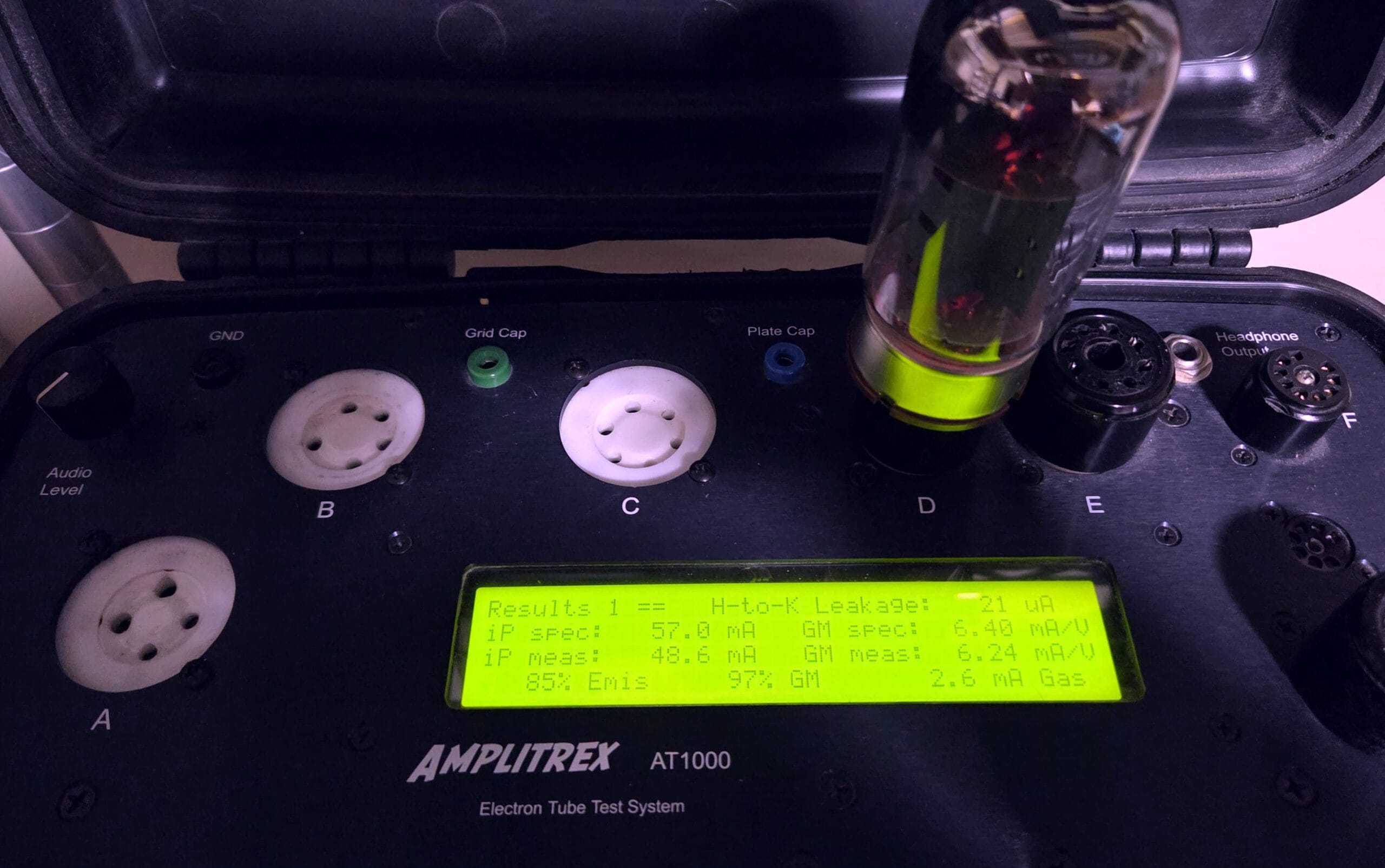
While rebuilding a 6550 push-pull amplifier, I gathered some compelling data regarding the critical impact of dynamic tube symmetry on overall circuit performance.
Static vs. Dynamic Matching: The DatA
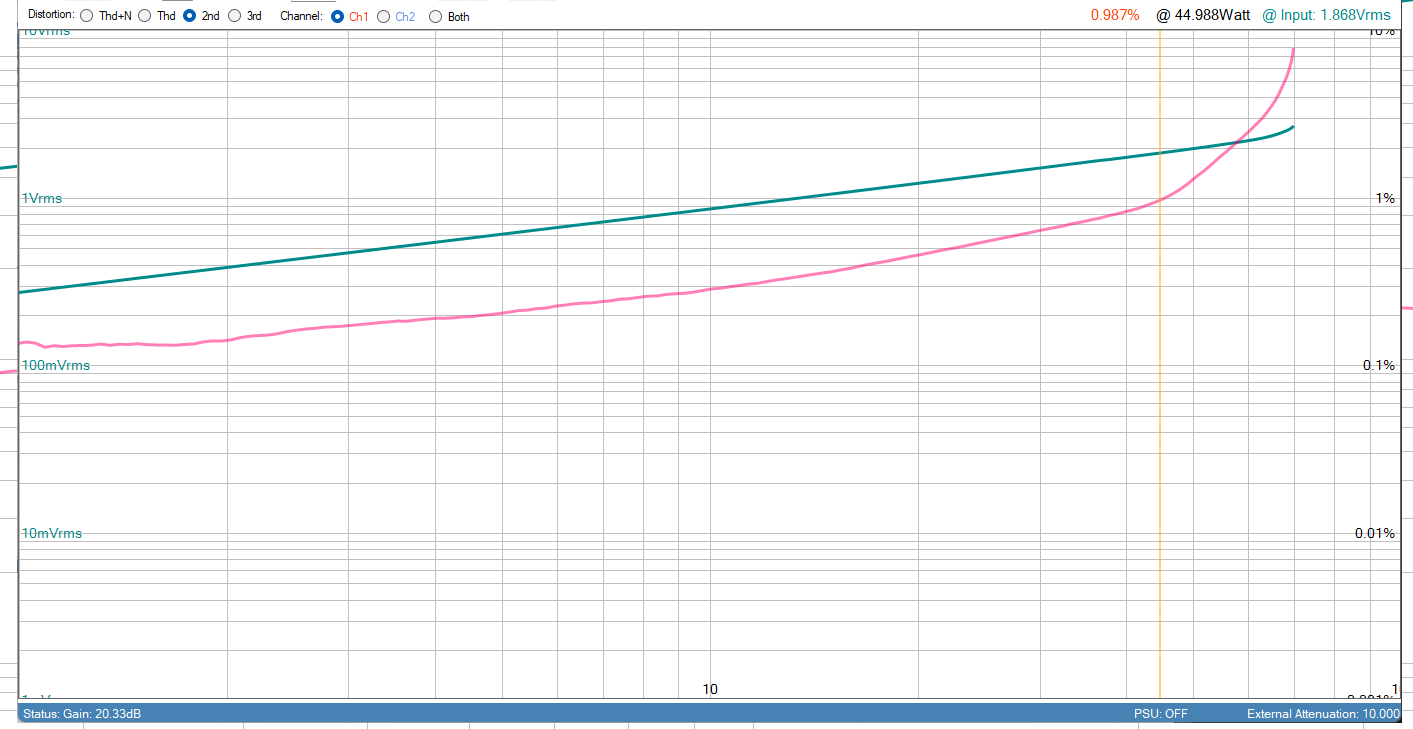
In my first test scenario, I utilized a pair with a perfect Ip (Static Plate Current) match but a 10% deviation in Gm (Transconductance). Despite the identical bias points, the amplifier reached 1% THD (Total Harmonic Distortion) at only 44 watts.
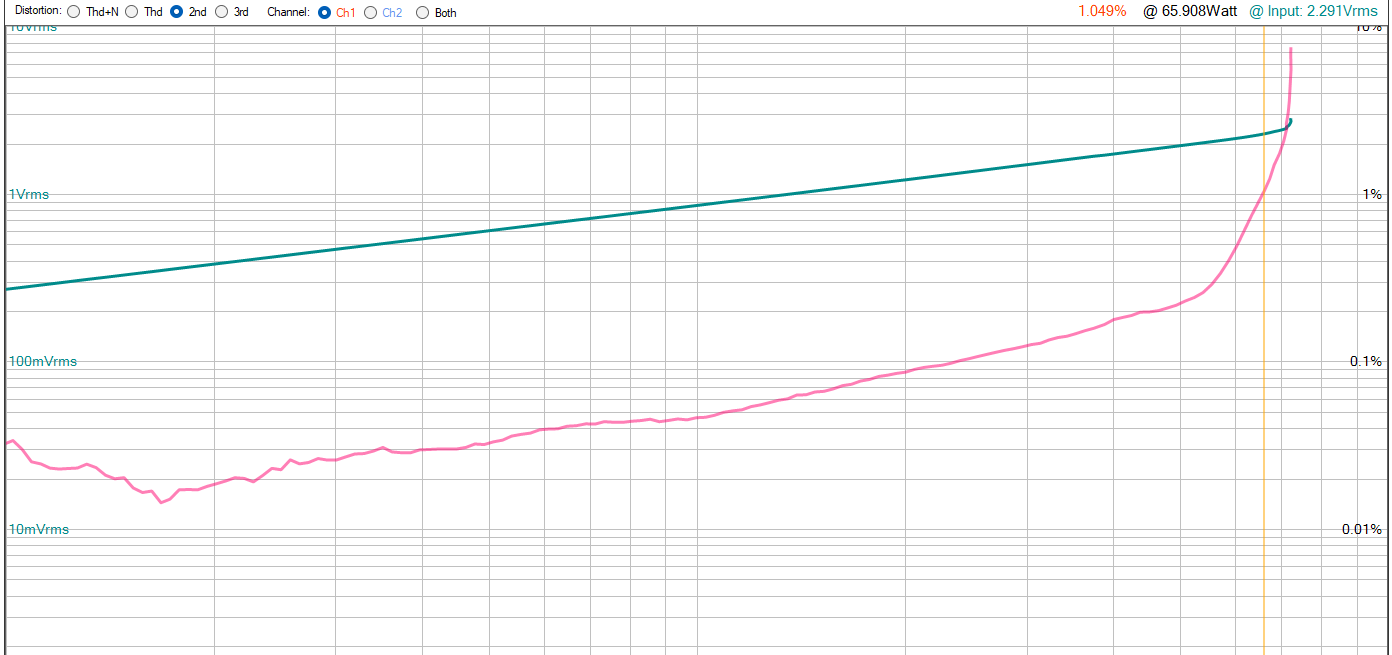
When I swapped these for a “perfectly” matched pair—where both Ip and Gm were within a 2% tolerance—the results were night and day:
Low-Level Linearity: Even at nominal power levels, the distortion floor dropped from 0.15% to 0.015%—a 10x improvement in signal purity.
Power Output: The amp produced 65 watts at the same 1% distortion threshold.
Headroom: That is a 20-watt delta in clean power, directly attributable to the tubes’ ability to swing current symmetrically under load.
Second image shows “perfectly”, within 2%, matched tubes producing 65 watts at 1%.
The Importance of Real-World Operating Voltages
A critical takeaway is that vacuum tubes are non-linear devices; their characteristics shift depending on the HT (High Tension) rail voltage. For this build, I matched the tubes at 500V to mirror the amplifier’s actual operating environment.
- The Vendor Trap: Be cautious of “matched pairs” tested at only 250V–290V. A tube that appears balanced at low voltage can diverge significantly once subjected to higher B+ voltages.
- Bias Limits: While adjusting the negative grid bias or cathode resistors can null out Ip mismatch (DC balance), it does nothing to correct Gm mismatch (AC balance).
Understanding Distortion in Audio
In audio, distortion is any deviation in the output waveform relative to the input signal (excluding gain). In tube audio, we primarily deal with:
1. Harmonic Distortion (THD): The introduction of frequencies that are integer multiples of the fundamental signal. While second-order harmonics are often perceived as “warm,” excessive distortion of any kind signifies a lack of control and reduced fidelity.
2. Intermodulation Distortion (IMD): This occurs when two or more signals interact in a non-linear way to produce sum and difference frequencies. When Gm is mismatched in a push-pull stage, the non-linearity increases, leading to a “congested” sound and a loss of low-level detail.
Final Verdict: If you want to achieve the maximum designed specifications of your amplifier, static current matching is insufficient. Always verify that your power tubes are matched for transconductance at full operating voltages.