“The little amp powered these speakers just fine in my small room” Read
Share this post:
2 thoughts on “APPJ PA0901A – Miniwatt N3”
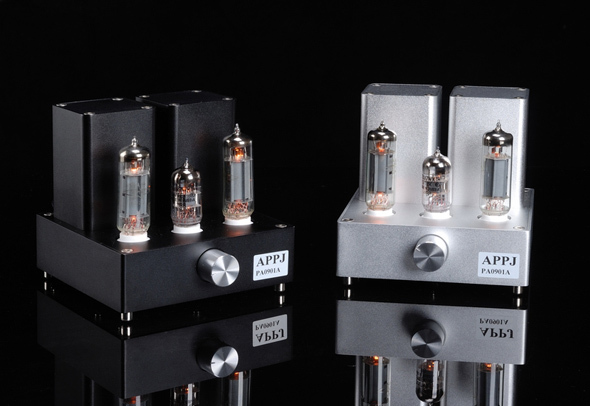
I’ve lived with the APPJ PA0901A – Miniwatt N3 for about six months now, originally purchasing it for my office setup. On paper, this unit is incredibly attractive for two reasons: its price—at $220, it’s among the cheapest tube amplifiers on the market—and its compact footprint, which makes it perfect for desk placement where space is at a premium. It is undeniably “cute” and aesthetically pleasing, but unfortunately, the praise ends there.
To put it bluntly, the APPJ PA0901A is utterly boring. While it works perfectly fine for conference calls, it fails as a high-fidelity musical component. The dynamics you expect from a quality tube stage are completely absent. Even when rolled with premium glass like the Reflector 6P14P-EV, the bass response remains mediocre—flat, lifeless, and entirely unimpressive.
The performance issues persist even with high-sensitivity speakers. Despite using 100dB sensitive drivers, the amp struggled to “move” them with any authority; it was loud, but lacked control. Instrument positioning was horrific, with no cohesive imaging to speak of, and the soundstage was virtually non-existent. After six months of evaluation using top-tier tubes like the Tesla E83CC and Mullard 6BQ5, the verdict remains the same: this is a cute amplification device, but not a true tube amplifier. It simply fails to bring the inherent value of vacuum tubes to the forefront.
Final Verdict
If you are looking for a decorative “tube-style” ornament for your desk, the APPJ PA0901A fits the bill. However, if you are seeking authentic tube sound, you would be much better off with a standard transistor amp. For serious listeners: STAY AWAY.
I have a Miniwatt N3 that I acquired for a second, smaller system. So far, I have only exchanged out one tube, the preamp tube, for a Tung Sol 12ax7. My impression is entirely favorable and in direct contrast to your observations. I am currently using 87 db efficient speakers, well less efficient than your pair. The Miniwatt drives these with ease at less than half of the full on position. Soundstage abounds, front to back and side to side. Timbral accuracy is also very high. I find myself enjoying this amp more than my 400 watt per channel Aragon 4004. In my judgement this amp is a true tube amp, far from just a nice looking desktop ornament, This amp has earned a place on my audio rack.
I am feeding the Miniwatt from another small Chinese tube preamp which perhaps makes the difference in my particular setup.
My speakers at the moment, to be specific, are anything but exotic. They are Dayton B652s, one of the best performers per dollar and by far the least expensive audio component I ever bought. While I have theoretically higher performing speakers I could use, the Miniwatt is making these sing. So much so, I have temporarily put my buying decision for a high efficiency speaker on hold. I can only imagine what can be achieved with the the Miniwatt and a high efficiency speaker which the Miniwatt is designed for. I will next be rolling out the 6P14s for a European EL84 but suffice it to say that this amp, to my ears, is producing audio far exceeding what I had thought possible with these modest set of components.


 (25 votes, average: 3.28 out of 5)
 Loading...
I’ve lived with the APPJ PA0901A – Miniwatt N3 for about six months now, originally purchasing it for my office setup. On paper, this unit is incredibly attractive for two reasons: its price—at $220, it’s among the cheapest tube amplifiers on the market—and its compact footprint, which makes it perfect for desk placement where space is at a premium. It is undeniably “cute” and aesthetically pleasing, but unfortunately, the praise ends there.
To put it bluntly, the APPJ PA0901A is utterly boring. While it works perfectly fine for conference calls, it fails as a high-fidelity musical component. The dynamics you expect from a quality tube stage are completely absent. Even when rolled with premium glass like the Reflector 6P14P-EV, the bass response remains mediocre—flat, lifeless, and entirely unimpressive.
The performance issues persist even with high-sensitivity speakers. Despite using 100dB sensitive drivers, the amp struggled to “move” them with any authority; it was loud, but lacked control. Instrument positioning was horrific, with no cohesive imaging to speak of, and the soundstage was virtually non-existent. After six months of evaluation using top-tier tubes like the Tesla E83CC and Mullard 6BQ5, the verdict remains the same: this is a cute amplification device, but not a true tube amplifier. It simply fails to bring the inherent value of vacuum tubes to the forefront.
Final Verdict
If you are looking for a decorative “tube-style” ornament for your desk, the APPJ PA0901A fits the bill. However, if you are seeking authentic tube sound, you would be much better off with a standard transistor amp. For serious listeners: STAY AWAY.
I have a Miniwatt N3 that I acquired for a second, smaller system. So far, I have only exchanged out one tube, the preamp tube, for a Tung Sol 12ax7. My impression is entirely favorable and in direct contrast to your observations. I am currently using 87 db efficient speakers, well less efficient than your pair. The Miniwatt drives these with ease at less than half of the full on position. Soundstage abounds, front to back and side to side. Timbral accuracy is also very high. I find myself enjoying this amp more than my 400 watt per channel Aragon 4004. In my judgement this amp is a true tube amp, far from just a nice looking desktop ornament, This amp has earned a place on my audio rack.
I am feeding the Miniwatt from another small Chinese tube preamp which perhaps makes the difference in my particular setup.
My speakers at the moment, to be specific, are anything but exotic. They are Dayton B652s, one of the best performers per dollar and by far the least expensive audio component I ever bought. While I have theoretically higher performing speakers I could use, the Miniwatt is making these sing. So much so, I have temporarily put my buying decision for a high efficiency speaker on hold. I can only imagine what can be achieved with the the Miniwatt and a high efficiency speaker which the Miniwatt is designed for. I will next be rolling out the 6P14s for a European EL84 but suffice it to say that this amp, to my ears, is producing audio far exceeding what I had thought possible with these modest set of components.