
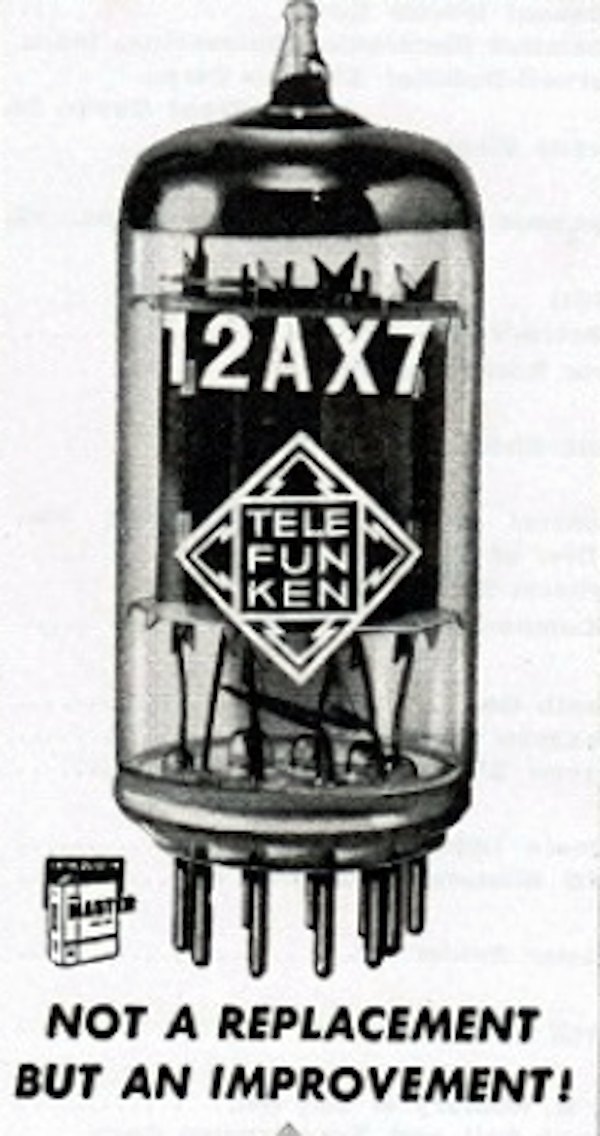
The 12AX7 is arguably the most iconic and widely utilized audio vacuum tube in history. Its enduring popularity stems from its ubiquitous presence in high-fidelity (Hi-Fi) home audio and, most notably, guitar amplifiers. In the latter, these tubes are often pushed to their operational limits, leading to a faster replacement cycle compared to other applications..
Introduction and Technical Specifications
Introduced in May 1947, the 12AX7 gained immediate industry traction due to its remarkably high voltage gain, featuring a Mu of 100. This allows the tube to amplify voltage by a factor of 100. While some modern iterations from manufacturers like JJ and Sovtek have been measured as high as 115, a Mu of 100 remains the official design specification.
To this day, the 12AX7 remains the highest-gain tube in common use. Although the 6AV6 was a single-triode alternative with similar gain, it remains a rarity in the market. The high-gain nature of the 12AX7 allowed manufacturers—particularly those building phono preamplifiers and guitar heads—to use fewer total components, thereby reducing costs and improving overall reliability.
Manufacturing Challenges and the 5751
Despite its advantages, the 12AX7 presented significant engineering hurdles. Maintaining consistent control grid winding for such a high-gain component was difficult, often leading to quality variances and elevated even-order harmonics. To address these issues, the 5751 was introduced in 1949. This variant offered superior grid precision and lower noise, albeit with a reduced Mu of 70.
The European Influence: ECC83 and 7025
European manufacturers significantly influenced the tube’s evolution by introducing the ECC83. These versions often utilized superior cathode materials, resulting in extended operational lifespans. Telefunken, in particular, is renowned for producing tubes with exceptional sonic characteristics and lifespans exceeding 10,000 hours.
Furthermore, the introduction of spiral-wound heater wires helped mitigate hum. This innovation was eventually adopted by American manufacturers for the 7025 variant, a low-noise version that maintained the standard 12AX7 distortion profile.
Microphonics and Plate Variations
The high gain of the original 12AX7 made it susceptible to microphonics, particularly in versions featuring “long plates” (17 mm). This led to the development of the 12AX7A, which utilized shorter 14 mm plates to improve stability. While the “A” version was once considered a technical improvement, modern audiophiles often prefer the original long-plate non-A versions for their perceived “fuller” sound signature.
Manufacturer Performance and Harmonic Distortion
Success in grid winding varied by manufacturer. In the 1950s, Mullard achieved impressive results, reducing second-order harmonics to as low as 0.015%. While Sylvania struggled with higher distortion in their standard 12AX7 (0.15%), they excelled with their 5751 production, achieving a remarkably low 0.02%.
Specialized Variants
Several premium variants have been developed over the decades to meet specific professional needs:
- E83CC: A specialized, long-life version (10,000+ hours). Telefunken and Tesla even produced frame-grid versions of the E83CC to further reduce distortion.
- ECC803S: A “screened” tube designating low-noise operation and factory-matched triodes.
- B759: The Genalex designation for specially selected tubes, though these were historically manufactured by Mullard.
Whether you are seeking the historical accuracy of a 1950s Mullard or the rugged reliability of a military-grade 5751, the 12AX7 family offers a diverse range of sonic flavors for any high-end audio system. For a detailed list of compatible alternatives, please refer to our Tube Equivalents guide.
Pingback: ECC83 Vs 12AX7: Comparing Two Iconic Vacuum Tubes - Killer Rig