


 (15 votes, average: 3.80 out of 5)
 Loading...
“The Tungsram are brighter on the high frequencies anda little coolerregarding the midrangeproducing accurate sonics without beingthe least bit sterile sounding in my applications.” Read
“Tungsram sounds much more precise, open, and clear, with more resolution top-to-bottom.” Read
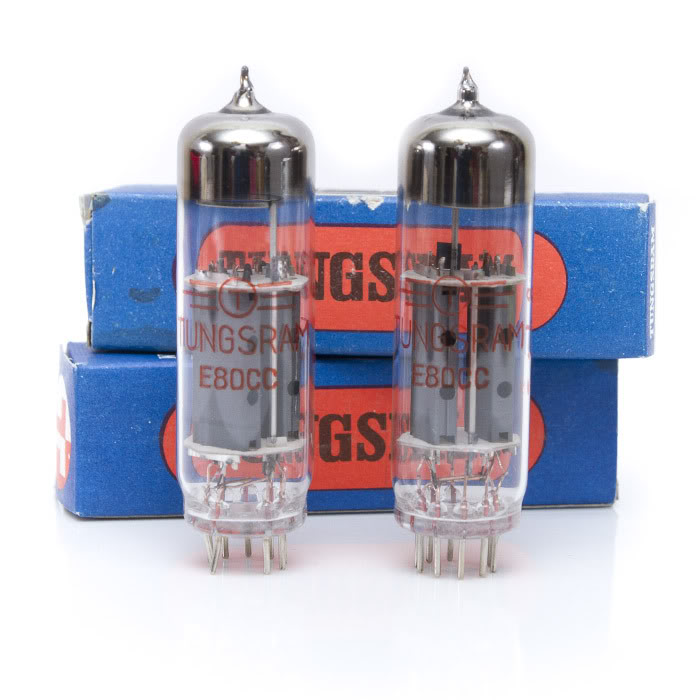
The Tungsram E80CC is an intriguing addition to the brand’s lineup, especially for those already impressed by their ECC82 and ECC83 offerings. This tube delivers a remarkably liquid sound signature paired with punchy dynamics that practically force you to tap your feet. However, while it is technically impressive, its character is a stark departure from the traditional 12AU7 experience.
The primary technical difference between the E80CC and the ECC82 lies in their physical and electrical specifications. The E80CC is a “Special Quality” long-life tube with a much larger bottle and, crucially, a higher heater current draw (typically 600mA compared to the ECC82’s 300mA at 6.3V). Because of this, you must check if your amplifier’s power transformer can handle the extra load before swapping an ECC82 for an E80CC; failing to do so could overheat and damage your equipment.
Sonically, the E80CC offers incredible precision and density that makes it “perfect” from a measurement standpoint, yet it possesses a clinical edge that surpasses even the renowned Telefunken 12AU7. While the standard ECC82 is often maligned for higher distortion, it provides a softness and harmonic richness that remains incredibly appealing for long-term listening. The E80CC, by comparison, can feel overburdening with information, making it a dream for detail-hunters but potentially fatiguing for those who just want to get lost in the music.
A lot of people think this is “the” tube – i see it on a lot of favorites lists. I didn’t quite get it in my system. The matched quad brought incredible highs that soar to the ceiling, but the mid-range and bass seemed a bit thin. It also lacked a bit of detail in the mid-range. Soundstage exists, but not 3D or holographic. There’s also a bit of a fatiguing factor (not overbearing, but it comes eventually).
I agree with Nick, it’s punchy and has a bit of a “solid state” sound to it. Don’t get me wrong, they’re high quality tubes (and I should probably give them more time), but there’s just so many tubes out there!
Tungsram E80CC – 3.5 to 4 stars
The E80CC is my favorite small signal tube. In my system, which includes a Cayin TA-30 integrated and Legacy Classic speakers, the Tungsram’s sound more balanced and actually less fatiguing than the Philips gold pin E80CC’s I have. The Philips are known to have more midrange depth and presense. I can hear that compared to the Tungsram’s. But, I wouldn’t say that the Tungsrams are flat or clinical sounding, either. I suspect that it has something to do with my system already being fairly midrange-forward sounding to begin with. My CD player and phono stage are both tubed in addition to the the all tube Cayin integrated. The Philips E80CC’s might be tipping the scales since there is an upper midrange emphasis with those tubes installed that can become grating over time. I also really like the Tungsram 6922/E88CC tubes. Same sparkling, detailed and well balanced sound. I use them in both my Njoe Tjoeb CD4000 and Bottlehead Seduction phono stage.