“Like the Tung-Sol a little sweeter, nice balance of detail and timbre” Read
Share this post:
One thought on “Raytheon CRP 6SN7GT D-getter Black Plates”
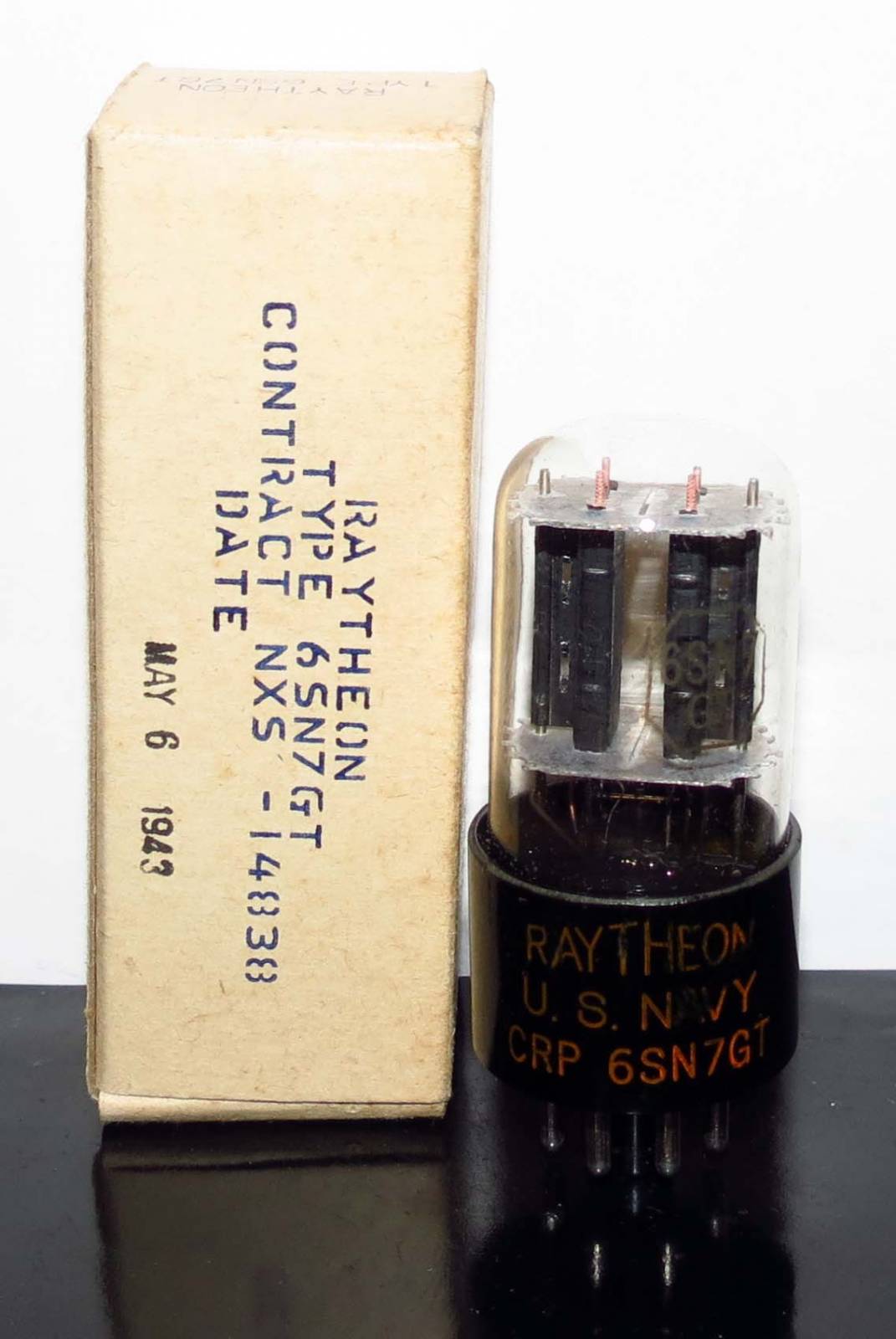
The Raytheon CRP 6SN7GT D-getter Black Plates is another truly beautiful specimen. The specific pair I reviewed dates back to 1943, still preserved in the original boxes—it is genuinely hard to believe that components like this still exist in such pristine condition over 80 years after their date of manufacture.
Returning to the performance, this is a very natural sounding tube that offers significantly better top-end extension than the majority of its peers. If your primary goal is syrupy warmth, you won’t find much of it here. however, if you are searching for a natural presentation with great transparency, this Raytheon stands as one of the best 6SN7 tubes available. It provides a clear, uncolored window into the music that few other vintage valves can match.
History of the 6SN7 and Its Role in WWII
The 6SN7 was introduced in 1941, just as the world was engulfed in World War II. It was a medium-mu dual triode that effectively combined two 6J5 triodes into a single glass envelope, saving precious space in military hardware. Because of its reliability and linear performance, it became the backbone of Allied electronic warfare.
During the war, the 6SN7 played a critical role in radar systems, anti-aircraft gun directors, and early computing devices like the ENIAC. The “CRP” designation on this Raytheon stands for “Combined Army-Navy Navy-Bureau of Ships,” signifying that it was built to rigorous military specifications (MIL-SPEC). These wartime tubes were constructed with extra bracing and high-purity materials to ensure they could survive the vibrations of a bomber or the shock of naval artillery, which is why Raytheon examples from the early 1940s remain so structurally sound and sonically excellent today.
Final Verdict
The Raytheon CRP 6SN7GT is a transparency king from the Greatest Generation. While it eschews modern “warmth” for historical accuracy and high-frequency air, its military-grade build quality ensures it remains a top-tier reference tube for any serious 6SN7-based preamplifier.

 (7 votes, average: 4.29 out of 5)
 Loading...
The Raytheon CRP 6SN7GT D-getter Black Plates is another truly beautiful specimen. The specific pair I reviewed dates back to 1943, still preserved in the original boxes—it is genuinely hard to believe that components like this still exist in such pristine condition over 80 years after their date of manufacture.
Returning to the performance, this is a very natural sounding tube that offers significantly better top-end extension than the majority of its peers. If your primary goal is syrupy warmth, you won’t find much of it here. however, if you are searching for a natural presentation with great transparency, this Raytheon stands as one of the best 6SN7 tubes available. It provides a clear, uncolored window into the music that few other vintage valves can match.
History of the 6SN7 and Its Role in WWII
The 6SN7 was introduced in 1941, just as the world was engulfed in World War II. It was a medium-mu dual triode that effectively combined two 6J5 triodes into a single glass envelope, saving precious space in military hardware. Because of its reliability and linear performance, it became the backbone of Allied electronic warfare.
During the war, the 6SN7 played a critical role in radar systems, anti-aircraft gun directors, and early computing devices like the ENIAC. The “CRP” designation on this Raytheon stands for “Combined Army-Navy Navy-Bureau of Ships,” signifying that it was built to rigorous military specifications (MIL-SPEC). These wartime tubes were constructed with extra bracing and high-purity materials to ensure they could survive the vibrations of a bomber or the shock of naval artillery, which is why Raytheon examples from the early 1940s remain so structurally sound and sonically excellent today.
Final Verdict
The Raytheon CRP 6SN7GT is a transparency king from the Greatest Generation. While it eschews modern “warmth” for historical accuracy and high-frequency air, its military-grade build quality ensures it remains a top-tier reference tube for any serious 6SN7-based preamplifier.