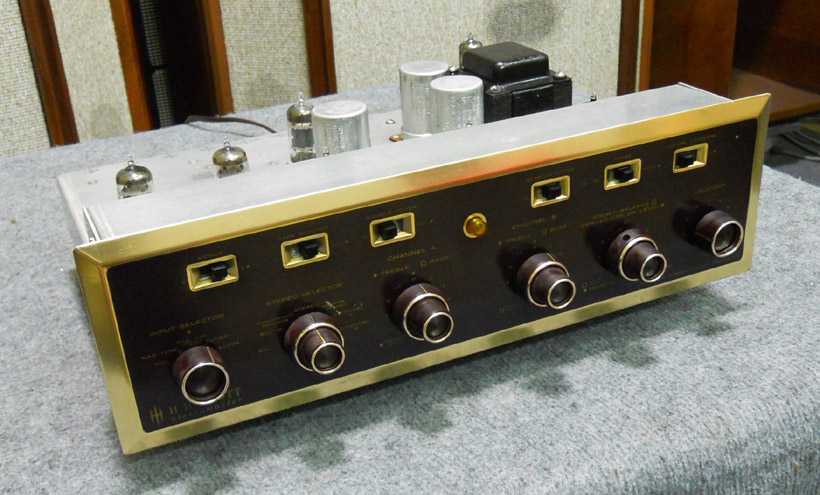
The H.H. Scott LC-21 is a visually striking and undeniably “fun” relic from the 1960s. I paired this unit with an HH Scott LT-150 power amp, and while they look the part of a classic duo, the sonic performance tells a more complicated story.
While the aesthetic is top-tier, the sound is merely serviceable. Born in an era of “low fidelity,” the LC-21 is cluttered with excessive circuitry that complicates the signal path. Modern listeners will likely find the various filters—like the Rumble and Scratch switches—to be unnecessary additions that only serve to “muddy” the audio quality.
The internal architecture has several notable drawbacks for the contemporary audiophile:
Mediocre Component Quality: The extensive use of ceramic coupling capacitors in the signal path limits transparency. Upgrading to PIO or Teflon caps is almost a requirement for better clarity. Maintenance Issues: The original potentiometers are significantly noisier than modern equivalents, often requiring deep cleaning or replacement. Compatibility Hurdles: With a high output impedance, this preamp is a poor match for most solid-state (SS) amplifiers. Additionally, the MM phono stage struggles with cartridges under 4 mV, resulting in a thin, weak bass response. Superfluous Features: Features like the center channel output are largely relics that add complexity without benefiting modern stereo playback.
Final Verdict: The LC-21 is a warm, romantic-sounding preamplifier that prioritizes 1960s-era features over absolute detail. While it can be significantly improved with a shunt regulator and high-end capacitors, it will never truly compete with modern high-fidelity equipment. It is a charming piece for vintage enthusiasts, but it simply cannot match current transparency requirements.



 Loading...
The H.H. Scott LC-21 is a visually striking and undeniably “fun” relic from the 1960s. I paired this unit with an HH Scott LT-150 power amp, and while they look the part of a classic duo, the sonic performance tells a more complicated story.
While the aesthetic is top-tier, the sound is merely serviceable. Born in an era of “low fidelity,” the LC-21 is cluttered with excessive circuitry that complicates the signal path. Modern listeners will likely find the various filters—like the Rumble and Scratch switches—to be unnecessary additions that only serve to “muddy” the audio quality.
The internal architecture has several notable drawbacks for the contemporary audiophile:
Mediocre Component Quality: The extensive use of ceramic coupling capacitors in the signal path limits transparency. Upgrading to PIO or Teflon caps is almost a requirement for better clarity.
Maintenance Issues: The original potentiometers are significantly noisier than modern equivalents, often requiring deep cleaning or replacement.
Compatibility Hurdles: With a high output impedance, this preamp is a poor match for most solid-state (SS) amplifiers. Additionally, the MM phono stage struggles with cartridges under 4 mV, resulting in a thin, weak bass response.
Superfluous Features: Features like the center channel output are largely relics that add complexity without benefiting modern stereo playback.
Final Verdict: The LC-21 is a warm, romantic-sounding preamplifier that prioritizes 1960s-era features over absolute detail. While it can be significantly improved with a shunt regulator and high-end capacitors, it will never truly compete with modern high-fidelity equipment. It is a charming piece for vintage enthusiasts, but it simply cannot match current transparency requirements.